. 2010 Mar 23;107(12):5664-8.
doi: 10.1073/pnas.0910955107. Epub 2010 Mar 8.

Hose in Hose, an S locus-linked mutant of Primula vulgaris, is caused by an unstable mutation at the Globosa locus

Affiliations

Hose in Hose, an S locus-linked mutant of Primula vulgaris, is caused by an unstable mutation at the Globosa locus

Jinhong Li et al. Proc Natl Acad Sci U S A. .

Abstract

Hose in Hose mutants of primrose and cowslip have been cultivated since the early 17th century and show dominant homeotic conversion of sepals to petals. The phenotype shows variable penetrance and expressivity and is linked to the S locus, which controls floral heteromorphy in Primula species. Here we demonstrate that the homeotic conversion of sepals to petals in Hose in Hose is associated with up-regulation of both Primula B-function MADS box genes PvDef and PvGlo in the first floral whorl. We have defined a restriction fragment length polymorphism associated with PvGlo that cosegregates with the Hose in Hose phenotype and have also identified and characterized a retrotransposon insertion in the PvGlo promoter which is associated with the up-regulated expression of PvGlo. Excision of this retrotransposon, associated with epigenetic changes at the locus, causes reversion toward normal calyces and restores wild-type flower development. These data define the molecular basis of the Hose in Hose mutation and provide an explanation for its long-documented phenotypic instability.


Conflict of interest statement

The authors declare no conflict of interest.

Figures

Fig. 1.
Fig. 1.
Genetics, organization, and expression of PvGlo in Hose in Hose and wild-type plants. (A) Phenotypes and genotypes of parents and progeny classes segregating for dominant Hose in Hose and thrum phenotypes. (B) Southern analysis of XbaI-digested genomic DNA from sibling Hose in Hose (Hose) or wild-type (WT) pin (P) and thrum (T) plants using PvGlo cDNA (GenBank accession no. DQ381428) as probe. The Hose in Hose allele is indicated (*). (C) RNA gel blot analysis of PvGlo and PvDef in leaves (L) and the four floral whorls (W1–W4) from wild-type and Hose in Hose plants alongside ethidium-bromide-stained RNA gel, probed by PvDef cDNA (GenBank accession no. DQ381427) and PvGlo cDNA (GenBank accession no. DQ381428), respectively.
Fig. 2.
Fig. 2.
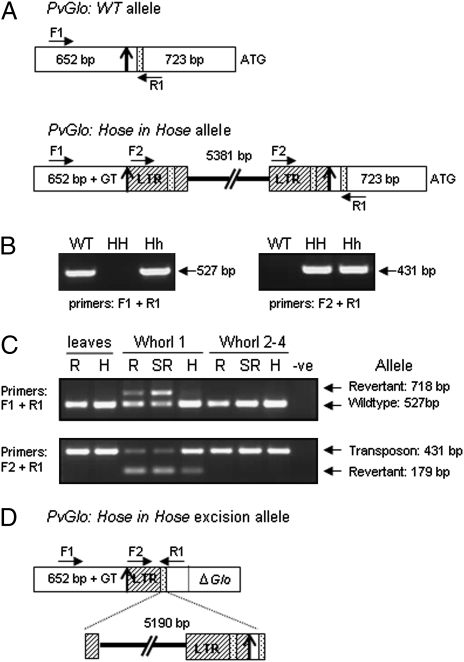
Hose in Hose is caused by a retrotransposon insertion in the promoter of PvGlo. (A) Structure of wild-type (GenBank accession no. DQ381430) and Hose in Hose alleles (GenBank accession no. DQ38144) of PvGlo. The 1373-bp sequence upstream of the translation initiation codon (ATG) is bisected into regions upstream (650 bp) and downstream (723 bp) of the transposon insertion site (vertical arrow). The 2-bp target site duplication (GT) and the 10-bp motif AGCAATTTTA (stippled) in the native promoter and present in both long terminal repeats (LTR, hatched) of the 5381-bp retrotransposon (GenBank accession no. DQ381432) (thick line) are shown together with PCR primers. (B) PCR analysis of DNA from wild-type (WT), homozygous Hose in Hose (HH), and heterozygous Hose in Hose (Hh) plants. (C) Agarose gel electrophoresis of PCR products from Whorl 1 only and combined whorl 2, 3, and 4 tissue of revertant (R), semirevertant (SR), and Hose in Hose flowers (H) alongside a no-DNA control (-ve). DNA from leaves of the crowns producing semirevertant and revertant (R) and Hose in Hose (H) flowers was also amplified with primers as shown. (D) Revertant allele structure derived from sequence analysis (GenBank accession no. FJ897502) of PCR products from C, showing deletion (ΔGlo) after retrotransposon excision. Labels are as in A.
Fig. 3.
Fig. 3.
Hose in Hose mutant and revertant flowers. (A) Woodblock print (4) of Hose in Hose showing sepal-to-petal conversion and revertant wild-type flower (arrow) exhibiting a normal calyx. (B) Two crowns from a single Hose in Hose plant with mutant, semirevertant, and revertant flowers on sectors of the same plant. (C) Individual Hose in Hose, semirevertant, and revertant flowers from B.
Fig. 4.
Fig. 4.
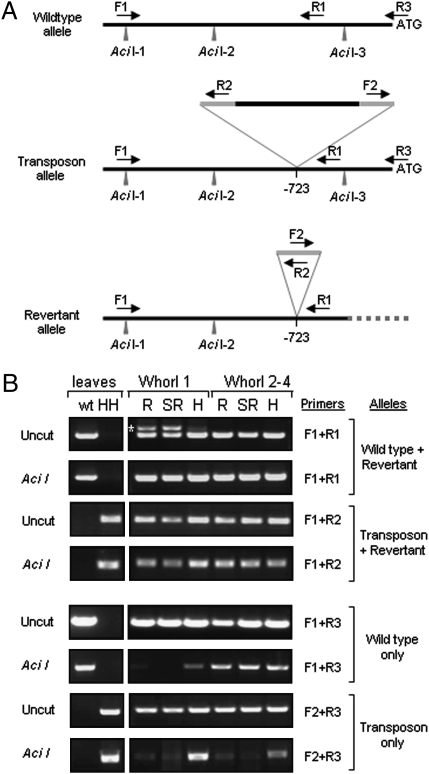
Retrotransposon excision is associated with demethylation of the PvGlo locus. (A) Organization of wild-type, transposon, and revertant alleles of PvGlo showing location of upstream methylation-sensitive AciI restriction enzyme sites. The PvGlo-specific primers (F1, R1, R3) and transposon-specific PCR primers (R2, F2) are indicated. The retrotransposon insertion site is shown (-723); LTRs are shown in gray. (B) Methylation-sensitive PCR analysis of the wild-type, transposon, and revertant alleles of PvGlo using allele-specific primer combinations as indicated. Primer specificity is demonstrated on DNA from leaves of wild-type (wt) and homozygous Hose in Hose (HH) plants. DNA samples from whorl-1 tissue or combined whorl-2, -3, and -4 tissue from revertant (R), semirevertant (SR), and Hose in Hose (H) flowers from the same plant were either digested with Aci1 or uncut as indicated before PCR amplification using allele-specific primer combinations as shown before fractionation by agarose gel electrophoresis. The different alleles amplified by each primer combination are indicated and the excision allele-specific PCR product is highlighted (*). PCR products generated from uncut genomic DNA that are absent after predigestion with AciI reveal unmethylated sites.

References

    1. Meyerowitz EM, Smyth DR, Bowman JL. Abnormal flowers and pattern formation in floral development. Development. 1989;106:209–217.
    1. Gerard J. In: The Herball or Generall Historie of Plantes. Johnson T, editor. London: John Norton; 1633.
    1. de Reneaulm P. Specimen Historiae Plantarum: Plantae Typis Aneis Expressae. Paris: Beys; 1611.
    1. van de Passe C. Hortus Floridus. Utrecht: J. Jansson; 1614.
    1. Parkinson J. Paradisus in Sole Paradisus Terrestris. London: Humfrey Lownes and Robert Young; 1629.

Publication types

LinkOut - more resources