. 2010 Apr;137(7):1095-105.
doi: 10.1242/dev.041798.

Consistent left-right asymmetry cannot be established by late organizers in Xenopus unless the late organizer is a conjoined twin

Affiliations

Consistent left-right asymmetry cannot be established by late organizers in Xenopus unless the late organizer is a conjoined twin

Laura N Vandenberg et al. Development. 2010 Apr.

Abstract

How embryos consistently orient asymmetries of the left-right (LR) axis is an intriguing question, as no macroscopic environmental cues reliably distinguish left from right. Especially unclear are the events coordinating LR patterning with the establishment of the dorsoventral (DV) axes and midline determination in early embryos. In frog embryos, consistent physiological and molecular asymmetries manifest by the second cell cleavage; however, models based on extracellular fluid flow at the node predict correct de novo asymmetry orientation during neurulation. We addressed these issues in Xenopus embryos by manipulating the timing and location of dorsal organizer induction: the primary dorsal organizer was ablated by UV irradiation, and a new organizer was induced at various locations, either early, by mechanical rotation, or late, by injection of lithium chloride (at 32 cells) or of the transcription factor XSiamois (which functions after mid-blastula transition). These embryos were then analyzed for the position of three asymmetric organs. Whereas organizers rescued before cleavage properly oriented the LR axis 90% of the time, organizers induced in any position at any time after the 32-cell stage exhibited randomized laterality. Late organizers were unable to correctly orient the LR axis even when placed back in their endogenous location. Strikingly, conjoined twins produced by late induction of ectopic organizers did have normal asymmetry. These data reveal that although correct LR orientation must occur no later than early cleavage stages in singleton embryos, a novel instructive influence from an early organizer can impose normal asymmetry upon late organizers in the same cell field.


Figures
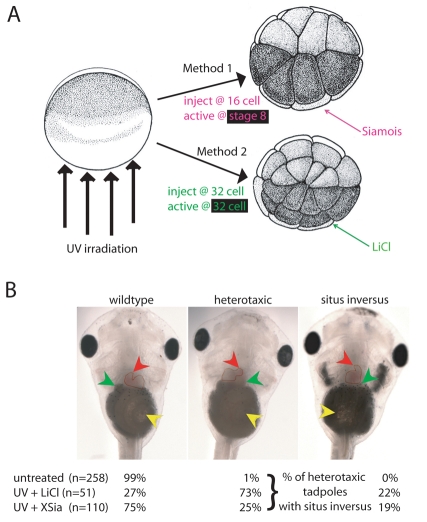
Fig. 1.
Fig. 1.
Late rescue of UV irradiation via injection of LiCl or XSiamois mRNA results in heterotaxia in embryos with a normal DAI. (A) One-cell embryos are exposed to UV irradiation from the vegetal side. Method 1: XSiamois mRNA is injected into a vegetal blastomere at the 16-cell stage. Method 2: LiCl is injected into a third tier blastomere at the 32-cell stage. (B) Organ situs of rescued embryos with DAI=5 compared with untreated embryos. All embryos were determined to be wild type or heterotaxic (inverted placement of at least one asymmetric organ). Of the heterotaxic embryos, the percentage with situs inversus (randomization of all three organs) is reported. Red arrowhead, heart loop; green arrowhead, gall bladder; yellow arrowhead, stomach.
Fig. 2.
Fig. 2.
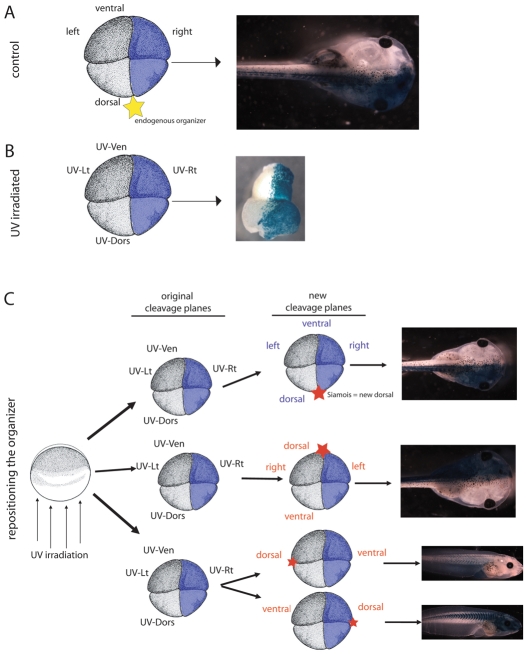
Establishment of the midline is dependent on the location of the new organizer, unless no organizer is present. (A) Both right blastomeres of control four-cell embryos were injected with β-gal. When the organizer develops on the dorsal side as expected (termed the ‘endogenous placement’, marked by a yellow star), β-gal signal remains localized to the right side of the tadpole. (B) In UV-irradiated embryos, the blastomeres no longer have ‘dorsal’ or ‘ventral’ fates, although they maintain the same appearance (i.e. cell size and pigmentation). New terms are therefore assigned to each blastomere (i.e. UV-Ven, UV-Dors, UV-Rt, UV-Lt). β-gal was injected into both UV-Rt blastomeres at the four-cell stage. If no further treatment is given, the β-gal signal localizes to one half of the resulting belly piece. (C) Both UV-Rt blastomeres of four-cell UV-irradiated embryos were injected with β-gal. Then, the position of the organizer was specifically targeted to one of three locations (marked by a red star) via injection of XSiamois at the 16-cell stage. When XSiamois is injected into the same location as the endogenous placement (UV-Dors), the cells maintain their original identities and the β-gal localizes to the right side of the rescued tadpole. When XSiamois is injected opposite the endogenous placement, the UV-Ven cells are re-defined as dorsal, and the β-gal signal localizes to the left side of rescued tadpole. Finally, if the organizer is positioned 90 degrees from the endogenous placement, β-gal is localized to either the ventral or the dorsal cells. Thus, proper organizer placement could be verified by β-gal localization in rescued tadpoles. Labels for cells that maintain their original identity are shown in blue, labels for cells that changed identity after placement of the organizer are shown in red.
Fig. 3.
Fig. 3.
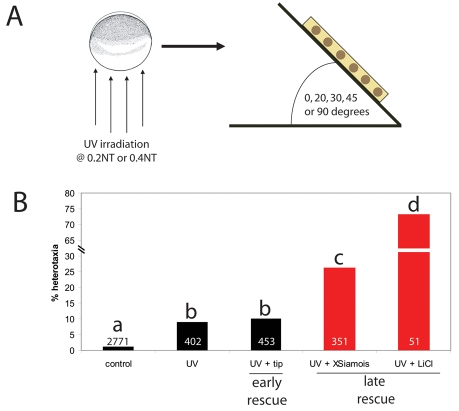
Very early rescue of UV irradiation via tipping results in embryos with normal LR asymmetry. (A) One-cell embryos were UV irradiated at either 0.2NT or 0.4NT and immediately pipetted into an agarose grid. The grid (depicted by a yellow rectangle) was then tipped at 0, 20, 30, 45 or 90 degrees for at least one cell division. (B) Statistical comparison of all embryos irradiated at 0.4NT indicates that late rescue of UV irradiation (via XSiamois or LiCl injections) produces significantly more heterotaxia than the randomizing effects of the UV irradiation itself (as indicated from the tipping rescue). Different letters indicate groups that are significantly different from each other (P<0.01). Sample sizes are indicated on the bars of the graph.
Fig. 4.
Fig. 4.
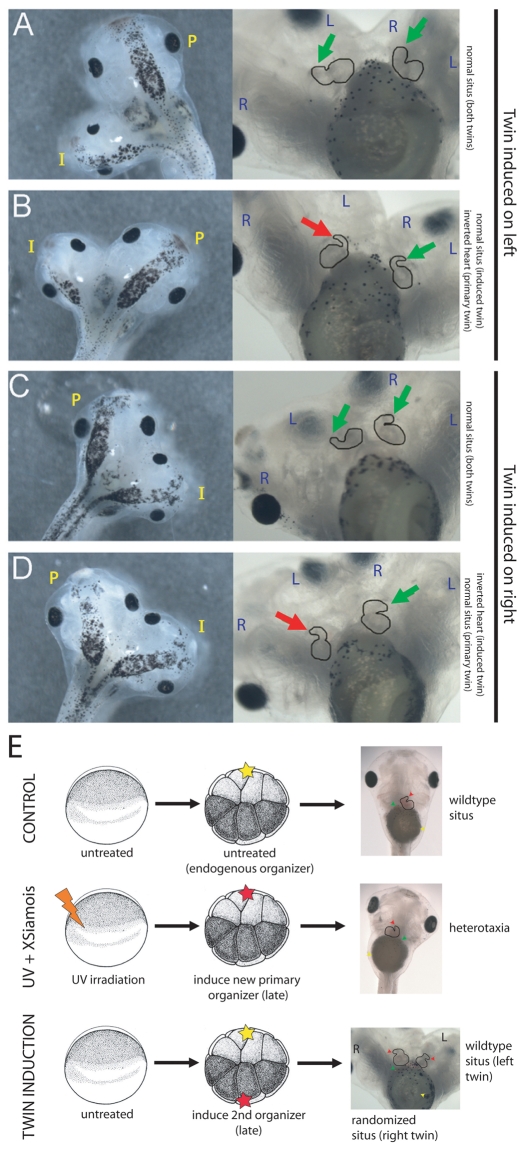
Induced twins re-pattern the LR axis information established by the primary twin but the LR axis cannot be oriented de novo late in development. (A,B) In conjoined twins where the induced twin is located on the left, the left twin typically develops with proper heart situs. However, the twin on the right has randomized heart situs. (C,D) When the induced twin is located on the right, the primary twin, forming on the left, still develops with proper heart situs. However, the right-sided twin is randomized. Green arrow, correct heart looping; red arrow, inverted heart looping. The primary (P) and induced (I) twins are indicated, and the left (L) and right (R) halves of each twin are marked. (E) Schematic detailing experiments distinguishing the LR patterning in singleton versus twinned late organizers. In untreated embryos, tadpoles develop normal organ situs. In embryos that have patterning information ablated at the one-cell stage and a single organizer introduced at late stages, the embryo is often heterotaxic. In embryos that maintain the primary axis but develop a second axis late in development, the induced twin typically has normal organ situs (if it develops on the left). Yellow star, endogenous organizer; red star, induced organizer.
Fig. 5.
Fig. 5.
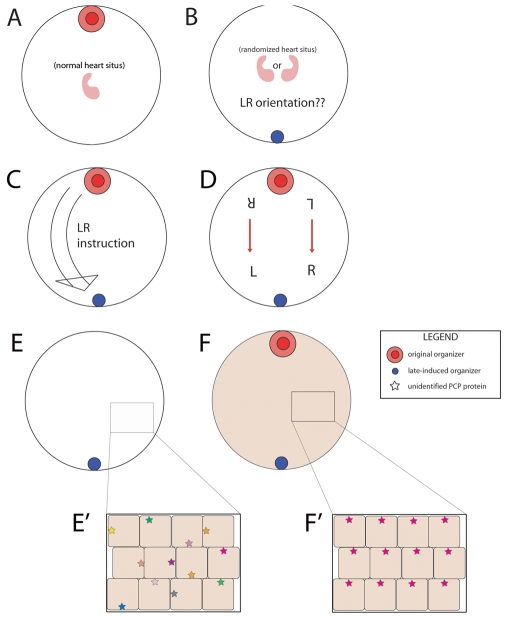
A polarity model for the instructive influence exerted by an early-induced organizer upon late-induced twin axes. (A) Schematic of a single organizer in an unperturbed, normal embryo. (B) When the primary organizer is not present and an organizer is induced late, the LR orientation is randomized. (C) If an organizer is induced late in the presence of an endogenous early organizer, LR instruction is passed from the primary organizer to the late-forming organizer. (D) The new orientation of the LR axis cannot be due to leaky signaling from the primary axis because only the left and right halves of each twin are in contact to share a LR morphogen. (E) In an embryo lacking a primary organizer with a late-induced organizer, a PCP protein (indicated by stars) that normally points all cells ‘dorsal’ towards the organizer is distributed randomly (E′). (F) Using cytoplasmic mechanisms, an embryo with a primary organizer and a late-induced organizer can orient all cells in a coherent pattern (F′) that each organizer can use, in combination with its own local AP/DV direction, to derive a consistent LR axis.

References

    1. Adams D. S., Robinson K. R., Fukumoto T., Yuan S., Albertson R. C., Yelick P., Kuo L., McSweeney M., Levin M. (2006). Early, H+-V-ATPase-dependent proton flux is necessary for consistent left-right patterning of non-mammalian vertebrates. Development 133, 1657-1671 - PMC - PubMed
    1. Aw S., Levin M. (2008). What's left in asymmetry? Dev. Dyn. 237, 3453-3463 - PMC - PubMed
    1. Aw S., Levin M. (2009). Is left-right asymmetry a form of planar cell polarity? Development 136, 355-366 - PMC - PubMed
    1. Aw S., Adams D. S., Qiu D., Levin M. (2008). H,K-ATPase protein localization and Kir4.1 function reveal concordance of three axes during early determination of left-right asymmetry. Mech. Dev. 125, 353-372 - PMC - PubMed
    1. Bonnafe E., Touka M., AitLounis A., Baas D., Barras E., Ucla C., Moreau A., Flamant F., Dubruille R., Couble P., et al. (2004). The transcription factor RFX3 directs nodal cilium development and left-right asymmetry specification. Mol. Cell. Biol. 24, 4417-4427 - PMC - PubMed

Publication types

MeSH terms