


doi: 10.1534/genetics.109.112789.
Epub 2010 Mar 9.
Muller's ratchet and the degeneration of the Drosophila miranda neo-Y chromosome
Affiliations
- PMID: 20215466
- PMCID: PMC2870968
- DOI: 10.1534/genetics.109.112789
Item in Clipboard
Muller's ratchet and the degeneration of the Drosophila miranda neo-Y chromosome
Genetics.
2010 May.
Abstract
Since its formation about 1.75 million years ago, the Drosophila miranda neo-Y chromosome has undergone a rapid process of degeneration, having lost approximately half of the genes that it originally contained. Using estimates of mutation rates and selection coefficients for loss-of-function mutations, we show that the high rate of accumulation of these mutations can largely be explained by Muller's ratchet, the process of stochastic loss of the least-loaded mutational class from a finite, nonrecombining population. We show that selection at nonsynonymous coding sites can accelerate the process of gene loss and that this effect varies with the number of genes still present on the degenerating neo-Y chromosome.
Figures
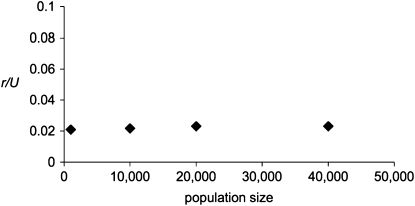
r/U scales with the diploid population size, N. At the “major” sites, Ns for the corresponding diploid population is 315, as estimated for “major” mutations. At the BGS sites, selection occurs with a constant selection coefficient, so that Ns = 10 for the diploid population. The mutation rates at all sites are also scaled by the population size. L = 32 kb in all cases; each data point is the average of four simulation runs.
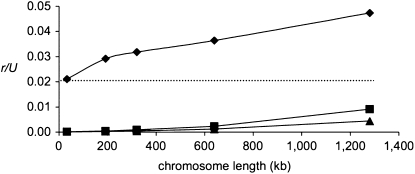
The effect of increasing the number of sites subject to BGS on the rate of fixation of “major” mutations (the values are the averages of four simulation runs). Diamonds: U = 3.78 and s = 0.63, which correspond to the scaled values of U = 0.009 and s = 0.0015 as estimated for the D. miranda neo-Y. Selection at the BGS sites is drawn from a log-normal distribution with Ns(harmonic mean) = 10. The dashed line indicates the simulated value of r/U when there is no BGS. Squares, U = 2.50, s = 0.63; triangles, U = 1.89, s = 0.63.
References
-
- Adams, M. D., S. E. Celniker, R. A. Holt, C. A. Evans, J. D. Gocayne et al., 2000. The genome sequence of Drosophila melanogaster. Science 287 2185–2195. - PubMed
-
- Bachtrog, D., 2006. Expression profile of a degenerating neo-Y chromosome in Drosophila. Curr. Biol. 16 1694–1699. - PubMed
-
- Bachtrog, D., 2007. Reduced selection for codon usage bias in Drosophila miranda. J. Mol. Evol. 64 586–590. - PubMed
Publication types
MeSH terms
LinkOut - more resources
Full Text Sources
Molecular Biology Databases
