


Short-term effects of extended-release niacin on endothelial function in HIV-infected patients on stable antiretroviral therapy
- PMID: 20216298
- PMCID: PMC2925834
- DOI: 10.1097/QAD.0b013e3283383016
Short-term effects of extended-release niacin on endothelial function in HIV-infected patients on stable antiretroviral therapy
Abstract
Objective: To assess the short-term effects of extended-release niacin (ERN) on endothelial function in HIV-infected patients with low high-density lipoprotein-cholesterol (HDL-c) levels.
Methods: Randomized controlled study to determine the short-term effects of ERN on endothelial function, measured by flow-mediated vasodilation (FMD) of the brachial artery, in HIV-infected adults with low HDL-c. Participants on stable HAART with fasting HDL-c less than 40 mg/dl and low-density lipoprotein-cholesterol less than 130 mg/dl were randomized to ERN or control arms. ERN treatment started at 500 mg/night and titrated to 1500 mg/night for 12 weeks. Controls received the same follow-up but were not given ERN (no placebo). Participants were excluded if they had a history of cardiac disease, uncontrolled hypertension, diabetes mellitus, or were on lipid-lowering medications such as statins and fibrates. Change in FMD was compared between arms with respect to baseline HDL-c.
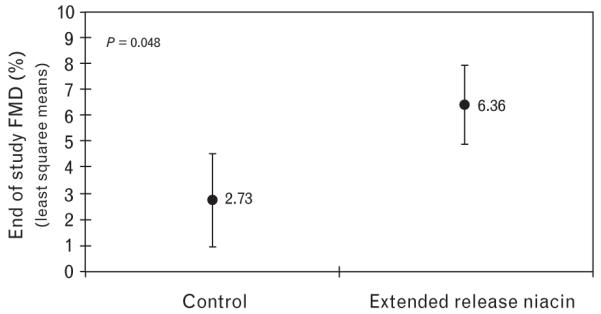
Results: Nineteen participants were enrolled: 89% men, median age 50 years, 53% white/non-Hispanic, median CD4 cell count 493 cells/microl, and 95% of them had HIV RNA below 50 copies/ml. Participants receiving ERN had a median HDL-c (interquartile range) increase of 3.0 mg/dl (0.75 to 5.0) compared with -1.0 mg/dl in controls (-6.0 to 2.5), a P value is equal to 0.04. The median change in FMD was 0.91% (-2.95 to 2.21) for ERN and -0.48% (-2.65 to 0.98) for controls (P = 0.67). However, end of study FMD for ERN was significantly different from controls after adjusting for baseline differences in FMD and HDL-c, 6.36% (95% confidence interval 4.85-7.87) and 2.73% (95% confidence interval 0.95-4.51) respectively, a P value is equal to 0.048.
Conclusion: This pilot study demonstrated that short-term niacin therapy could improve endothelial function in HIV-infected patients with low HDL-c.
Trial registration: ClinicalTrials.gov NCT00986986.
Figures
References
-
- Weverling-Rijnsburger AW, Jonkers IJ, van Exel E, Gussekloo J, Westendorp RG. High-density vs low-density lipoprotein cholesterol as the risk factor for coronary artery disease and stroke in old age. Arch Intern Med. 2003;163:1549–1554. - PubMed
-
- Shah PK, Amin J. Low high density lipoprotein level is associated with increased restenosis rate after coronary angioplasty. Circulation. 1992;85:1279–1285. - PubMed
-
- Burke AP, Farb A, Malcom GT, Liang Y, Smialek JE, Virmani R. Plaque rupture and sudden death related to exertion in men with coronary artery disease. JAMA. 1999;281:921–926. - PubMed
-
- von Eckardstein A, Hersberger M, Rohrer L. Current understanding of the metabolism and biological actions of HDL. Curr Opin Clin Nutr Metab Care. 2005;8:147–152. - PubMed
-
- Ludmer PL, Selwyn AP, Shook TL, Wayne RR, Mudge GH, Alexander RW, Ganz P. Paradoxical vasoconstriction induced by acetylcholine in atherosclerotic coronary arteries. N Engl J Med. 1986;315:1046–1051. - PubMed
Publication types
MeSH terms
Substances
Associated data
Grants and funding
LinkOut - more resources
Full Text Sources
Medical
Research Materials
