


Elucidation of amyloid beta-protein oligomerization mechanisms: discrete molecular dynamics study
- PMID: 20218566
- PMCID: PMC5767167
- DOI: 10.1021/ja9096303
Elucidation of amyloid beta-protein oligomerization mechanisms: discrete molecular dynamics study
Abstract
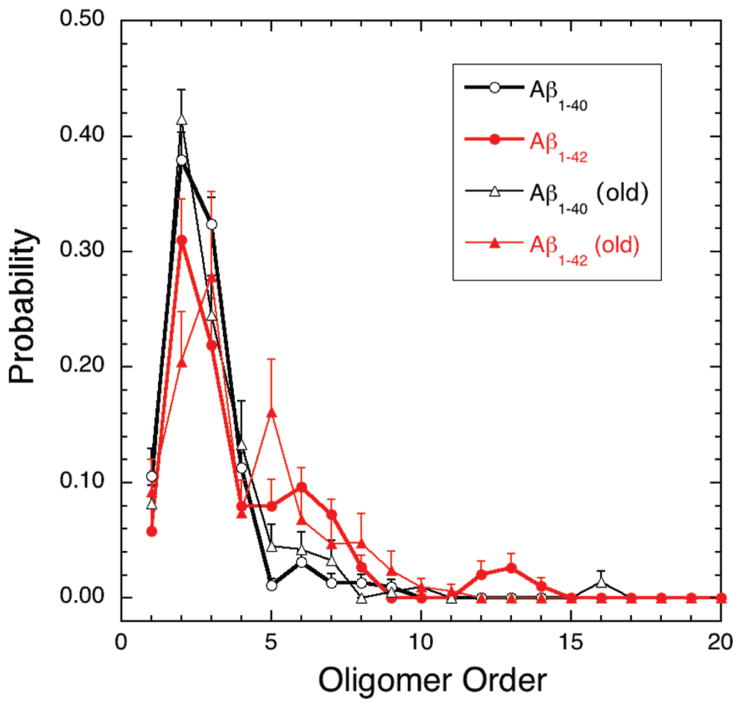
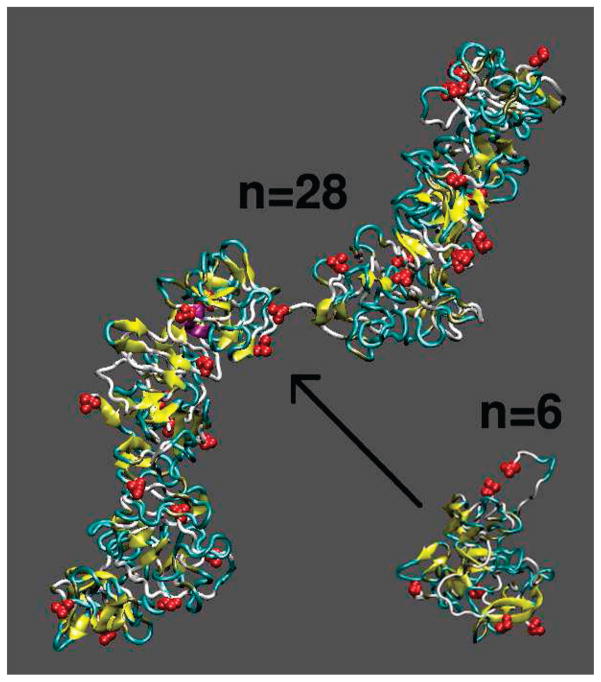
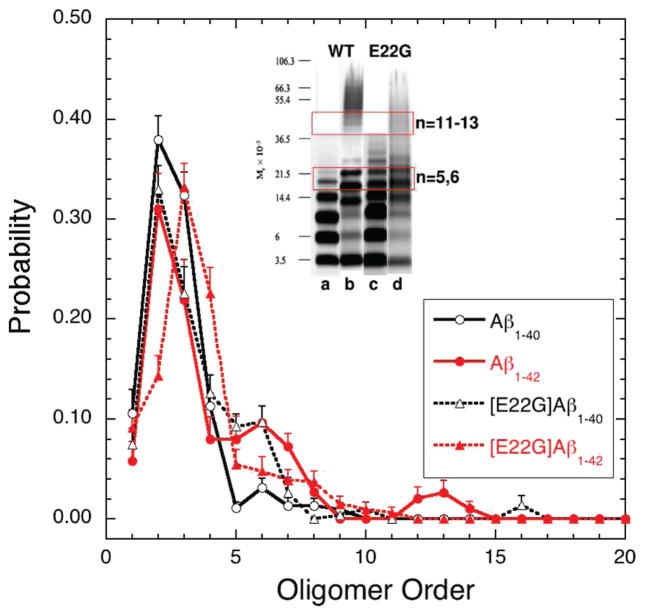
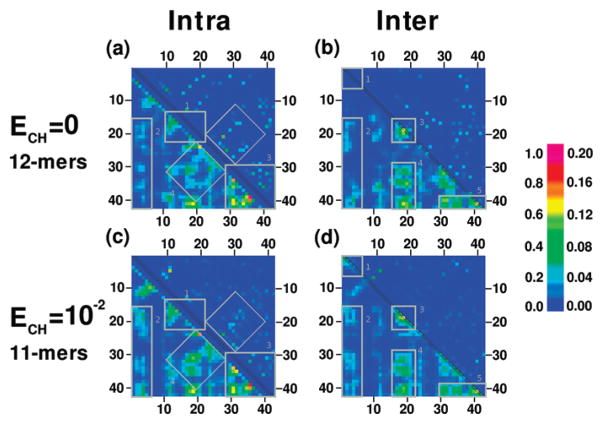
Oligomers of amyloid beta-protein (Abeta) play a central role in the pathology of Alzheimer's disease. Of the two predominant Abeta alloforms, Abeta(1-40) and Abeta(1-42), Abeta(1-42) is more strongly implicated in the disease. We elucidated the structural characteristics of oligomers of Abeta(1-40) and Abeta(1-42) and their Arctic mutants, [E22G]Abeta(1-40) and [E22G]Abeta(1-42). We simulated oligomer formation using discrete molecular dynamics (DMD) with a four-bead protein model, backbone hydrogen bonding, and residue-specific interactions due to effective hydropathy and charge. For all four peptides under study, we derived the characteristic oligomer size distributions that were in agreement with prior experimental findings. Unlike Abeta(1-40), Abeta(1-42) had a high propensity to form paranuclei (pentameric or hexameric) structures that could self-associate into higher-order oligomers. Neither of the Arctic mutants formed higher-order oligomers, but [E22G]Abeta(1-40) formed paranuclei with a similar propensity to that of Abeta(1-42). Whereas the best agreement with the experimental data was obtained when the charged residues were modeled as solely hydrophilic, further assembly from spherical oligomers into elongated protofibrils was induced by nonzero electrostatic interactions among the charged residues. Structural analysis revealed that the C-terminal region played a dominant role in Abeta(1-42) oligomer formation whereas Abeta(1-40) oligomerization was primarily driven by intermolecular interactions among the central hydrophobic regions. The N-terminal region A2-F4 played a prominent role in Abeta(1-40) oligomerization but did not contribute to the oligomerization of Abeta(1-42) or the Arctic mutants. The oligomer structure of both Arctic peptides resembled Abeta(1-42) more than Abeta(1-40), consistent with their potentially more toxic nature.
Figures



References
-
-
We note that “order” generally is used herein to define the number of Aβ monomers comprising a particular assembly. Unless stated otherwise, order does not refer to secondary or tertiary structure characteristics.
-
-
- Hardy J, Selkoe DJ. Science. 2002;297:353–356. - PubMed
-
- Hardy J. Ann Neurol. 2003;54:143–144. - PubMed
-
- Dahlgren KN, Manelli AM, Stine WB, Baker LK, Krafft GA, LaDu MJ. J Biol Chem. 2002;277:32046–32053. - PubMed
