. 2010 Mar 10:9:73.
doi: 10.1186/1475-2875-9-73.

Suppressive effect of azithromycin on Plasmodium berghei mosquito stage development and apicoplast replication

Affiliations

Suppressive effect of azithromycin on Plasmodium berghei mosquito stage development and apicoplast replication

Shoichi Shimizu et al. Malar J. .

Abstract

Background: Azithromycin (AZM) is a macrolide antibiotic that displays an excellent safety profile even in children and pregnant women and has been shown to have anti-malarial activity against blood stage Plasmodium falciparum. This study evaluated the transmission-blocking effect of AZM using a rodent malaria model.

Methods: AZM-treated mice infected with Plasmodium berghei were exposed to Anopheles stephensi mosquitoes, followed by the observation of parasite development at different phases in the mosquito, i.e., ookinetes in the midgut, oocysts on the midgut, and sporozoites in the midgut and salivary glands. Furthermore, to evaluate the effect on organelle replication of each stage, quantitative real-time PCR analysis was performed.

Results: The inhibitory effect of AZM was noticeable in both gametocyte-ookinete transformation in the midgut and sporozoite production in the oocyst, while the latter was most remarkable among all the developmental phases examined. Real-time PCR analysis revealed that AZM suppressed apicoplast replication at the period of sporozoite production in oocysts.

Conclusions: AZM inhibits parasite development in the mosquito stage, probably through the same mechanism as in the liver and blood stages. Such a multi-targeting anti-malarial, along with its safety, would be ideal for mass drug administration in malaria control programmes.


Figures

Figure 1
Figure 1
Effect of AZM on exflagellation of P. berghei microgametocytes in vitro. The number of exflagellation events per 104 RBCs was counted in vitro 24 hours after administration of AZM (White circle) or CMC (Black circle, as control). Horizontal lines and adjacent numbers represent the median number of exflagellation events in each group. P values were determined by Mann-Whitney U test. Combined results of three independent experiments are shown (n = 12).
Figure 2
Figure 2
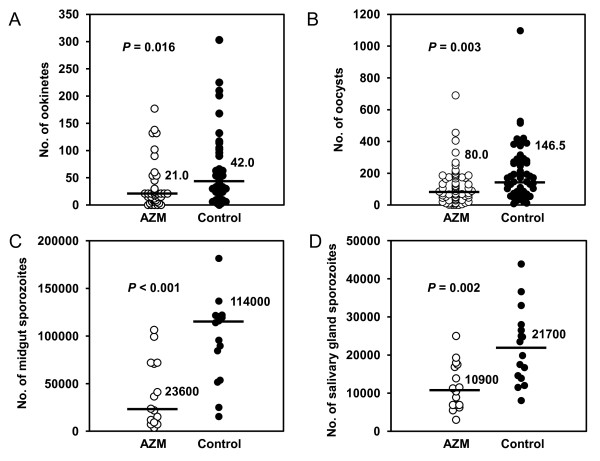
Effect of AZM on P. berghei mosquito stage development. Mosquitoes were allowed to feed on blood of P. berghei-infected mice that had been given AZM (White circle) or CMC (Black circle) at 24 hours before blood feeding. (A) Ookinete numbers in midguts dissected at 24 hours post blood feeding were determined by microscopy analysis. (B) Oocyst numbers on midguts dissected at 10 days post blood feeding were counted. (C, D) Sporozoite numbers in midgut oocysts (C) and salivary glands (D) were determined at 20 days post blood feeding. Horizontal lines and adjacent numbers represent the medians (n = 40 in (A); n = 60 in (B); n = 15 (calculated from 150 mosquitoes) in (C) and (D)). P values were determined by Mann-Whitney U test. Combined results of three to five independent experiments are shown.
Figure 3
Figure 3
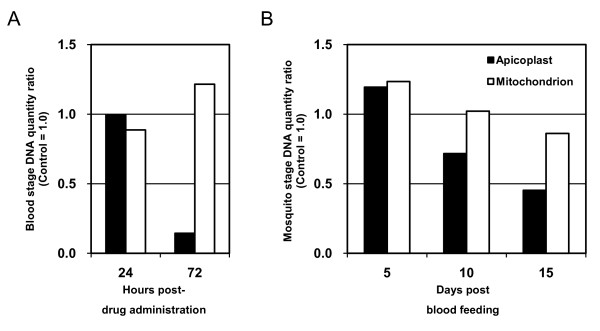
Effect of AZM on replication of P. berghei apicoplasts. Ratios of apicoplast DNA/nuclear DNA in AZM-treated parasites were calculated by quantitative real-time PCR, then standardized with the ratio from control parasites, giving ratios of (apicoplast/nuclear DNA ratio in AZM-treated parasites)/(apicoplast/nuclear DNA ratio in control parasites) (Black square). Similarly, the ratios of (mitochondrial/nuclear DNA ratio in AZM-treated parasites)/(mitochondrial/nuclear DNA ratio in control parasites) were calculated (White square). (A) Analysis of blood stage parasites at 24 hours post-drug administration (= the time of blood feeding) and 72 hours post-drug administration. (B) Analysis of mosquito stage parasites at 5, 10, and 15 days post blood feeding. DNA ratio of each control group is 1.0 on the vertical axis. A representative result of four independent experiments is shown.

References

    1. Aregawi M, Cibulskis R, Otten M, Williams R, Dye C. World Malaria Report 2008. World Health Organization, Geneva; 2008.
    1. Carter R, Mendis KN, Miller LH, Molineaux L, Saul A. Malaria transmission-blocking vaccines--how can their development be supported? Nat Med. 2000;6:241–244. doi: 10.1038/73062. - DOI - PubMed
    1. Kaslow DC. Transmission-blocking vaccines: Uses and current status of development. Int J Parasitol. 1997;27:183–189. doi: 10.1016/S0020-7519(96)00148-8. - DOI - PubMed
    1. Bucher GA. Antimalarial drugs and the mosquito transmission of Plasmodium. Int J Parasitol. 1997;27:975–987. doi: 10.1016/S0020-7519(97)00079-9. - DOI - PubMed
    1. Coleman RE, Nath AK, Schneider I, Song GH, Klein TA, Milhous WK. Prevention of sporogony of Plasmodium falciparum and P. berghei in Anopheles stephensi mosquitoes by transmission-blocking antimalarials. Am J Trop Med Hyg. 1994;50:646–653. - PubMed

Publication types

LinkOut - more resources