


Atmospheric oxygen level and the evolution of insect body size
- PMID: 20219733
- PMCID: PMC2880098
- DOI: 10.1098/rspb.2010.0001
Atmospheric oxygen level and the evolution of insect body size
Abstract
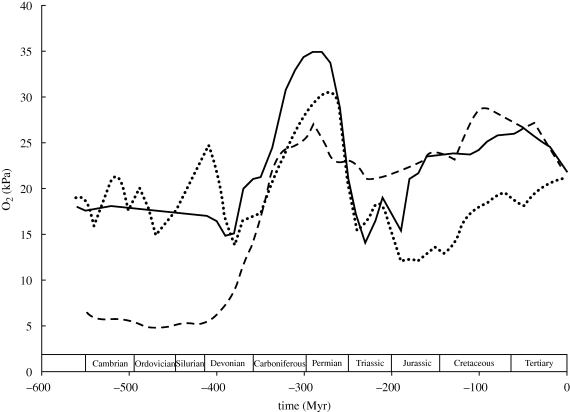
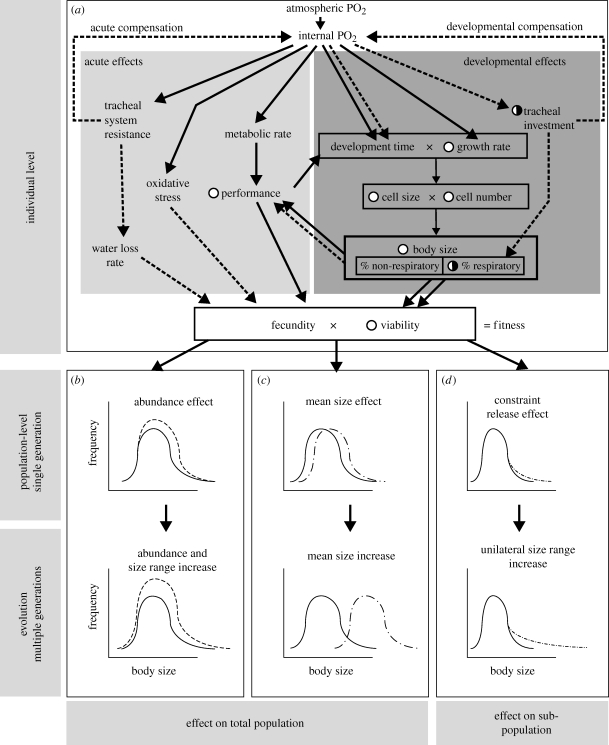
Insects are small relative to vertebrates, possibly owing to limitations or costs associated with their blind-ended tracheal respiratory system. The giant insects of the late Palaeozoic occurred when atmospheric PO(2) (aPO(2)) was hyperoxic, supporting a role for oxygen in the evolution of insect body size. The paucity of the insect fossil record and the complex interactions between atmospheric oxygen level, organisms and their communities makes it impossible to definitively accept or reject the historical oxygen-size link, and multiple alternative hypotheses exist. However, a variety of recent empirical findings support a link between oxygen and insect size, including: (i) most insects develop smaller body sizes in hypoxia, and some develop and evolve larger sizes in hyperoxia; (ii) insects developmentally and evolutionarily reduce their proportional investment in the tracheal system when living in higher aPO(2), suggesting that there are significant costs associated with tracheal system structure and function; and (iii) larger insects invest more of their body in the tracheal system, potentially leading to greater effects of aPO(2) on larger insects. Together, these provide a wealth of plausible mechanisms by which tracheal oxygen delivery may be centrally involved in setting the relatively small size of insects and for hyperoxia-enabled Palaeozoic gigantism.
Figures
References
-
- Allen C. R., Garmestani A. F., Havlicek T. D., Marquet P. A., Peterson P. D., Restrepo C., Stow C. A., Weeks B. E.2006Patterns in body size distributions: sifting among alternative hypotheses. Ecol. Lett. 9, 630–648 (doi:10.1111/j.1461-0248.2006.00902.x) - DOI - PubMed
-
- Bailey S. M., Xu J., Feng J. H., Hu X., Zhang C., Qui S.2007Tradeoffs between oxygen and energy in tibial growth at high altitude. Am. J. Hum. Biol. 19, 662–668 (doi:10.1002/ajhb.20667) - DOI - PubMed
-
- Beckemeyer R. J., Hall J. D.2007The entomofauna of the lower Permian fossil insect beds of Kansas and Oklahoma, USA. Afr. Invertebrates 48, 23–39
-
- Bergman N. M., Lenton T. M., Watson A. J.2004COPSE: a new model of biogeochemical cycling over Phanaerozoic time. Am. J. Sci. 304, 397–437 (doi:10.2475/ajs.304.5.397) - DOI
-
- Berner R. A.2005The carbon and sulfur cycles and atmospheric oxygen from middle Permian to middle Triassic. Geochim. Cosmochim. Acta 69, 3211–3217 (doi:10.1016/j.gca.2005.03.021) - DOI
Publication types
MeSH terms
Substances
LinkOut - more resources
Full Text Sources
