Combining information regarding chromosomal aberrations t(4;14) and del(17p13) with the International Staging System classification allows stratification of myeloma patients undergoing autologous stem cell transplantation
- PMID: 20220069
- PMCID: PMC2895040
- DOI: 10.3324/haematol.2009.016436
Combining information regarding chromosomal aberrations t(4;14) and del(17p13) with the International Staging System classification allows stratification of myeloma patients undergoing autologous stem cell transplantation
Abstract
Background: Chromosomal abnormalities have been shown to play a major role in disease evolution of multiple myeloma. Specific changes in interphase cells can be detected by fluorescent in situ hybridization, which overcomes the problem of the lack of dividing cells required for conventional cytogenetics.
Design and methods: We analyzed the prognostic value of 12 frequent chromosomal abnormalities detected by fluorescent in situ hybridization in a series of patients (n=315) with newly diagnosed, symptomatic multiple myeloma. All patients underwent frontline autologous stem cell transplantation according to the GMMG-HD3- or GMMG-HD4-trial protocols or analogous protocols.
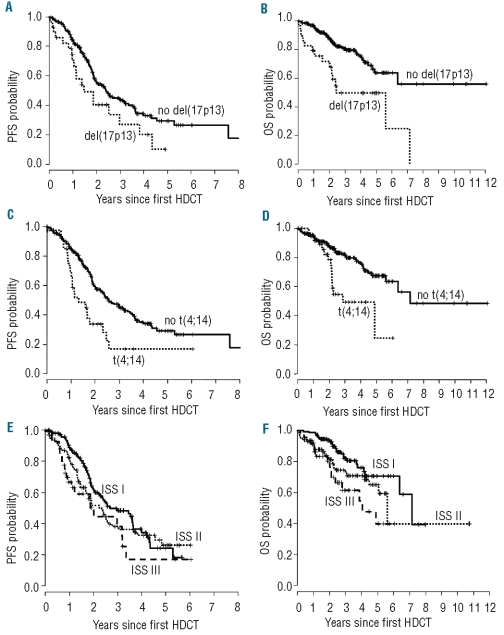
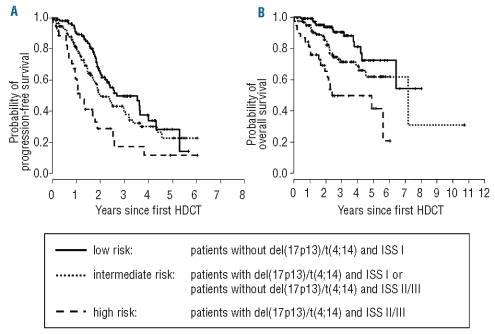
Results: Univariate statistical analyses revealed that the presence of del(13q14), del(17p13), t(4;14), +1q21 and non-hyperdiploidy was associated with adverse progression-free and overall survival rates independently of the International Staging System (ISS) classification. Multivariate analyses showed that only t(4;14) and del(17p13) retained prognostic value for both progression-free and overall survival. According to the presence or absence of t(4;14) and del(17p13) and the patients' International Staging System classification, the cohort could be stratified into three distinct groups: a group with a favorable prognosis [absence of t(4;14)/del(17p13) and ISS I], a group with a poor prognosis [presence of t(4;14)/del(17p13) and ISS II/III] and a group with an intermediate prognosis (all remaining patients). The probabilities of overall survival at 5 years decreased from 72% in the favorable prognostic group to 62% (hazard ratio 2.4; P=0.01) in the intermediate and 41% (hazard ratio 5.6; P<0.001) in the poor prognostic groups.
Conclusions: These results have implications for risk-adapted management for patients with multiple myeloma undergoing high-dose chemotherapy followed by autologous stem cell transplantation and suggest that new treatment concepts are urgently needed for patients who belong to the poor prognosis group. As targeted therapies evolve, different treatment options might have variable success, depending on the underlying genetic nature of the clone.
Figures
References
-
- Harousseau JL, Moreau P. Autologous hematopoietic stem-cell transplantation for multiple myeloma. N Engl J Med. 2009;360(25):2645–54. - PubMed
-
- Raab MS, Podar K, Breitkreutz I, Richardson PG, Anderson KC. Multiple myeloma. Lancet. 2009;374(9686):324–39. - PubMed
-
- Greipp PR, San Miguel J, Durie BG, Crowley JJ, Barlogie B, Bladé J, et al. International staging system for multiple myeloma. J Clin Oncol. 2005;23(15):3412–20. - PubMed
-
- Fonseca R, Blood E, Rue M, Harrington D, Oken MM, Kyle RA, et al. Clinical and biologic implications of recurrent genomic aberrations in myeloma. Blood. 2003;101 (11):4569–75. - PubMed
-
- Wuilleme S, Robillard N, Lodé L, Magrangeas F, Beris H, Harousseau JL, et al. Ploidy, as detected by fluorescence in situ hybridization, defines different subgroups in multiple myeloma. Leukemia. 2005;19(2):275–8. - PubMed
Publication types
MeSH terms
LinkOut - more resources
Full Text Sources
Other Literature Sources
Medical