


Evaluation of an immunochromatographic test for rapid and reliable serodiagnosis of human tularemia and detection of Francisella tularensis-specific antibodies in sera from different mammalian species
- PMID: 20220165
- PMCID: PMC2863864
- DOI: 10.1128/JCM.01475-09
Evaluation of an immunochromatographic test for rapid and reliable serodiagnosis of human tularemia and detection of Francisella tularensis-specific antibodies in sera from different mammalian species
Abstract
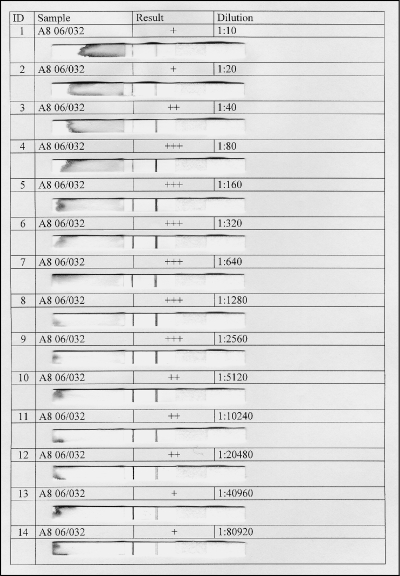
Tularemia is a highly contagious infectious zoonosis caused by the bacterial agent Francisella tularensis. Serology is still considered to be a cornerstone in tularemia diagnosis due to the low sensitivity of bacterial culture and the lack of standardization in PCR methodology for the direct identification of the pathogen. We developed a novel immunochromatographic test (ICT) to efficiently detect F. tularensis-specific antibodies in sera from humans and other mammalian species (nonhuman primate, pig, and rabbit). This new tool requires none or minimal laboratory equipment, and the results are obtained within 15 min. When compared to the method of microagglutination, which was shown to be more specific than the enzyme-linked immunosorbent assay, the ICT had a sensitivity of 98.3% (58 positive sera were tested) and a specificity of 96.5% (58 negative sera were tested) on human sera. On animal sera, the overall sensitivity was 100% (22 positive sera were tested) and specificity was also 100% (70 negative sera were tested). This rapid test preferentially detects IgG antibodies that may occur early in the course of human tularemia, but further evaluation with human sera is important to prove that the ICT can be a valuable field test to support a presumptive diagnosis of tularemia. The ICT can also be a useful tool to monitor successful vaccination with subunit vaccines or live vaccine strains containing lipopolysaccharide (e.g., LVS) and to detect seropositive individuals or animals in outbreak situations or in the context of epidemiologic surveillance programs in areas of endemicity as recently recommended by the World Health Organization.
Figures

References
-
- Al Dahouk, S., K. Nockler, H. Tomaso, W. D. Splettstoesser, G. Jungersen, U. Riber, D. Hoffmann, H. C. Scholz, A. Hensel, and H. Neubauer. 2005. Seroprevalence of brucellosis, tularemia, and yersiniosis in wild boars (Sus scrofa) from North-Eastern Germany. J. Vet. Med. B Infect. Dis. Vet. Public Health 52:444-455. - PubMed
-
- Altman, D. G. 1991. Practical statistics for medical research, p. 403-409. Chapman & Hall, London, United Kingdom.
MeSH terms
Substances
LinkOut - more resources
Full Text Sources
Molecular Biology Databases
