


Revisiting pneumococcal carriage by use of broth enrichment and PCR techniques for enhanced detection of carriage and serotypes
- PMID: 20220175
- PMCID: PMC2863911
- DOI: 10.1128/JCM.02243-09
Revisiting pneumococcal carriage by use of broth enrichment and PCR techniques for enhanced detection of carriage and serotypes
Abstract
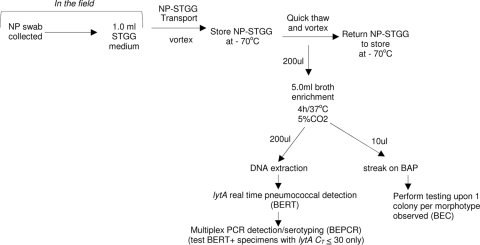
The measurement of pneumococcal carriage in the nasopharyngeal reservoir is subject to potential confounders that include low-density and multiple-strain colonization. To compare different methodologies, we picked a random sampling of 100 nasopharyngeal specimens recovered from infants less than 2 years of age who were previously assessed for pneumococcal carriage and serotypes by a conventional method that used direct plating from the transport/storage medium (50 specimens were culture negative and 50 specimens were culture positive for pneumococci). We used a broth enrichment approach and a conventional PCR approach (with and without broth enrichment) to determine pneumococcal carriage and serotypes, and the results were compared to the initial conventional culture-based results. Additionally, we used a lytA-targeted real-time PCR for pneumococcal detection. Broth enrichment for both the culture-based and the PCR-based methods enhanced the isolation of pneumococci and detection of serotype diversity, with the most effective serotype deduction method being one that used broth enrichment prior to sequential multiplex PCR. Similarly, we also found that broth enrichment followed by the lytA-specific real-time PCR was the most sensitive for the detection of apparent pneumococcal carriage. The broth enrichment, conventional multiplex PCR, and real-time PCR approaches used in this study were effective in detecting pneumococcal carriage in the 50 specimens that were negative by conventional direct plating from transport medium (range of numbers of positive specimens, 8/50 to 22/50 [16 to 44%]), and the three different serotyping approaches that used broth enrichment increased the number of serotype identifications from the 100 specimens (12 to 29 additional serotype identifications to be positive). A PCR-based approach that employed a broth enrichment step appeared to best enhance the detection of mixed serotypes and low-density pneumococcal carriage.
Figures
References
-
- Antonio, M., I. Hakeem, K. Sankareh, Y. B. Cheung, and R. A. Adegbola. 2009. Evaluation of sequential multiplex PCR for direct detection of multiple serotypes of Streptococcus pneumoniae from nasopharyngeal secretions. J. Med. Microbiol. 58:296-302. - PubMed
-
- Azzari, C., M. Moriondo, G. Indolfi, C. Massai, L. Becciolini, M. de Martino, and M. Resti. 2008. Molecular detection methods and serotyping performed directly on clinical samples improve diagnostic sensitivity and reveal increased incidence of invasive disease by Streptococcus pneumoniae in Italian children. J. Med. Microbiol. 57:1205-1212. - PMC - PubMed
-
- Carvalho, M. D. G., F. C. Pimenta, R. E. Gertz, Jr., H. H. Joshi, A. A. Trujillo, L. Keys, J. Findley, I. S. Moura, I. H. Park, S. K. Hollingshead, T. Pilishvili, C. G. Whitney, M. H. Nahm, B. W. Beall, and the Active Bacterial Core Surveillance Team. 2009. PCR-based quantitation and clonal diversity of the current prevalent invasive serogroup 6 pneumococcal serotype, 6C, in the United States in 1999 and 2006 to 2007. J. Clin. Microbiol. 47:554-559. - PMC - PubMed
-
- Carvalho, M. D. G., M. L. Tondella, K. McCaustland, L. Weidlich, L. McGee, L. W. Mayer, A. Steigerwalt, M. Whaley, R. R. Facklam, B. Fields, G. Carlone, E. W. Ades, R. Dagan, and J. S. Sampson. 2007. Evaluation and improvement of real-time PCR assays targeting lytA, ply, and psaA genes for detection of pneumococcal DNA. J. Clin. Microbiol. 45:2460-2466. - PMC - PubMed
Publication types
MeSH terms
LinkOut - more resources
Full Text Sources
Other Literature Sources
Medical
