Review
. 2010 Apr-Jun;21(2-3):91-8.
doi: 10.1016/j.cytogfr.2010.02.006. Epub 2010 Mar 12.

Clinical trials with oncolytic reovirus: moving beyond phase I into combinations with standard therapeutics

Affiliations
Review

Clinical trials with oncolytic reovirus: moving beyond phase I into combinations with standard therapeutics

K J Harrington et al. Cytokine Growth Factor Rev. 2010 Apr-Jun.

Abstract

It is time for those working on oncolytic viruses to take stock of the status of the field. We now have at our disposal an array of potential therapeutic agents, and are beginning to conduct early-phase clinical trials in patients with relapsed/metastatic cancers. By drawing on lessons learned during the development of other biological therapies, such as monoclonal antibodies and targeted small molecule inhibitors, we are now in a position to chart the course of the next wave of trials that will go beyond the phase I studies of safety and feasibility. In this article we review our approach to the development of oncolytic viruses as cancer therapeutics. In doing so, we emphasise the fact that this process is modular and involves multiple iterative steps between the laboratory and the clinic. Ultimately, at least in the medium term, the future of oncolytic virotherapy lies in combination regimens with standard anti-cancer agents such as radiation and chemotherapy.


Figures

Fig. 1
Fig. 1
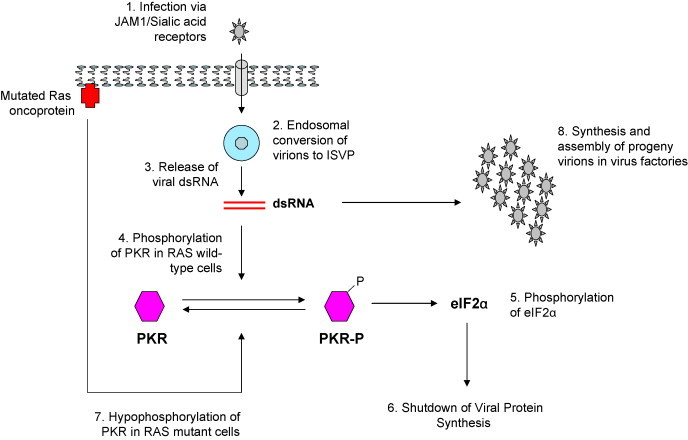
Schematic view of the infective cycle of reovirus. Initial infection occurs through interaction between the virion and junctional adhesion molecule 1 (JAM1) and sialic acid residues on the cell membrane (1). The virus is internalised in an endosomal compartment where it is partially digested to form the intermediate subviral particle (ISVP) (2). Viral double-stranded RNA (dsRNA) escapes for the endosome (3). In cells that contain normal wild-type RAS genes, the presence of dsRNA leads to phosphorylation of PKR (4) and subsequent activation of eIF2α (5). This in turn leads to shutdown of viral protein synthesis, thus aborting a productive infection (6). In contrast, in cells with mutant RAS or an activated Ras pathway, PKR remains in a hypophosphorylated form (7) and viral RNA species are able to direct synthesis and assembly of daughter virions (8).
Fig. 2
Fig. 2
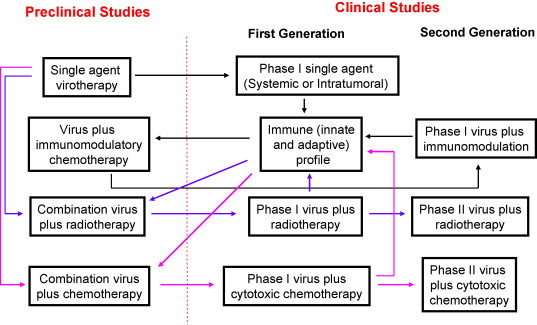
Modular and iterative nature of preclinical and clinical development of oncolytic virotherapy. Black arrows chart the course of preclinical and clinical trials involved in the use of single-agent reovirus. Specifically, data that emerged from the initial phase I study of intravenous viral administration provided essential data on the immune effects in patients. These results were used to design studies in the laboratory that ultimately provided a mechanism for attempting to modulate the NARA response with cyclophosphamide. Blue arrows show the course of studies in which reovirus is combined with radiotherapy. Once again, immune profiling has been a key component in this work. Pink arrows indicate work streams for combinations with cytotoxic chemotherapy. In this regard, phase I and II combination studies have been completed and have resulted in successful submission of a proposal for a phase III trial. (For interpretation of the references to color in this figure legend, the reader is referred to the web version of the article.)
Fig. 3
Fig. 3
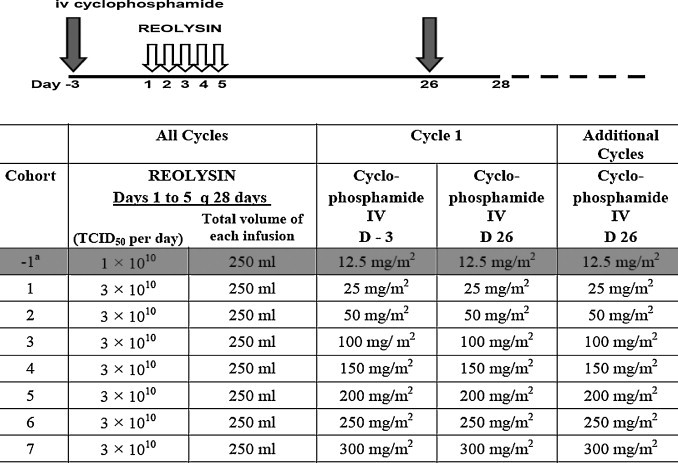
Scheme of delivery of cyclophosphamide and reovirus (REOLYSIN) in phase I study of immunomodulatory therapy. Cyclophosphamide is delivered 3 days before a 5-day cycle of reovirus with cycles repeated each 4 weeks. The −1 dose level was written into the protocol in case dose-limiting toxicity was encountered in cohort 1, but was not needed during study conduct.
Fig. 4
Fig. 4
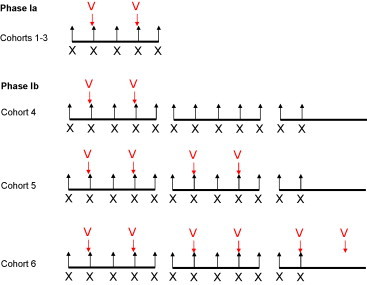
Trial design for the phase I study of reovirus in combination with radiotherapy. In phase Ia, patients in cohorts 1–3 received palliative radiotherapy to a dose of 20 Gy in 5 fractions (X = 4 Gy per fraction), with escalating doses of virus (V) delivered on days 2 and 4. In cohort 1, virus doses were 1 × 108 TCID50. In cohort 2, virus doses were 1 × 109 TCID50, and in cohort 3 doses were 1 × 1010 TCID50 per injection. In phase Ib, patients received palliative radiotherapy to a dose of 36 Gy in 12 fractions (X = 3 Gy per fraction) with increasing numbers of virus administrations. Each virus dose (V) was at the 1 × 1010 TCID50 dose level. Patients in cohort 4 received 2 injections, those in cohort 5 received 4 injections and those in cohort 6 received 6 injections.
Fig. 5
Fig. 5
Clinical trial design for the randomised phase III trial of carboplatin, paclitaxel and reovirus or placebo in patients with relapsed/metastatic, platin-refractory head and neck cancer (SCCHN, squamous cell cancer of the head and neck; AUC, area under the curve; CR, complete response; PR, partial response; SD, stable disease).

References

    1. Harrington K.J., Epenetos A.A. Recent developments in radioimmunotherapy. Clin Oncol (R Coll Radiol) 1994;6:391–398. - PubMed
    1. Kohler G., Milstein C. Continuous culture of fused cells secreting antibodies of predefined specificity. Nature. 1975;256:495–497. - PubMed
    1. Jain R.K. Physiological barriers to delivery of monoclonal antibodies and other macromolecules in tumours. Cancer Res. 1990;50(Suppl.):814s–819s. - PubMed
    1. Courtenay-Luck N.S., Epenetos A.A., Moore R., Larche M., Pectasides D., Dhokia B. Development of primary and secondary immune responses to mouse monoclonal antibodies used in the diagnosis and therapy of malignant neoplasms. Cancer Res. 1986;46:6489–6493. - PubMed
    1. Forni L., Coutinho A., Köhler G., Jerne N.K. IgM antibodies induce the production of antibodies of the same specificity. Proc Natl Acad Sci USA. 1980;77:1125–1128. - PMC - PubMed