


Review
doi: 10.1038/nri2743.
Epub 2010 Mar 12.
iNKT cell autoreactivity: what is 'self' and how is it recognized?
Affiliations
- PMID: 20224567
- PMCID: PMC3070484
- DOI: 10.1038/nri2743
Item in Clipboard
Review
iNKT cell autoreactivity: what is 'self' and how is it recognized?
Nat Rev Immunol.
2010 Apr.
Abstract
Following stimulation through their T cell receptor, invariant natural killer T (iNKT) cells function as innate effector cells by rapidly releasing large amounts of effector cytokines and chemokines and therefore have an important role in modulating the ensuing immune response. iNKT cells recognize, and are activated by, diverse glycolipid antigens, many of which are found in microorganisms. However, iNKT cells also show some reactivity to 'self'. Here, I outline our current understanding of iNKT cell autoreactivity and propose that several self lipids are probably involved in the positive selection and autoreactivity of iNKT cells.
Figures
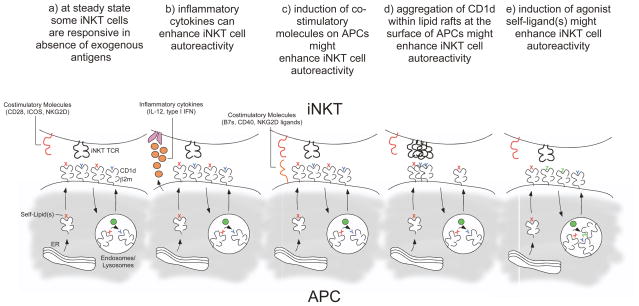
(a) Some iNKT cell hybridomas and clones can readily be activated by CD1d-expressing APCs. During steady state, some self-antigens, depicted as x (in red), are loaded into CD1d molecules in the ER/secretion pathway and other self-antigens, depicted as y (in blue), are loaded into CD1d in the endosomes/lysosomes with the help of lipid transfer proteins (depicted as green circles), and both are presented by CD1d molecules at the surface of APCs. (b) A combination of pro-inflammatory cytokines (IL-12, type I interferons) and recognition of self-antigen(s) can trigger an iNKT cell response. (c) Upregulation of co-stimulatory molecules at the surface of activated APCs helps triggering the response of iNKT cells toward self-antigen(s) presented by CD1d. (d) Under certain conditions, CD1d molecules might aggregate within lipid rafts at the surface of the APCs and trigger a response by iNKT cells. (e) Following activation, high affinity agonist self-antigen(s), depicted as z (in green), are generated and loaded onto CD1d in the lysosomes of APCs with the help of lipid transfer proteins and replace otherwise weakly stimulatory self-antigen(s), x and y, that are usually presented by CD1d at steady state. Of course, these various possibilities to induce an iNKT cell response against “self” are not mutually exclusive.
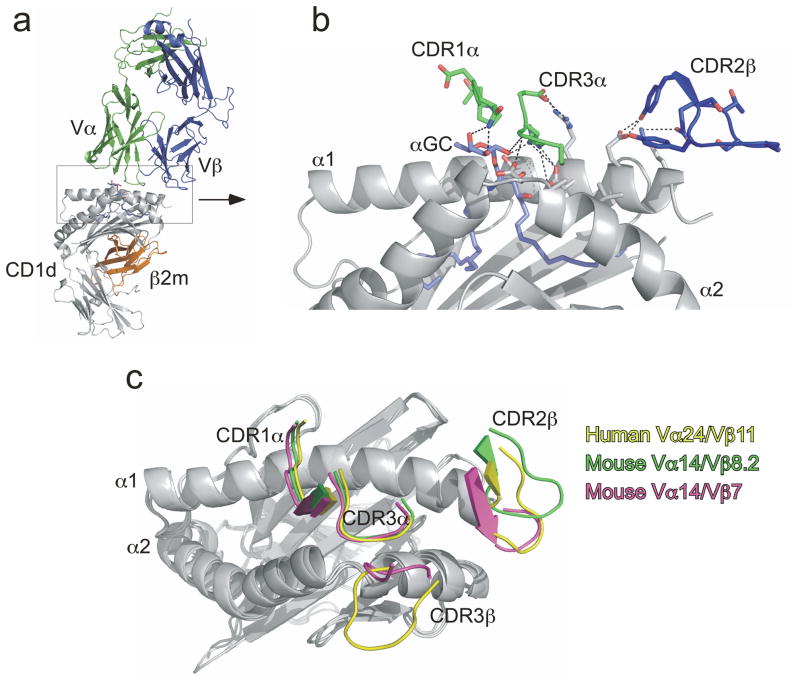
(a) Vα14–Vβ8.2 NKT cell TCR in complex with αGalCer–mouse CD1d. (b) Magnified view of iNKT cell TCR interaction with αGalCer–mouse CD1d complex. CDR3α mediates multiple contacts between mouse CD1dα– helices and αGalCer. Residues in the CDR2β loop contacts the α1 helix of mouse CD1d. CDR1α interacts solely with αGalCer galactose head group. Other CDR loops were not depicted for purposes of clarity. (c) Superposition of human Vα24-Vβ11 NKT-TCR (yellow) on human CD1d, mouse Vα14–Vβ8.2 (green) on mouse CD1d and mouse Vα14–Vβ7 (pink) on mouse CD1d. CD1d molecules are shown in gray. Only the CDR1α, CDR3α, CDR2β and CDR3β loops of each TCR are depicted for clarity. Note the location of the CDR3β loops over the α2 helix of CD1d. The CDR3β of the Vα14–Vβ8.2 TCR is not depicted as it was mobile and hence could not be resolved on the crystal structure.
References
-
- Kronenberg M. Toward an Understanding of NKT Cell Biology: Progress and Paradoxes. Annu Rev Immunol. 2005;23:877–900. - PubMed
-
- Bendelac A, Savage PB, Teyton L. The Biology of NKT Cells. Annu Rev Immunol. 2006 - PubMed
-
- Kronenberg M, Gapin L. The unconventional lifestyle of NKT cells. Nat Rev Immunol. 2002;2:557–568. - PubMed
-
- Brigl M, Brenner MB. CD1: antigen presentation and T cell function. Annu Rev Immunol. 2004;22:817–90. - PubMed
Publication types
MeSH terms
Grants and funding
LinkOut - more resources
Full Text Sources
