Role of breast regression protein-39/YKL-40 in asthma and allergic responses
- PMID: 20224674
- PMCID: PMC2831605
- DOI: 10.4168/aair.2010.2.1.20
Role of breast regression protein-39/YKL-40 in asthma and allergic responses
Abstract
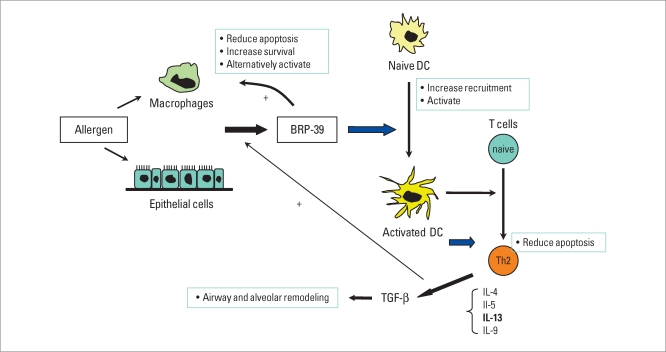
BRP-39 and its human homolog YKL-40 have been regarded as a prototype of chitinase-like proteins (CLP) in mammals. Exaggerated levels of YKL-40 protein and/or mRNA have been noted in a number of diseases characterized by inflammation, tissue remodeling, and aberrant cell growth. Asthma is an inflammatory disease characterized by airway hyperresponsiveness and airway remodeling. Recently, the novel regulatory role of BRP-39/YKL-40 in the pathogenesis of asthma has been demonstrated both in human studies and allergic animal models. The levels of YKL-40 are increased in the circulation and lungs from asthmatics where they correlate with disease severity, and CHI3L1 polymorphisms correlate with serum YKL-40 levels, asthma and abnormal lung function. Animal studies using BRP-39 null mutant mice demonstrated that BRP-39 was required for optimal allergen sensitization and Th2 inflammation. These studies suggest the potential use of BRP-39 as a biomarker as well as a therapeutic target for asthma and other allergic diseases. Here, we present an overview of chitin/chitinase biology and summarize recent findings on the role of BRP-39 in the pathogenesis of asthma and allergic responses.
Keywords: BRP-39; asthma; human CHI3L1 protein; hypersensitivity.
Conflict of interest statement
There are no financial or other issues that might lead to conflict of interest.
Figures
Similar articles
-
Chitinase 3-like 1 protein plays a critical role in respiratory syncytial virus-induced airway inflammation.Allergy. 2019 Apr;74(4):685-697. doi: 10.1111/all.13661. Epub 2018 Dec 4. Allergy. 2019. PMID: 30402955 Free PMC article.
-
Chitinase 3-like 1 drives allergic skin inflammation via Th2 immunity and M2 macrophage activation.Clin Exp Allergy. 2019 Nov;49(11):1464-1474. doi: 10.1111/cea.13478. Epub 2019 Aug 28. Clin Exp Allergy. 2019. PMID: 31397016 Clinical Trial.
-
Role of breast regression protein 39 (BRP-39)/chitinase 3-like-1 in Th2 and IL-13-induced tissue responses and apoptosis.J Exp Med. 2009 May 11;206(5):1149-66. doi: 10.1084/jem.20081271. Epub 2009 May 4. J Exp Med. 2009. PMID: 19414556 Free PMC article.
-
YKL-40 as a possible marker of neutrophilic asthma.Front Med (Lausanne). 2023 Feb 8;10:1115938. doi: 10.3389/fmed.2023.1115938. eCollection 2023. Front Med (Lausanne). 2023. PMID: 36844232 Free PMC article. Review.
-
New Insights Into the Relationship Between Chitinase-3-Like-1 and Asthma.Curr Allergy Asthma Rep. 2016 Aug;16(8):57. doi: 10.1007/s11882-016-0637-2. Curr Allergy Asthma Rep. 2016. PMID: 27438466 Review.
Cited by
-
Antibody directed against human YKL-40 increases tumor volume in a human melanoma xenograft model in scid mice.PLoS One. 2014 Apr 21;9(4):e95822. doi: 10.1371/journal.pone.0095822. eCollection 2014. PLoS One. 2014. PMID: 24752554 Free PMC article.
-
New insights into the role of the CHI3L2 protein in invasive ductal breast carcinoma.Sci Rep. 2024 Nov 18;14(1):28529. doi: 10.1038/s41598-024-77930-5. Sci Rep. 2024. PMID: 39557919 Free PMC article.
-
Novel biological activities of allosamidins.Molecules. 2013 Jun 13;18(6):6952-68. doi: 10.3390/molecules18066952. Molecules. 2013. PMID: 23765233 Free PMC article. Review.
-
A cis-eQTL allele regulating reduced expression of CHI3L1 is associated with late-onset adult asthma in Japanese cohorts.BMC Med Genet. 2019 Apr 2;20(1):58. doi: 10.1186/s12881-019-0786-y. BMC Med Genet. 2019. PMID: 30940096 Free PMC article.
-
Commentary: IL-4 and IL-13 receptors and signaling.Cytokine. 2015 Sep;75(1):38-50. doi: 10.1016/j.cyto.2015.05.023. Epub 2015 Jul 14. Cytokine. 2015. PMID: 26187331 Free PMC article.
References
-
- Morrison BW, Leder P. neu and ras initiate murine mammary tumors that share genetic markers generally absent in c-myc and int-2-initiated tumors. Oncogene. 1994;9:3417–3426. - PubMed
-
- Rejman JJ, Hurley WL. Isolation and characterization of a novel 39 kDa whey protein from boviine mammary secretions collected during the nonlactating period. Biochem Biophys Res Commun. 1988;150:329–334. - PubMed
-
- Hakala BE, White C, Recklies AD. Human cartilage gp-39, a major secretory product of articular chondrocytes and synovial cells, is a mammalian member of a chitinase protein family. J Biol Chem. 1993;268:25803–25810. - PubMed
-
- Shackleton LM, Mann DM, Millis JT. Identification of a 38-kDa heparin-binding glycoprotein (gp39k) in differentiating vascular smooth muscle cells as a member of a group of proteins associated with tissue remodeling. J Biol Chem. 1995;270:13076–13083. - PubMed
-
- Kawamura K, Shibata T, Saget O, Peel D, Bryant PJ. A new family of growth factors produced by the fat body and active on Drosophila imaginal disc cells. Development. 1999;126:211–219. - PubMed
Grants and funding
LinkOut - more resources
Full Text Sources
Other Literature Sources
Miscellaneous