


Embryos in the fast lane: high-temperature heart rates of turtles decline after hatching
- PMID: 20224773
- PMCID: PMC2835746
- DOI: 10.1371/journal.pone.0009557
Embryos in the fast lane: high-temperature heart rates of turtles decline after hatching
Abstract
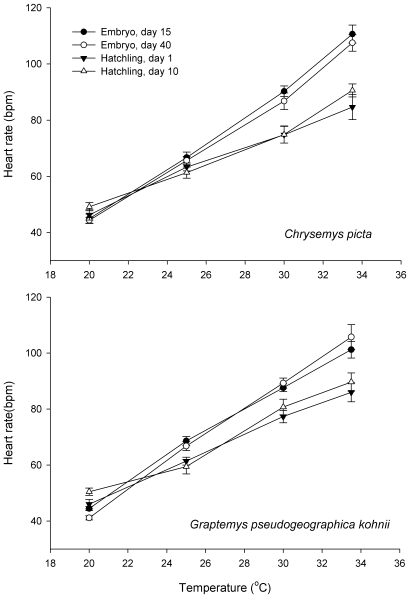
In ectotherms such as turtles, the relationship between cardiovascular function and temperature may be subject to different selective pressures in different life-history stages. Because embryos benefit by developing as rapidly as possible, and can "afford" to expend energy to do so (because they have access to the yolk for nutrition), they benefit from rapid heart (and thus, developmental) rates. In contrast, hatchlings do not have a guaranteed food supply, and maximal growth rates may not enhance fitness--and so, we might expect a lower heart rate, especially at high temperatures where metabolic costs are greatest. Our data on two species of emydid turtles, Chrysemys picta, and Graptemys pseudogeographica kohnii, support these predictions. Heart rates of embryos and hatchlings were similar at low temperatures, but heart rates at higher temperatures were much greater before than after hatching.
Conflict of interest statement
Figures
References
-
- Pough EH, Andrews RM, Cadle JE, Crump ML, Savitzky AH, et al. Englewood Cliffs: NJ:Prentice-Hall; 1998. Herpetology.
-
- Gillooly JF, Brown JH, West GB, Savage VM, Charnov EL. Effects of size and temperature on metabolic rate. Science. 2001;293:2248–2250. - PubMed
-
- Seebacher F, Franklin CE. Physiological mechanisms of thermoregulation in reptiles: a review. Journal of Comparative Physiology B. 2005;175:533–541. - PubMed
-
- Huey RB, Berrigan D. Testing evolutionary hypotheses of acclimation. In: Johnston IA, Bennett AF, editors. Animals and Temperature. Cambridge: Cambridge University Press; 1996. pp. 205–237.
-
- Du WG, Radder RS, Sun B, Shine R. Determinants of incubation period: do reptilian embryos hatch after a fixed total number of heart beats? Journal of Experimental Biology. 2009;212:1302–1306. - PubMed
Publication types
MeSH terms
LinkOut - more resources
Full Text Sources
