


Low prevalence of human papillomavirus in oral cavity carcinomas
- PMID: 20226055
- PMCID: PMC2851586
- DOI: 10.1186/1758-3284-2-6
Low prevalence of human papillomavirus in oral cavity carcinomas
Abstract
Background: Increasing evidence shows that Human Papillomavirus (HPV) is preferentially associated with some head and neck squamous cell carcinomas (HNSCCs), with variable infection rates reported.
Methods: We assessed HPV involvement in HNSCC using the Roche Linear Array HPV Genotyping Test, which can detect 37 different HPV types. We examined the prevalence of HPV infection in 92 HNSCCs (oropharynx, oral cavity, and other HNSCC sites).
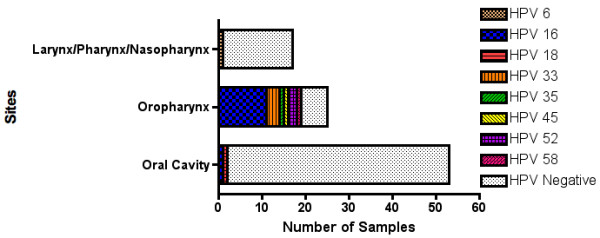
Results: HPV was frequently detected in oropharyngeal cancers (OPCs) (16/22, 73%), but was uncommon in oral cavity cancers (2/53, 4%), and in other HNSCC subsites (1/17, 6%). HPV positive tumors were associated with patients that were 40-60 years old (p = 0.02), and node positive (p = < 0.0001). HPV 16 was the most prevalent type, but other types detected included 6, 18, 33, 35, 45, and 52/58.
Conclusion: Our results show that in contrast to oropharyngeal cancers, oral cancers and other HNSCCs infrequently harbor HPV.
Figures
Similar articles
-
[Prevalence of human papillomavirus infection in squamous cell carcinoma of the oral cavity, oropharynx and larynx].Cir Cir. 2016 Sep-Oct;84(5):363-8. doi: 10.1016/j.circir.2016.01.006. Epub 2016 Mar 28. Cir Cir. 2016. PMID: 27032466 Spanish.
-
Frequency and genotype distribution of multiple human papillomavirus infections in cancer of the head and neck in a Mexican population.Oral Surg Oral Med Oral Pathol Oral Radiol. 2012 Sep;114(3):350-7. doi: 10.1016/j.oooo.2012.05.003. Oral Surg Oral Med Oral Pathol Oral Radiol. 2012. PMID: 22862976
-
[Involvement of human papillomavirus in upper aero-digestive tracts cancers].Bull Cancer. 2009 Oct;96(10):941-50. doi: 10.1684/bdc.2009.0923. Bull Cancer. 2009. PMID: 19744917 Review. French.
-
Head and neck squamous cell carcinoma: role of the human papillomavirus in tumour progression.New Microbiol. 2006 Jan;29(1):25-33. New Microbiol. 2006. PMID: 16608122
-
Human papillomavirus (HPV) in head and neck cancer.J Clin Virol. 2005 Mar;32 Suppl 1:S59-66. doi: 10.1016/j.jcv.2004.11.017. J Clin Virol. 2005. PMID: 15753013 Review.
Cited by
-
Hybrid Capture 2 is as effective as PCR testing for high-risk human papillomavirus in head and neck cancers.Appl Immunohistochem Mol Morphol. 2015 Apr;23(4):266-72. doi: 10.1097/PDM.0000000000000036. Appl Immunohistochem Mol Morphol. 2015. PMID: 25839700 Free PMC article.
-
p53 in head and neck cancer: functional consequences and environmental implications of TP53 mutations.Head Neck Oncol. 2010 Dec 15;2:36. doi: 10.1186/1758-3284-2-36. Head Neck Oncol. 2010. PMID: 21159183 Free PMC article.
-
HPV positive tonsillar cancer in two laser surgeons: case reports.J Otolaryngol Head Neck Surg. 2013 Nov 18;42(1):54. doi: 10.1186/1916-0216-42-54. J Otolaryngol Head Neck Surg. 2013. PMID: 24246045 Free PMC article.
-
The phosphatase and tensin homologue deleted on chromosome 10 mediates radiosensitivity in head and neck cancer.Br J Cancer. 2010 Jun 8;102(12):1778-85. doi: 10.1038/sj.bjc.6605707. Epub 2010 May 25. Br J Cancer. 2010. PMID: 20502457 Free PMC article.
-
HPV-16 in a distinct subset of oral epithelial dysplasia.Mod Pathol. 2017 Dec;30(12):1646-1654. doi: 10.1038/modpathol.2017.71. Epub 2017 Aug 11. Mod Pathol. 2017. PMID: 28799537
References
-
- Hashibe M, Brennan P, Benhamou S, Castellsague X, Chen C, Curado MP, Dal Maso L, Daudt AW, Fabianova E, Fernandez L, Wunsch-Filho V, Franceschi S, Hayes RB, Herrero R, Koifman S, La Vecchia C, Lazarus P, Levi F, Mates D, Matos E, Menezes A, Muscat J, Eluf-Neto J, Olshan AF, Rudnai P, Schwartz SM, Smith E, Sturgis EM, Szeszenia-Dabrowska N, Talamini R, Wei Q, Winn DM, Zaridze D, Zatonski W, Zhang ZF, Berthiller J, Boffetta P. Alcohol drinking in never users of tobacco, cigarette smoking in never drinkers, and the risk of head and neck cancer: pooled analysis in the International Head and Neck Cancer Epidemiology Consortium. J Natl Cancer Inst. 2007;99:777–789. doi: 10.1093/jnci/djk179. - DOI - PubMed
-
- Hafkamp HC, Speel EJ, Haesevoets A, Bot FJ, Dinjens WN, Ramaekers FC, Hopman AH, Manni JJ. A subset of head and neck squamous cell carcinomas exhibits integration of HPV 16/18 DNA and overexpression of p16INK4A and p53 in the absence of mutations in p53 exons 5-8. Int J Cancer. 2003;107:394–400. doi: 10.1002/ijc.11389. - DOI - PubMed
Publication types
MeSH terms
LinkOut - more resources
Full Text Sources
Medical
