. 2010 Jan 25;1(1):2.
doi: 10.1186/1759-8753-1-2.

Epigenetic histone modifications of human transposable elements: genome defense versus exaptation

Affiliations

Epigenetic histone modifications of human transposable elements: genome defense versus exaptation

Ahsan Huda et al. Mob DNA. .

Abstract

Background: Transposition is disruptive in nature and, thus, it is imperative for host genomes to evolve mechanisms that suppress the activity of transposable elements (TEs). At the same time, transposition also provides diverse sequences that can be exapted by host genomes as functional elements. These notions form the basis of two competing hypotheses pertaining to the role of epigenetic modifications of TEs in eukaryotic genomes: the genome defense hypothesis and the exaptation hypothesis. To date, all available evidence points to the genome defense hypothesis as the best explanation for the biological role of TE epigenetic modifications.

Results: We evaluated several predictions generated by the genome defense hypothesis versus the exaptation hypothesis using recently characterized epigenetic histone modification data for the human genome. To this end, we mapped chromatin immunoprecipitation sequence tags from 38 histone modifications, characterized in CD4+ T cells, to the human genome and calculated their enrichment and depletion in all families of human TEs. We found that several of these families are significantly enriched or depleted for various histone modifications, both active and repressive. The enrichment of human TE families with active histone modifications is consistent with the exaptation hypothesis and stands in contrast to previous analyses that have found mammalian TEs to be exclusively repressively modified. Comparisons between TE families revealed that older families carry more histone modifications than younger ones, another observation consistent with the exaptation hypothesis. However, data from within family analyses on the relative ages of epigenetically modified elements are consistent with both the genome defense and exaptation hypotheses. Finally, TEs located proximal to genes carry more histone modifications than the ones that are distal to genes, as may be expected if epigenetically modified TEs help to regulate the expression of nearby host genes.

Conclusions: With a few exceptions, most of our findings support the exaptation hypothesis for the role of TE epigenetic modifications when vetted against the genome defense hypothesis. The recruitment of epigenetic modifications may represent an additional mechanism by which TEs can contribute to the regulatory functions of their host genomes.


Figures
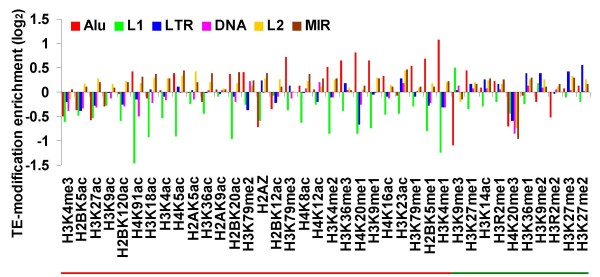
Figure 1
Figure 1
Enrichment or depletion of 38 individual histone modifications in transposable element (TE) families. Log2 normalized ratio of the number of tags of each of the 38 histone modifications located within each TE family over the total number of tags taken as the genomic background is shown. Statistical significance determined by the G test (see Additional file 1, Table S1).
Figure 2
Figure 2
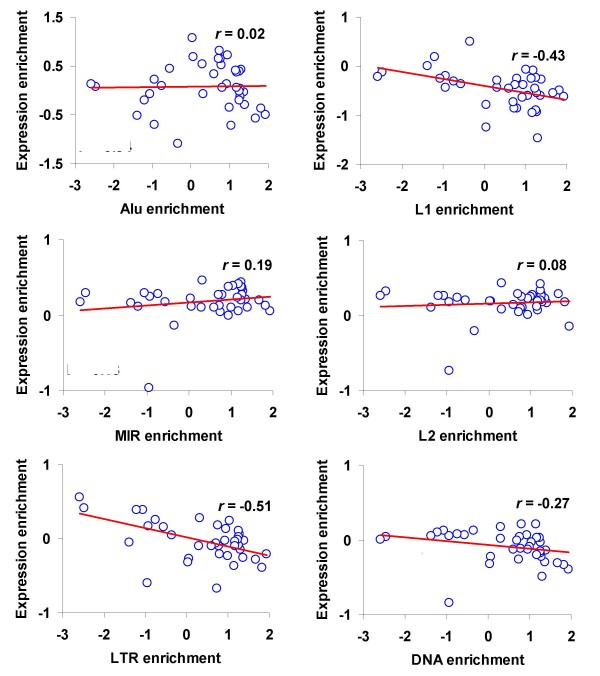
Correlation between enrichment of histone modifications in transposable element (TE) families and for human gene expression. The enrichment of 38 histone modifications in human gene expression (Additional file 1, Figure S2) is plotted against the same in six TE families (Figure 1). See Methods for details and Additional file 1, Table S2 for statistical significance. Pearson correlation coefficient values (r) are shown.
Figure 3
Figure 3
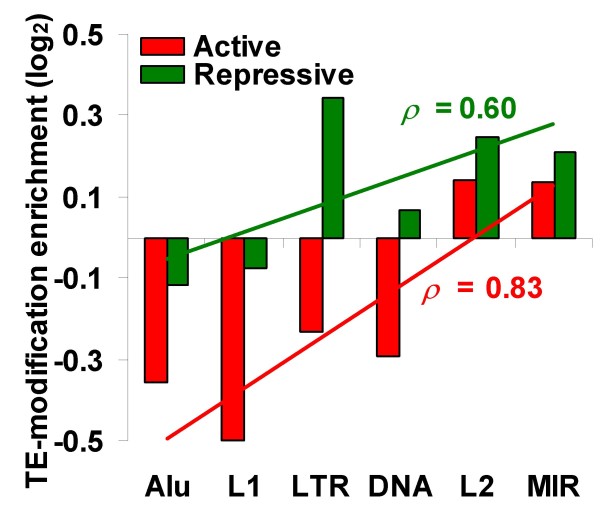
Enrichment or depletion of active and repressive histone modifications in retrotransposons. Histone modifications were classified as active or repressive based on expression enrichment (Additional file 1, Figure S2). The log2 normalized ratios of the number of tags of active or repressive modifications located within each family of retrotransposons over the total number of tags taken as the genomic background is shown. Retrotransposon families are arranged according to their relative ages. Spearman rank correlations (ρ) between active and repressive transposable element (TE)-modification enrichments (depletions) and the relative ages of TE families are shown.
Figure 4
Figure 4
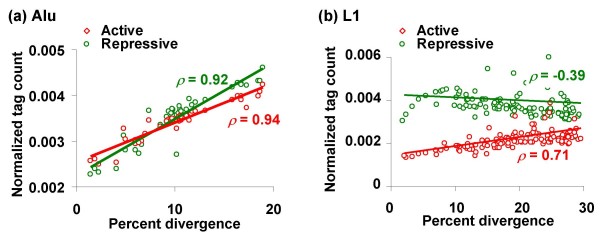
Age of Alu and L1 elements versus their histone modifications. Relative ages of Alu (a) and L1 (b) subfamilies, as determined by divergence from subfamily consensus sequences, are plotted against their respective tag counts normalized by genomic length. Spearman rank correlations (ρ) between tag counts and percent divergence are shown for active (red) and repressive (green) modifications separately (significance values are in Additional file 1, Table S4).
Figure 5
Figure 5
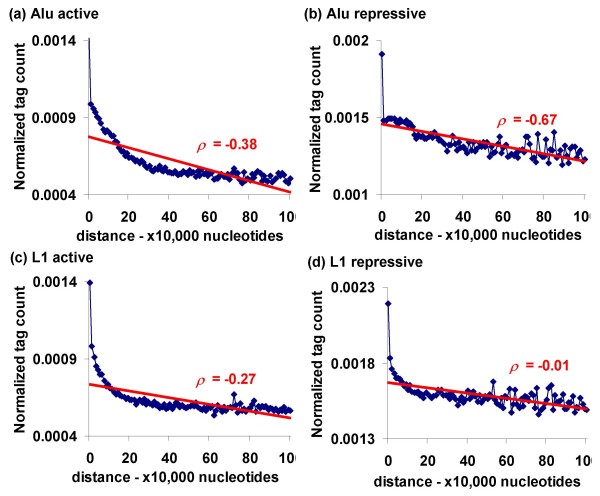
Transposable element (TE) distance from genes versus histone modifications. Distances between Alu (a and b) and L1 (c and d) sequences and the nearest genes are binned in 10 kb bins and plotted against the number of active (a and c) or repressive (b and d) histone modification tags mapped to the TE sequences normalized by their lengths. Spearman rank correlations (ρ) are shown and significance values are in Additional file 1, Table S3.

References

    1. Matzke MA, Mette MF, Matzke AJ. Transgene silencing by the host genome defense: implications for the evolution of epigenetic control mechanisms in plants and vertebrates. Plant Mol Biol. 2000;43:401–415. doi: 10.1023/A:1006484806925. - DOI - PubMed
    1. Lippman Z, Gendrel AV, Black M, Vaughn MW, Dedhia N, McCombie WR, Lavine K, Mittal V, May B, Kasschau KD, Carrington JC, Doerge RW, Colot V, Martienssen R. Role of transposable elements in heterochromatin and epigenetic control. Nature. 2004;430:471–476. doi: 10.1038/nature02651. - DOI - PubMed
    1. McDonald JF, Matzke MA, Matzke AJ. Host defenses to transposable elements and the evolution of genomic imprinting. Cytogenet Genome Res. 2005;110:242–249. doi: 10.1159/000084958. - DOI - PubMed
    1. Yoder JA, Walsh CP, Bestor TH. Cytosine methylation and the ecology of intragenomic parasites. Trends Genet. 1997;13:335–340. doi: 10.1016/S0168-9525(97)01181-5. - DOI - PubMed
    1. Gould SJ, Vrba ES. Exaptation: a missing term in the science of form. Paleobiology. 1982;8:4–15.