


University life and pandemic influenza: attitudes and intended behaviour of staff and students towards pandemic (H1N1) 2009
- PMID: 20226093
- PMCID: PMC2841672
- DOI: 10.1186/1471-2458-10-130
University life and pandemic influenza: attitudes and intended behaviour of staff and students towards pandemic (H1N1) 2009
Abstract
Background: In a pandemic young adults are more likely to be infected, increasing the potential for Universities to be explosive disease outbreak centres. Outbreak management is essential to reduce the impact in both the institution and the surrounding community. Through the use of an online survey, we aimed to measure the perceptions and responses of staff and students towards pandemic (H1N1) 2009 at a major university in Sydney, Australia.
Methods: The survey was available online from 29 June to 30 September 2009. The sample included academic staff, general staff and students of the University.
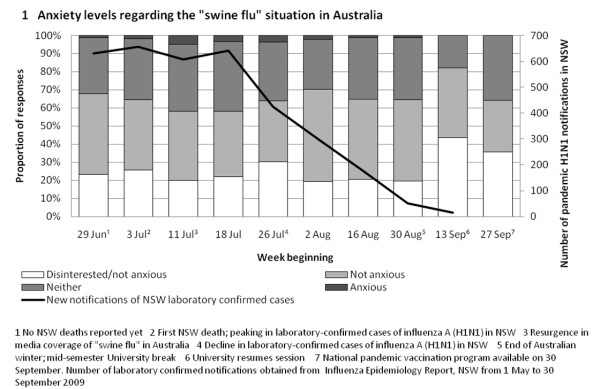
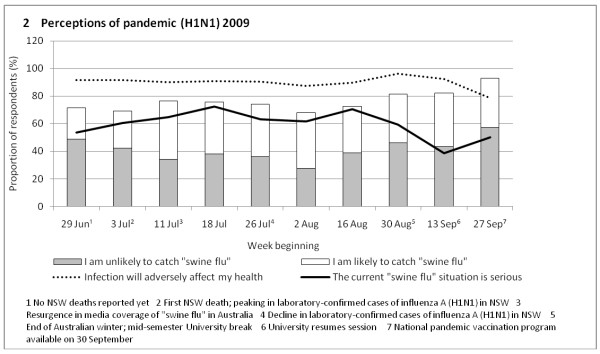
Results: A total of 2882 surveys were completed. Nearly all respondents (99.6%, 2870/2882) were aware of the Australian pandemic situation and 64.2% (1851/2882) reported either "no anxiety" or "disinterest." Asian-born respondents were significantly (p < 0.001) more likely to believe that the pandemic was serious compared to respondents from other regions. 75.9% (2188/2882) of respondents had not made any lifestyle changes as a result of the pandemic. Most respondents had not adopted any specific behaviour change, and only 20.8% (600/2882) had adopted the simplest health behaviour, i.e. hand hygiene. Adoption of a specific behaviour change was linked to anxiety and Asian origin. Students were more likely to attend the university if unwell compared with staff members. Positive responses from students strongly indicate the potential for expanding online teaching and learning resources for continuing education in disaster settings. Willingness to receive the pandemic vaccine was associated with seasonal influenza vaccination uptake over the previous 3 years.
Conclusions: Responses to a pandemic are subject to change in its pre-, early and mid-outbreak stages. Lessons for these institutions in preparation for a second wave and future disease outbreaks include the need to promote positive public health behaviours amongst young people and students.
Figures
References
-
- Australian Government Department of Health and Ageing. Pandemic (H1N1) 2009 Update Bulletin, 13 October 2009. Canberra. 2009.
-
- Australian Department of Health and Ageing. Australian Influenza Surveillance Report No 6. 2010.
-
- Peterson RA. On the Use of College Students in Social Science Research: Insights from a Second-Order Meta-analysis. J Consum Research. 2001;28:450–461. doi: 10.1086/323732. - DOI
-
- CDC Guidance for Responses to Influenza for Institutions of Higher Education during the 2009-2010 Academic Year. http://pandemicflu.gov/professional/school/higheredguidance.html
MeSH terms
Substances
LinkOut - more resources
Full Text Sources
Medical
