


Decoding individual episodic memory traces in the human hippocampus
- PMID: 20226665
- PMCID: PMC2849012
- DOI: 10.1016/j.cub.2010.01.053
Decoding individual episodic memory traces in the human hippocampus
Abstract
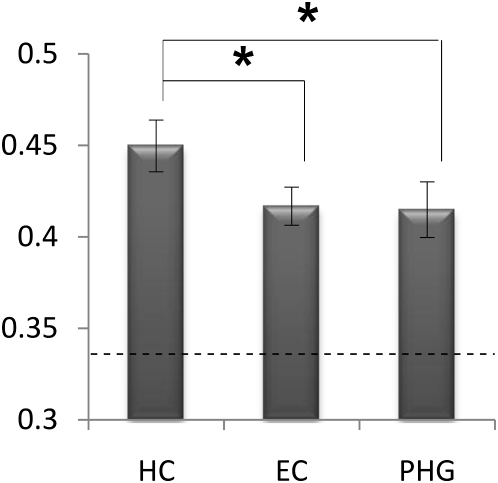
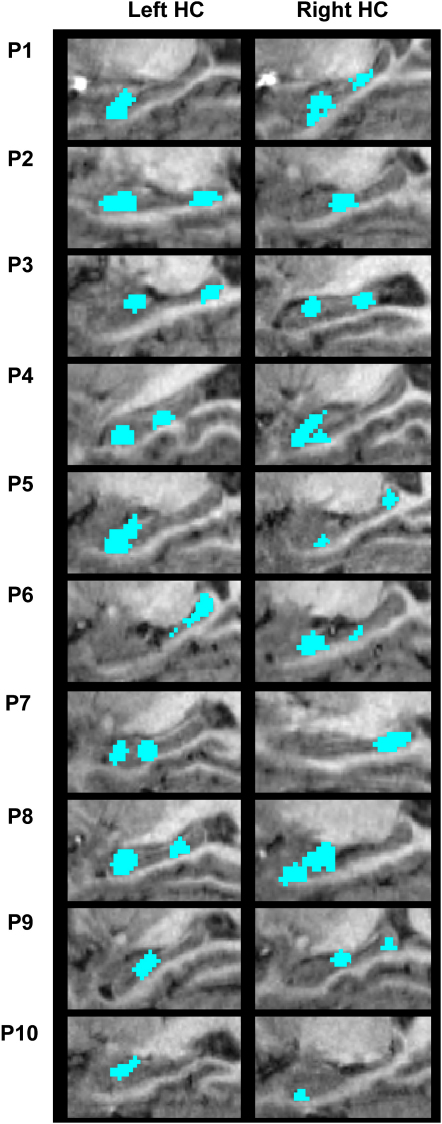
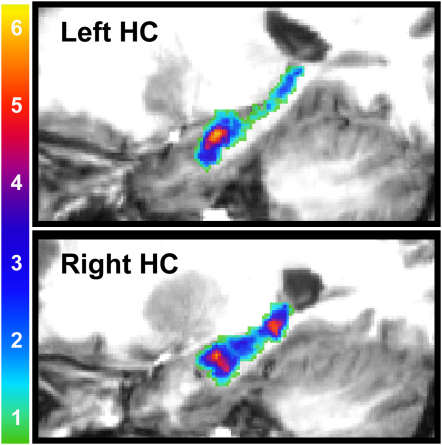
In recent years, multivariate pattern analyses have been performed on functional magnetic resonance imaging (fMRI) data, permitting prediction of mental states from local patterns of blood oxygen-level-dependent (BOLD) signal across voxels. We previously demonstrated that it is possible to predict the position of individuals in a virtual-reality environment from the pattern of activity across voxels in the hippocampus. Although this shows that spatial memories can be decoded, substantially more challenging, and arguably only possible to investigate in humans, is whether it is feasible to predict which complex everyday experience, or episodic memory, a person is recalling. Here we document for the first time that traces of individual rich episodic memories are detectable and distinguishable solely from the pattern of fMRI BOLD signals across voxels in the human hippocampus. In so doing, we uncovered a possible functional topography in the hippocampus, with preferential episodic processing by some hippocampal regions over others. Moreover, our results imply that the neuronal traces of episodic memories are stable (and thus predictable) even over many re-activations. Finally, our data provide further evidence for functional differentiation within the medial temporal lobe, in that we show the hippocampus contains significantly more episodic information than adjacent structures.
2010 Elsevier Ltd. All rights reserved.
Figures
Comment in
-
Brain imaging: decoding your memories.Curr Biol. 2010 Mar 23;20(6):R269-71. doi: 10.1016/j.cub.2010.02.001. Curr Biol. 2010. PMID: 20334832 No abstract available.
References
-
- Norman K.A., Polyn S.M., Detre G.J., Haxby J.V. Beyond mind-reading: Multi-voxel pattern analysis of fMRI data. Trends Cogn. Sci. 2006;10:424–430. - PubMed
-
- Haynes J.D., Rees G. Decoding mental states from brain activity in humans. Nat. Rev. Neurosci. 2006;7:523–534. - PubMed
-
- Semon R. Allen & Unwin; London: 1923. Mnemonic Psychology.
Publication types
MeSH terms
Substances
Grants and funding
LinkOut - more resources
Full Text Sources
Medical
