. 2010 May;38(5):1335-42.
doi: 10.1097/CCM.0b013e3181d99e67.

Toll-like receptor 2 plays a critical role in cardiac dysfunction during polymicrobial sepsis

Affiliations

Toll-like receptor 2 plays a critical role in cardiac dysfunction during polymicrobial sepsis

Lin Zou et al. Crit Care Med. 2010 May.

Abstract

Objective: To determine the role of toll-like receptor 2 in cardiac dysfunction during polymicrobial sepsis.

Design: Controlled animal study.

Setting: University hospital research laboratory.

Subjects: Male C57BL/6, wild-type, toll-like receptor 2-/-.

Intervention: Polymicrobial peritonitis, a clinically relevant model of sepsis, was generated by cecum ligation and puncture. Wild-type and toll-like receptor 2-/- mice were divided into sham and cecum ligation and puncture groups. The sham animals underwent laparotomy but without cecum ligation and puncture. Twenty-four hours after surgeries, the cardiac function was assessed by serial echocardiography in vivo, a pressure transducer catheter was inserted into the left ventricles of isolated hearts (Langendorff model), and in vitro measurement of Ca2+ transients and sarcomere shortening in adult cardiomyocytes were isolated from the sham and septic animals. In addition, myocardial and serum cytokines, blood white blood cell counts, peritoneal neutrophil recruitment, chemokine receptor expression, and survival rates were examined.

Measurements and results: Compared to septic wild-type mice, toll-like receptor 2-/- mice had markedly improved cardiac function during sepsis, as demonstrated by in vivo tissue Doppler imaging, better-preserved left ventricle function in isolated heart, and improved sarcomere shortening measured in single cardiomyocytes. There was also a significant survival benefit in toll-like receptor 2-/- mice compared to wild-type mice. These favorable outcomes in toll-like receptor 2-/- mice were associated with attenuated cardiodepressant cytokine levels in the myocardium and serum and enhanced neutrophil migratory function.

Conclusions: These studies suggest that toll-like receptor 2 signaling plays a critical role in mediating cardiomyopathy, deleterious myocardial and systemic inflammation, and high mortality during polymicrobial sepsis.


Conflict of interest statement

The authors have not disclosed any conflicts of interest.

Figures
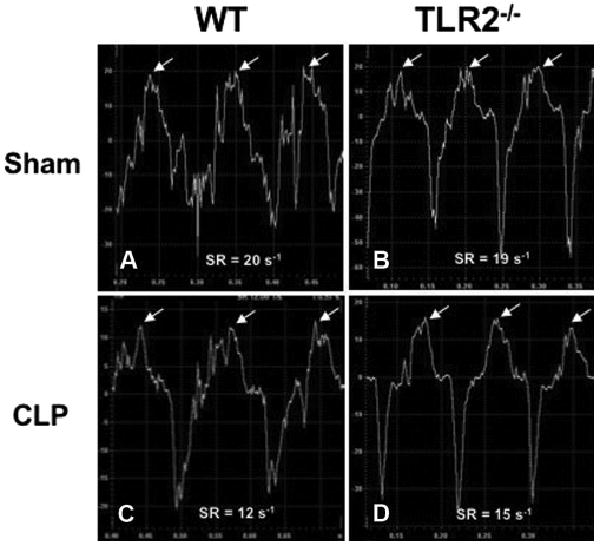
Figure 1
Figure 1
Representative images of strain rate. Wild-type (WT) and toll-like receptor 2 (TLR2)−/− mice were subjected to sham or cecum ligation and puncture (CLP) procedures. Twenty-four hours later, tissue Doppler imaging was performed and strain rate of left ventricle posterior wall was analyzed. Time–strain rate (SR) curve is represented. Peak radial SR is indicated by white arrows.
Figure 2
Figure 2
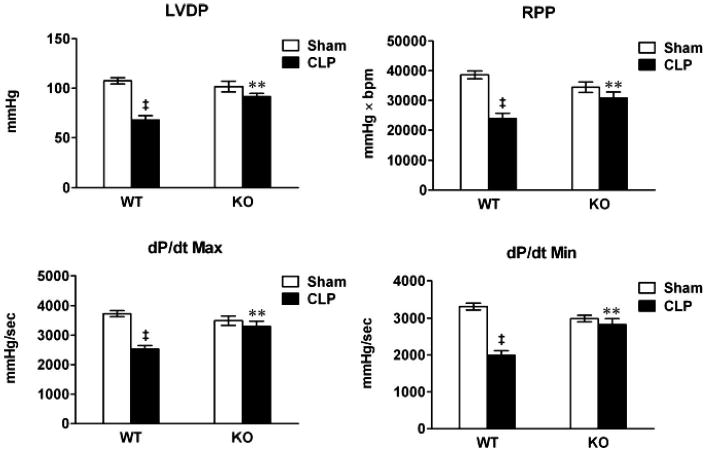
Toll-like receptor 2−/− mice have improved left ventricle function compared to wild-type (WT) after cecum ligation and puncture (CLP) as measured in isolated hearts. WT and toll-like receptor 2−/− mice underwent sham or CLP surgeries. Twenty-four hours later, the hearts were isolated and perfused with cell-free buffer in a Langendorff system. Left ventricle contractile functions were measured as described in Materials and Methods. LVDP, left ventricle developed pressure; RPP, rate pressure product = heart rate × LVDP; dP/dtmax, the maximum first derivative of LVDP; dP/dtmin, the minimum first derivative of LVDP; KO, knockout (toll-like receptor 2−/−). **p < .01 vs. WT CLP; ‡p < .001 vs. WT sham. n = 6–8.
Figure 3
Figure 3
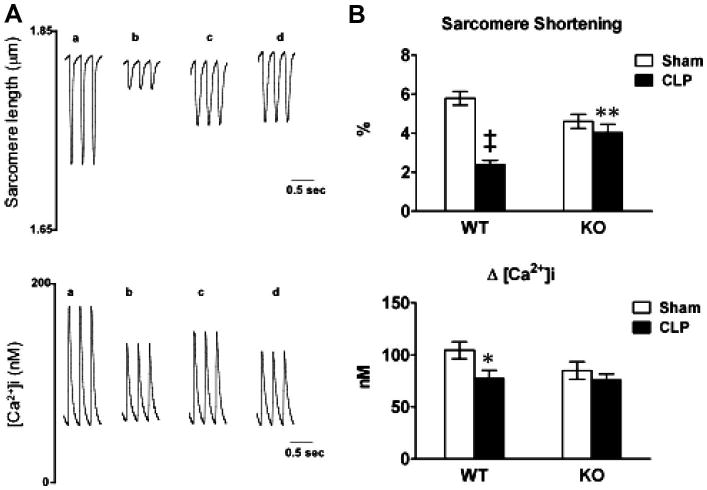
Toll-like receptor 2 (TLR2)−/− mice have improved cardiomyocyte function after polymicrobial sepsis. Wild-type (WT) and TLR2−/− mice underwent sham or cecum ligation and puncture (CLP) procedures. Twenty-four hours later, the hearts were harvested and cardiomyocytes were isolated. A, Representative tracing of sarcomere shortening and Ca2+ transients in cardiomyocytes isolated from WT (a, b) and TLR2−/− (c, d) mice subjected to either sham (a, c) or CLP (b, d) surgeries. B, Accumulated data of sarcomere shortening and Ca2+ transients. Each error bar represents mean ± se. The data in each group were recorded from 16 to 27 single adult cardiomyocytes isolated from more than four mice. * p < .05 vs. WT sham; ** p < .01 vs. WT CLP; ‡p < 0.001 vs. WT sham. KO, knockout (TLR2−/−).
Figure 4
Figure 4
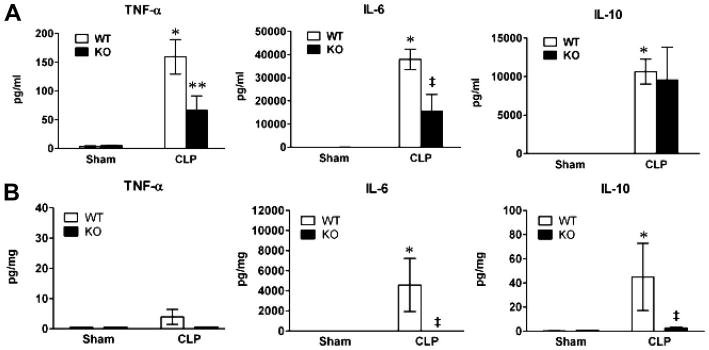
Toll-like receptor 2 (TLR2)−/− mice had attenuated serum and myocardial cytokine levels during polymicrobial sepsis. The two groups of mice, wild-type (WT) and TLR2−/−, underwent sham or cecum ligation and puncture (CLP) procedures. Twenty-four hours later, blood and the hearts were collected. Serum and tissue tumor necrosis factor (TNF)-α, interleukin (IL)-6, and IL-10 were measured with a multiplex fluorescent bead-based immunoassay. A, Serum cytokines. Each error bar represents mean ± se of four to seven mice. *p < .001 vs. WT sham; **p < .05 and ‡p < .01 vs. WT CLP; n = 5–7. B, Myocardial cytokines. The hearts were harvested from a separate set of mice. *p < .05 vs. WT sham; ‡p < .05 vs. WT CLP; n = 5. KO, knockout (TLR2−/−).
Figure 5
Figure 5
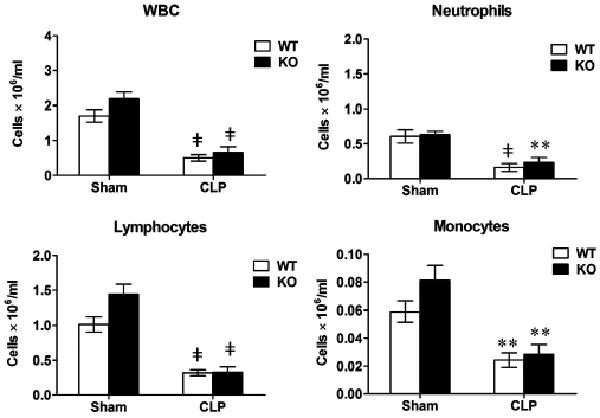
Polymicrobial sepsis leads to severe leucopenia. The two groups of mice, wild-type (WT) and toll-like receptor 2−/−, underwent sham or cecum ligation and puncture (CLP) procedures. Twenty-four hours later, total white blood cells (WBC), neutrophils, lymphocytes, and monocytes were counted. Each error bar represents mean ± se of six to nine mice. **p < .01; ‡p < .001 vs. the sham mice. KO, knockout (toll-like receptor 2−/−).
Figure 6
Figure 6
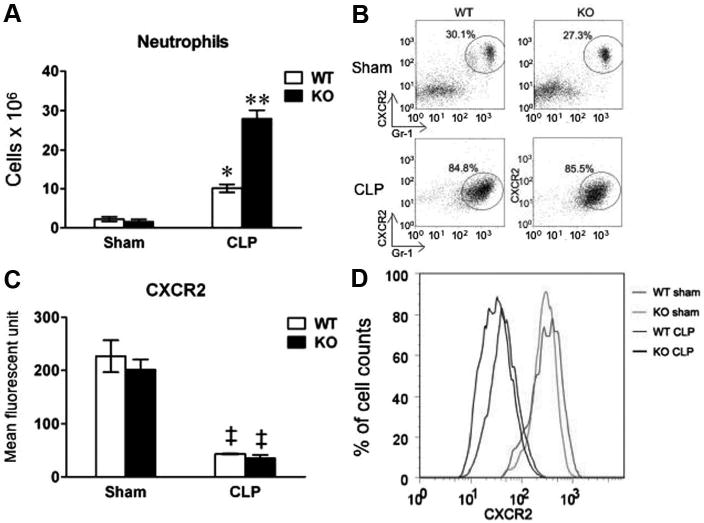
Peritoneal neutrophil recruitment and chemokine expression after cecum ligation and puncture (CLP). Mice underwent sham or CLP procedures. Twenty-four hours later, peritoneal cells were harvested from lavage fluid and manually counted. The same numbers of cells (5 × 10⁵) from each mouse were loaded for fluorescence-activated cell-sorting (FACS) analysis. A, Total peritoneal neutrophils in the peritoneum. Neutrophil numbers were calculated based on the total cells numbers manually counted multiplied by the percentage of neutrophils as measured by FACS. Each error bar represents mean ± se of four mice. *p < .05 vs. the sham mice; **p = .001 vs. wild-type (WT) CLP. B, A representative example of FACS plots of peritoneal neutrophils from WT and toll-like receptor 2 (TLR2)−/− mice. The cells were gated on CXCR2 (chemokine receptor) and GR-1 (neutrophil marker). The cells within the circle represent neutrophils. The percentage of neutrophils is shown. C, CXCR2 expression on neutrophils recruited to the peritoneum in WT and TLR2−/− mice. Each error bar represents mean ± se of four mice. ‡p < .001 vs. the sham mice. D, A representative example of FACS of neutrophil CXCR2 expression in WT sham (red), TLR2−/− sham (green), WT CLP (blue), and TLR2−/− CLP mice (black). KO, knockout (TLR2−/−).
Figure 7
Figure 7
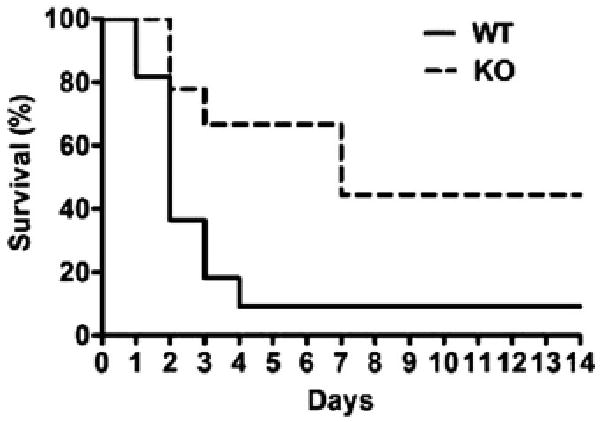
Impact of toll-like receptor 2 (TLR2) deficiency on the mouse mortality after cecum ligation and puncture. Survival rate of wild-type (WT) and TLR2−/− mice were recorded up to 14 days after cecum ligation and puncture. WT, n = 11; TLR2−/−, n = 9. p < .05. KO, knockout (TLR2−/−).

Comment in

References

    1. Angus DC, Linde-Zwirble WT, Lidicker J, et al. Epidemiology of severe sepsis in the United States: Analysis of incidence, outcome, and associated costs of care. Crit Care Med. 2001;29:1303–1310. - PubMed
    1. Dombrovskiy VY, Martin AA, Sunderram J, et al. Rapid increase in hospitalization and mortality rates for severe sepsis in the United States: A trend analysis from 1993 to 2003. Crit Care Med. 2007;35:1244–1250. - PubMed
    1. Hotchkiss RS, Karl IE. The pathophysiology and treatment of sepsis. N Engl J Med. 2003;348:138–150. - PubMed
    1. Parrillo JE. Pathogenetic mechanisms of septic shock. N Engl J Med. 1993;328:1471–1477. - PubMed
    1. Flierl MA, Rittirsch D, Huber-Lang MS, et al. Molecular events in the cardiomyopathy of sepsis. Mol Med. 2008;14:327–336. - PMC - PubMed

Publication types

MeSH terms