


Individual differences in the rejection-aggression link in the hot sauce paradigm: The case of Rejection Sensitivity
- PMID: 20228947
- PMCID: PMC2836513
- DOI: 10.1016/j.jesp.2007.07.004
Individual differences in the rejection-aggression link in the hot sauce paradigm: The case of Rejection Sensitivity
Abstract
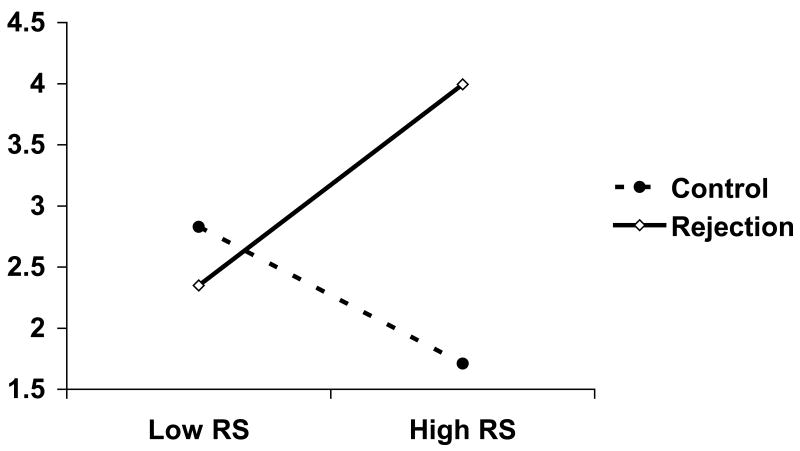
Prior research shows that social rejection elicits aggression. In this study, we investigated whether this is moderated by individual differences in Rejection Sensitivity (RS) - a processing disposition to anxiously expect, readily perceive and overreact to rejection. Participants (N = 129) took part in a purported web-based social interaction in which they were either rejected or not by a potential partner. Subsequently, they were given the opportunity to allocate hot sauce to the perpetrator, knowing that he/she disliked spicy food. Amount of hot sauce was used as a behavioral index of aggression. Participants in the rejection condition allocated more hot sauce to the perpetrator than those in the control condition. However, RS moderated this effect such that rejection elicited aggression in high but not in low RS people. These results held after controlling for trait neuroticism. Implications of these findings for understanding how and why rejection elicits aggression are discussed.
Figures
References
-
- Aiken LS, West SG. Multiple regression: Testing and interpreting interactions. Thousand Oaks, CA: Sage Publications; 1991.
-
- Ayduk O, Downey G, Testa A, Yen Y, Shoda Y. Does rejection elicit hostility in rejection sensitive women? Social Cognition. 1999;17(2):245–271.
-
- Ayduk O, Downey G, Kim M. Rejection sensitivity and depressive symptoms in women. Personality and Social Psychology Bulletin. 2001;27:868–877.
-
- Ayduk O, May D, Downey G, Higgins T. Tactical differences in coping with rejection sensitivity: The role of prevention pride. Personality and Social Psychology Bulletin. 2003;29(4):435–448. - PubMed
-
- Buckley K, Winkel R, Leary M. Reactions to acceptance and rejection: Effects of level and sequence of relational evaluation. Journal of Experimental Social Psychology. 2004;40(1):14–28.
Grants and funding
LinkOut - more resources
Full Text Sources