Alcohol consumption and workplace absenteeism: the moderating effect of social support
- PMID: 20230073
- PMCID: PMC2903009
- DOI: 10.1037/a0018018
Alcohol consumption and workplace absenteeism: the moderating effect of social support
Erratum in
- J Appl Psychol. 2010 May;95(3):581
Abstract
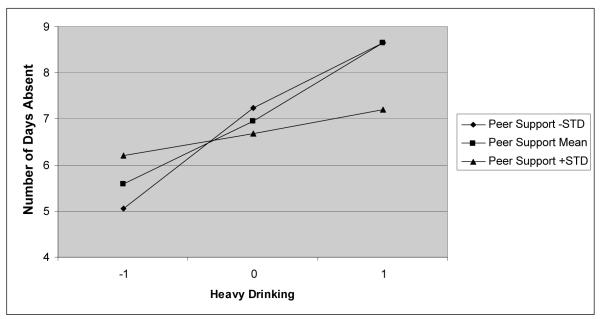
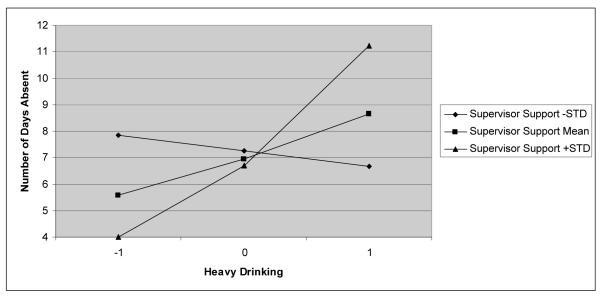
Although it is commonly assumed that alcohol consumption has a significant impact on employee absenteeism, the nature of the alcohol-absence relationship remains poorly understood. Proposing that alcohol impairment likely serves as a key mechanism linking drinking and work absence, we posit that this relationship is likely governed less by the amount of alcohol consumed and more by the way it is consumed. Using a prospective study design and a random sample of urban transit workers, we found that the frequency of heavy episodic drinking over the previous month is positively associated with the number of days of absence recorded in the subsequent 12-month period, whereas modal consumption (a metric capturing the typical amount of alcohol consumed in a given period of time) is not. In addition, consistent with both volitional treatments of absenteeism and social exchange theory, perceived coworker support was found to attenuate, and supervisory support to amplify, the link between the frequency of heavy episodic drinking and absenteeism.
2010 APA, all rights reserved
Figures
References
-
- Aiken LS, West SG. Multiple regression: Testing and interpreting interactions. Sage; Newbury Park, CA: 1991.
-
- Ames GM, Grube JW, Moore RS. The relationship of drinking and hangovers to workplace problems: An empirical study. Journal of Studies on Alcohol. 1997;58:37–47. - PubMed
-
- Ames GM, Grube JW, Moore RS. Social control and workplace drinking norms: A comparison of two organizational cultures. Journal of Studies on Alcohol. 2000;61:203–219. - PubMed
-
- Anderson SE, Williams LJ. Interpersonal, job, and individual factors related to helping processes at work. Journal of Applied Psychology. 1996;81:282–296.
-
- Antony MM, Bieling PJ, Cox BJ, Enns MW, Swinson RP. Psychometric properties of the 42-item and 21-item versions of the Depression Anxiety Stress Scales (DASS) in clinical groups and a community sample. Psychological Assessment. 1998;10:176–181.