Time-dependent inhibition (TDI) of CYP3A4 and CYP2C9 by noscapine potentially explains clinical noscapine-warfarin interaction
- PMID: 20233183
- PMCID: PMC2824481
- DOI: 10.1111/j.1365-2125.2009.03572.x
Time-dependent inhibition (TDI) of CYP3A4 and CYP2C9 by noscapine potentially explains clinical noscapine-warfarin interaction
Abstract
Aims: To investigate the inhibition potential and kinetic information of noscapine to seven CYP isoforms and extrapolate in vivo noscapine-warfarin interaction magnitude from in vitro data.
Methods: The activities of seven CYP isoforms (CYP3A4, CYP1A2, CYP2A6, CYP2E1, CYP2D6, CYP2C9, CYP2C8) in human liver microsomes were investigated following co- or preincubation with noscapine. A two-step incubation method was used to examine in vitro time-dependent inhibition (TDI) of noscapine. Reversible and TDI prediction equations were employed to extrapolate in vivo noscapine-warfarin interaction magnitude from in vitro data.
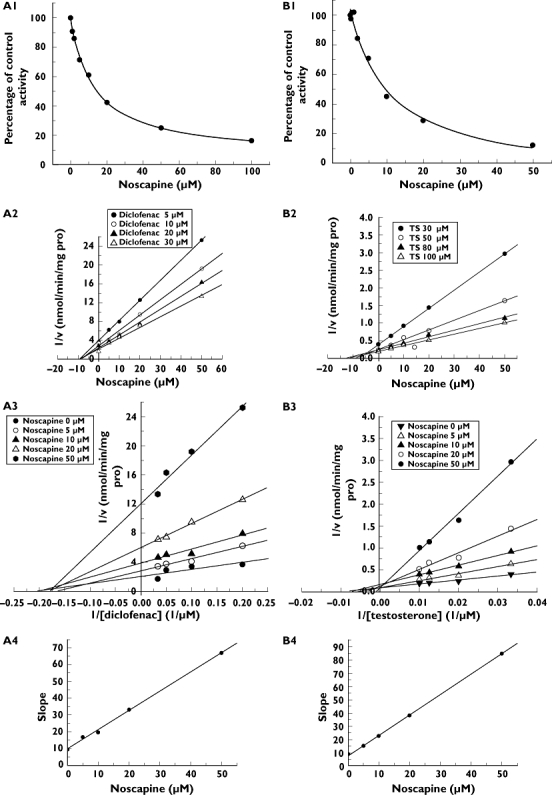
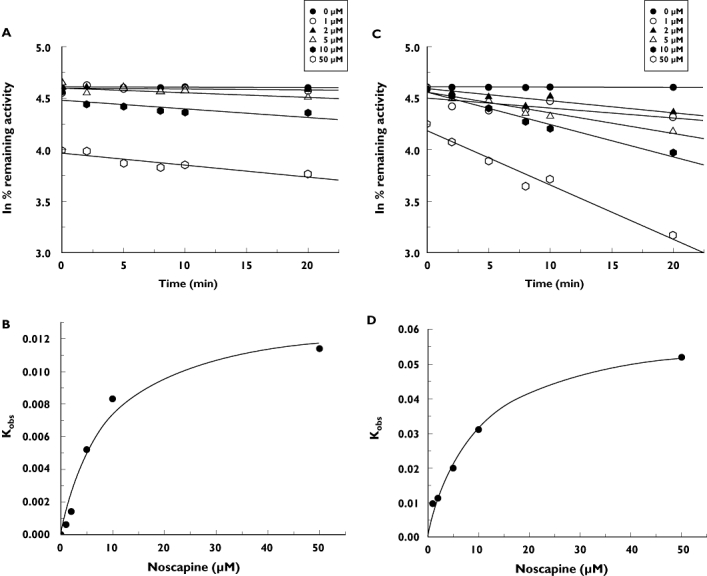
Results: Among seven CYP isoforms tested, the activities of CYP3A4 and CYP2C9 were strongly inhibited with an IC(50) of 10.8 +/- 2.5 microm and 13.3 +/- 1.2 microm. Kinetic analysis showed that inhibition of CYP2C9 by noscapine was best fit to a noncompetitive type with K(i) value of 8.8 microm, while inhibition of CYP3A4 by noscapine was best fit to a competitive manner with K(i) value of 5.2 microm. Noscapine also exhibited TDI to CYP3A4 and CYP2C9. The inactivation parameters (K(I) and k(inact)) were calculated to be 9.3 microm and 0.06 min(-1) for CYP3A4 and 8.9 microm and 0.014 min(-1) for CYP2C9, respectively. The AUC of (S)-warfarin and (R)-warfarin was predicted to increase 1.5% and 1.1% using C(max) or 0.5% and 0.4% using unbound C(max) with reversible inhibition prediction equation, while the AUC of (S)-warfarin and (R)-warfarin was estimated to increase by 110.9% and 48.9% using C(max) or 41.8% and 32.7% using unbound C(max) with TDI prediction equation.
Conclusions: TDI of CYP3A4 and CYP2C9 by noscapine potentially explains clinical noscapine-warfarin interaction.
Figures
References
-
- Empey DW, Laitinen LA, Young GA, Bye CE, Hughes DTD. Comparison of the antitussive effects of codeine phosphate 20 mg, dextromethorphan 30 mg and noscapine 30 mg using citric acid-induced cough in normal subjects. Eur J Clin Pharmacol. 1979;16:393–7. - PubMed
-
- Landen JW, Han V, Wang MS, Davis T, Ciliax B, Wainer BH, Van Meir EG, Glass JD, Joshi HC, Archer DR. Noscapine crosses the blood–brain barrier and inhibits glioblastoma growth. Clin Cancer Res. 2004;10:5187–201. - PubMed
-
- Aneja R, Dhiman N, Idnani J, Awasthi A, Arora SK, Chandra R, Joshi HC. Preclinical pharmacokinetics and bioavailability of noscapine, a tubulin-binding anticancer agent. Cancer Chemoth Pharm. 2007;60:831–9. - PubMed
Publication types
MeSH terms
Substances
Grants and funding
LinkOut - more resources
Full Text Sources
Medical
Miscellaneous