Sutures versus staples for skin closure in orthopaedic surgery: meta-analysis
- PMID: 20234041
- PMCID: PMC2840224
- DOI: 10.1136/bmj.c1199
Sutures versus staples for skin closure in orthopaedic surgery: meta-analysis
Abstract
Objective: To compare the clinical outcomes of staples versus sutures in wound closure after orthopaedic surgery.
Design: Meta-analysis.
Data sources: Medline, CINAHL, AMED, Embase, Scopus, and the Cochrane Library databases were searched, in addition to the grey literature, in all languages from 1950 to September 2009. Additional studies were identified from cited references. Selection criteria Two authors independently assessed papers for eligibility. Included studies were randomised and non-randomised controlled trials that compared the use of staples with suture material for wound closure after orthopaedic surgery procedures. All studies were included, and publications were not excluded because of poor methodological quality. Review methods Two authors independently reviewed studies for methodological quality and extracted data from each paper. Final data for analysis were collated through consensus. The primary outcome measure was the assessment of superficial wound infection after wound closure with staples compared with sutures. Relative risk and mean difference with 95% confidence intervals were calculated and pooled with a random effects model. Heterogeneity was assessed with I(2) and chi(2) statistical test.
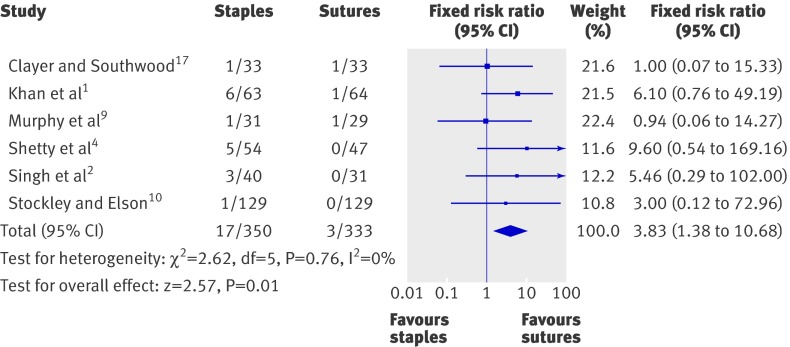
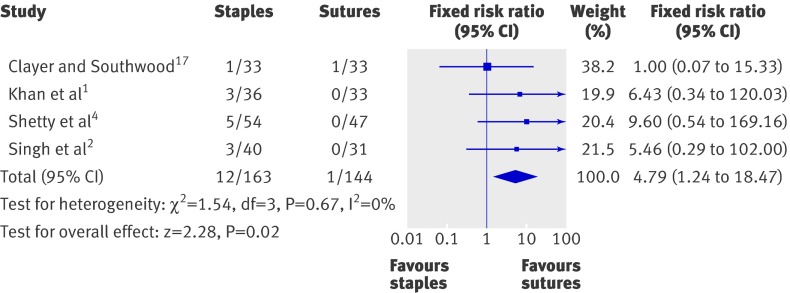
Results: Six papers, which included 683 wounds, were identified; 332 patients underwent suture closure and 351 staple closure. The risk of developing a superficial wound infection after orthopaedic procedures was over three times greater after staple closure than suture closure (relative risk 3.83, 95% confidence interval 1.38 to 10.68; P=0.01). On subgroup analysis of hip surgery alone, the risk of developing a wound infection was four times greater after staple closure than suture closure (4.79, 1.24 to 18.47; P=0.02). There was no significant difference between sutures and staples in the development of inflammation, discharge, dehiscence, necrosis, and allergic reaction. The included studies had several major methodological limitations, including the recruitment of small, underpowered cohorts, poorly randomising patients, and not blinding assessors to the allocated methods of wound closure. Only one study had acceptable methodological quality.
Conclusions: After orthopaedic surgery, there is a significantly higher risk of developing a wound infection when the wound is closed with staples rather than sutures. This risk is specifically greater in patients who undergo hip surgery. The use of staples for closing hip or knee surgery wounds after orthopaedic procedures cannot be recommended, though the evidence comes from studies with substantial methodological limitations. Though we advise orthopaedic surgeons to reconsider their use of staples for wound closure, definitive randomised trials are still needed to assess this research question.
Conflict of interest statement
Competing interests: None declared.
Figures


Comment in
-
Staples for skin closure in surgery.BMJ. 2010 Mar 16;340:c403. doi: 10.1136/bmj.c403. BMJ. 2010. PMID: 20234048 No abstract available.
-
Sutures v staples. More research needed.BMJ. 2010 May 18;340:c2625. doi: 10.1136/bmj.c2625. BMJ. 2010. PMID: 20483931 No abstract available.
-
Sutures v staples. Let's add three other studies.BMJ. 2010 May 18;340:c2627. doi: 10.1136/bmj.c2627. BMJ. 2010. PMID: 20483932 No abstract available.
-
Sutures versus staples. Conclusions are uncertain.BMJ. 2010 May 18;340:c2628. doi: 10.1136/bmj.c2628. BMJ. 2010. PMID: 20483933 No abstract available.
-
Sutures v staples. More methodological concerns.BMJ. 2010 May 18;340:c2630. doi: 10.1136/bmj.c2630. BMJ. 2010. PMID: 20483934 No abstract available.
-
Sutures v staples. Some troubles with staples.BMJ. 2010 May 18;340:c2633. doi: 10.1136/bmj.c2633. BMJ. 2010. PMID: 20483936 No abstract available.
-
Risk of wound infection is greater after skin closure with staples than with sutures in orthopaedic surgery.J Bone Joint Surg Am. 2010 Nov 17;92(16):2732. doi: 10.2106/JBJS.9216.ebo818. J Bone Joint Surg Am. 2010. PMID: 21084584 No abstract available.
References
-
- Khan RJK, Fick D, Yao F, Tang K, Hurworth M, Nivbrant B, et al. A comparison of three methods of wound closure following arthroplasty. A prospective, randomised controlled trial. J Bone Joint Surg 2006;88-B:238-42. - PubMed
-
- Singh B, Mowbray MAS, Nunn G, Mearns S. Closure of hip wound, clips or subcuticular sutures: does it make a difference? Eur J Orthop Surg Traumatol 2006;16:124-9. - PubMed
-
- Livesey C, Wylde V, Descamps S, Estela CM, Bannister GC, Learmonth ID, et al. Skin closure after total hip replacement: a randomised controlled trial of skin adhesive versus surgical staples. J Bone Joint Surg 2009;91-B:725-9. - PubMed
-
- Shetty AA, Kumar VS, Morgan-Hough C, Georgeu GA, James KD, Nicholl JE. Comparing wound complication rates following closure of hip wounds with metallic skin staples or subcuticular vicryl suture: a prospective trial. J Orthop Surg 2004;12:191-3. - PubMed
-
- Saleh K, Olson M, Resig S, Bershadsky B, Kuskowski M, Gioe T, et al. Predictors of wound infection in hip and knee joint replacement: results from a 20 year surveillance program. J Orthop Res 2002;20:506-15. - PubMed
Publication types
MeSH terms
LinkOut - more resources
Full Text Sources
Medical