


Cost of inbreeding in resistance to herbivores in Datura stramonium
- PMID: 20237119
- PMCID: PMC2859913
- DOI: 10.1093/aob/mcq038
Cost of inbreeding in resistance to herbivores in Datura stramonium
Abstract
Background and aims: Experiments show that inbred progenies are frequently more damaged by herbivores than outcrossed progenies, suggesting that selfing is costly when herbivores are present and can increase the magnitude of inbreeding depression in survival and reproductive components of fitness. The present study assesses whether inbreeding increases herbivory and estimates the magnitude of inbreeding depression on reproductive components of fitness in the annual plant Datura stramonium.
Methods: Two experiments were performed under natural conditions of herbivory to assess the effect of inbreeding on plant damage in D. stramonium. In the first experiment, outcrossed progeny was generated using foreign pollen donors, whereas inbred progeny was produced by self-pollination. In both groups, survival, herbivore damage and reproductive components of fitness were measured. In the second experiment, inbred and outcrossed progenies were produced using only local pollen donors, and only damage by herbivores was measured.
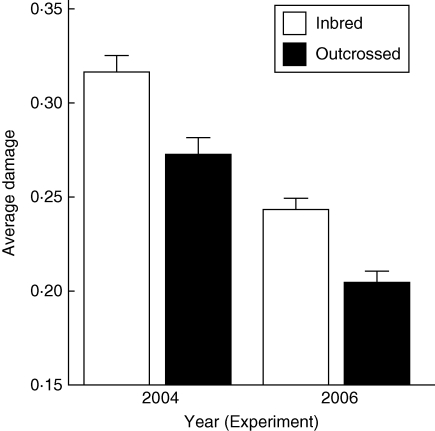
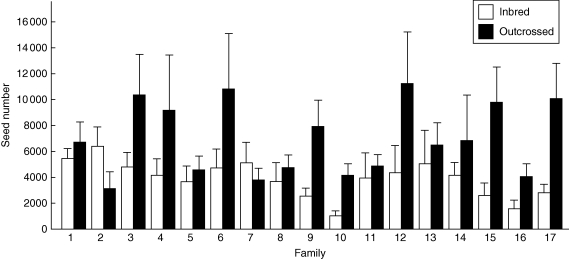
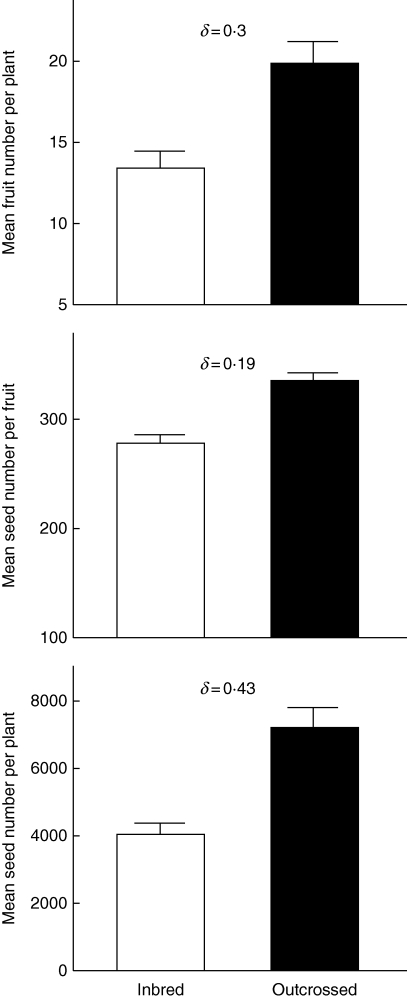
Key results: Despite yearly variation in damage caused by the same specialist herbivores, inbred progeny suffered consistently more damage than outcrossed progeny. There was a significant inbreeding depression for fruit number (delta = 0.3), seed number per fruit (delta = 0.19) and seed number per plant (delta = 0.43). Furthermore, significant genetic variation amongst families in the magnitude of inbreeding depression was observed.
Discussion: The results suggest that the plant's mating system modified the pattern of herbivory by specialist insects in D. stramonium. Inbred plants suffer not only from the genetic cost of low vigour but also from greater damage by herbivores. The mechanism by which inbreeding reduces plant resistance to herbivores remains unknown but is an interesting area for future research.
Figures
References
-
- Armbruster P, Reed DH. Inbreeding depression in benign and stressful environments. Heredity. 2005;95:235–242. - PubMed
-
- Botham R, Collin CL, Ashman TL. Plant–mycorrhizal fungus interactions affect the expression of inbreeding depression in wild strawberry. International Journal of Plant Sciences. 2009;170:143–150.
-
- Byers D, Waller DM. Do plant populations purge their genetic load? Effects of population size and mating history on inbreeding depression. Annual Review of Ecology and Systematics. 1999;30:479–513.
-
- Carr DE, Eubanks MD. Inbreeding alters resistance to insect herbivory and host plant quality in Mimulus guttatus (Scrophulariaceae) Evolution. 2002;56:22–30. - PubMed
