


Multigenerational interstitial growth of biological tissues
- PMID: 20238138
- PMCID: PMC2970697
- DOI: 10.1007/s10237-010-0205-y
Multigenerational interstitial growth of biological tissues
Abstract
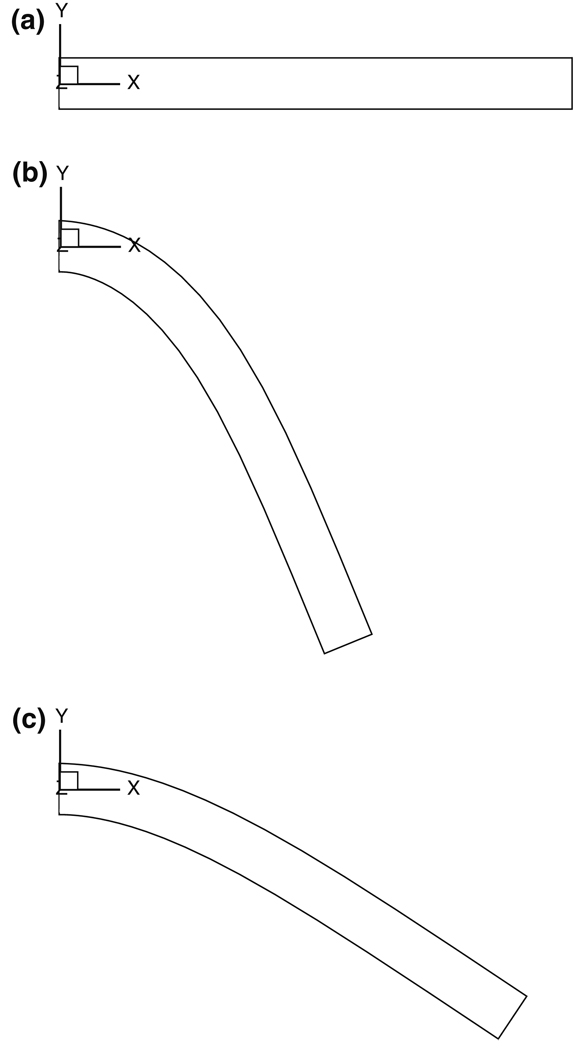
This study formulates a theory for multigenerational interstitial growth of biological tissues whereby each generation has a distinct reference configuration determined at the time of its deposition. In this model, the solid matrix of a growing tissue consists of a multiplicity of intermingled porous permeable bodies, each of which represents a generation, all of which are constrained to move together in the current configuration. Each generation's reference configuration has a one-to-one mapping with the master reference configuration, which is typically that of the first generation. This mapping is postulated based on a constitutive assumption with regard to that generations' state of stress at the time of its deposition. For example, the newly deposited generation may be assumed to be in a stress-free state, even though the underlying tissue is in a loaded configuration. The mass content of each generation may vary over time as a result of growth or degradation, thereby altering the material properties of the tissue. A finite element implementation of this framework is used to provide several illustrative examples, including interstitial growth by cell division followed by matrix turnover.
Figures


References
-
- Biot M. Mechanics of deformation and acoustic propagation in porous media. J Appl Phys. 1962;33(4):1482–1498.
-
- Biot MA. Theory of finite deformations of porous solids. Indiana U Math J. 1972;21(7):597–620.
-
- Bowen RM. Thermochemistry of reacting materials. J Chem Phys. 1968;49(4):1625–1637.
Publication types
MeSH terms
Grants and funding
LinkOut - more resources
Full Text Sources
Other Literature Sources
