


Vitrectomy outcomes in eyes with diabetic macular edema and vitreomacular traction
- PMID: 20299105
- PMCID: PMC2911350
- DOI: 10.1016/j.ophtha.2009.10.040
Vitrectomy outcomes in eyes with diabetic macular edema and vitreomacular traction
Abstract
Purpose: To evaluate vitrectomy for diabetic macular edema (DME) in eyes with at least moderate vision loss and vitreomacular traction.
Design: Prospective cohort study.
Participants: The primary cohort included 87 eyes with DME and vitreomacular traction based on investigator's evaluation, visual acuity 20/63-20/400, optical coherence tomography (OCT) central subfield >300 microns and no concomitant cataract extraction at the time of vitrectomy.
Methods: Surgery was performed according to the investigator's usual routine. Follow-up visits were performed after 3 months, 6 months (primary end point), and 1 year.
Main outcome measures: Visual acuity, OCT retinal thickening, and operative complications.
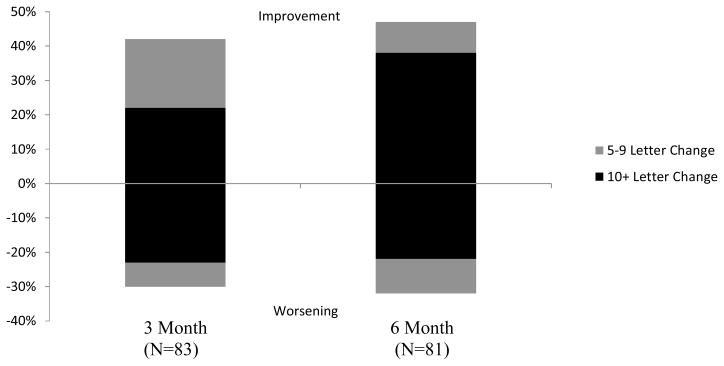
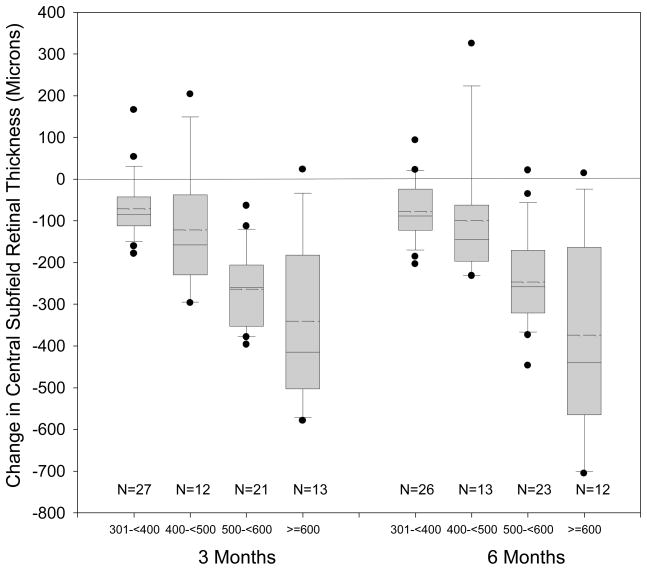
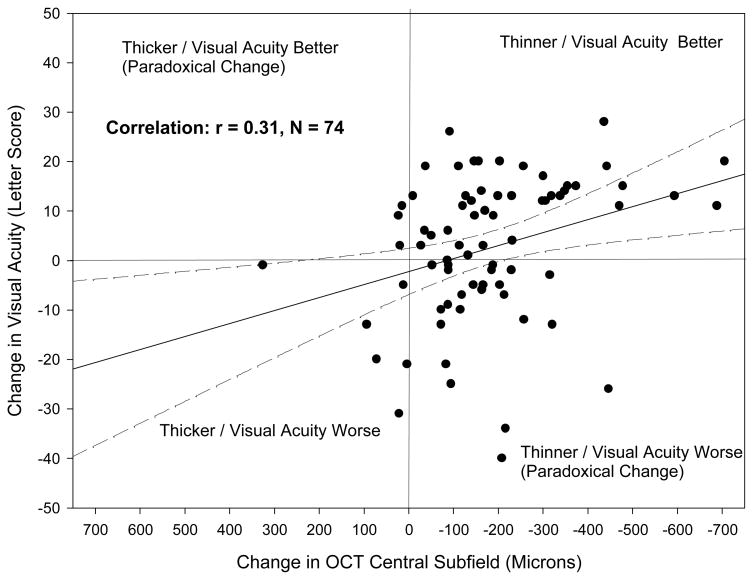
Results: At baseline, median visual acuity in the 87 eyes was 20/100 and median OCT thickness was 491 microns. During vitrectomy, additional procedures included epiretinal membrane peeling in 61%, internal limiting membrane peeling in 54%, panretinal photocoagulation in 40%, and injection of corticosteroids at the close of the procedure in 64%. At 6 months, median OCT central subfield thickness decreased by 160 microns, with 43% having central subfield thickness <250 microns and 68% having at least a 50% reduction in thickening. Visual acuity improved by > or =10 letters in 38% (95% confidence interval, 28%-49%) and deteriorated by > or =10 letters in 22% (95% confidence interval, 13%-31%). Postoperative complications through 6 months included vitreous hemorrhage (5 eyes), elevated intraocular pressure requiring treatment (7 eyes), retinal detachment (3 eyes), and endophthalmitis (1 eye). Few changes in results were noted between 6 months and 1 year.
Conclusions: After vitrectomy performed for DME and vitreomacular traction, retinal thickening was reduced in most eyes. Between 28% and 49% of eyes with characteristics similar to those included in this study are likely to have improvement of visual acuity, whereas between 13% and 31% are likely to have worsening. The operative complication rate is low and similar to what has been reported for this procedure. These data provide estimates of surgical outcomes and serve as a reference for future studies that might consider vitrectomy for DME in eyes with at least moderate vision loss and vitreomacular traction.
Copyright 2010 American Academy of Ophthalmology. Published by Elsevier Inc. All rights reserved.
Conflict of interest statement
Conflicts of interest statement: A complete list of all DRCR.net investigator financial disclosures can be found at
Figures
Comment in
-
Vitrectomy for diabetic macular edema.Ophthalmology. 2010 Nov;117(11):2235-6. doi: 10.1016/j.ophtha.2010.05.013. Ophthalmology. 2010. PMID: 20970013 No abstract available.
References
-
- Aiello LP, Bursell SE, Clermont A, et al. Vascular endothelial growth factor-induced retinal permeability is mediated by protein kinase C in vivo and suppressed by an orally effective beta-isoform-selective inhibitor. Diabetes. 1997;46:1473–80. - PubMed
-
- Klein R, Klein BE, Moss SE, Cruickshanks KJ. The Wisconsin epidemiologic study of diabetic retinopathy. XV. The long-term incidence of macular edema. Ophthalmology. 1995;102:7–16. - PubMed
-
- Moss SE, Klein R, Klein BE. Ten-year incidence of visual loss in a diabetic population. Ophthalmology. 1994;101:1061–70. - PubMed
-
- Moss S, Klein R, Klein B. The 14-year incidence of visual loss in a diabetic population. Ophthalmology. 1998;105:998–1003. - PubMed
Publication types
MeSH terms
Grants and funding
LinkOut - more resources
Full Text Sources
Other Literature Sources
Medical
