. 2008 Jul;1(2):93-100.
doi: 10.4103/0974-2069.43873.

Tetralogy of Fallot: Current surgical perspective

Affiliations

Tetralogy of Fallot: Current surgical perspective

Tom R Karl. Ann Pediatr Cardiol. 2008 Jul.

Abstract

Tetralogy of Fallot (TOF) is an important lesion for all pediatric and congenital heart surgeons. In designing the most appropriate operation for children with TOF, the postoperative physiology should be taken into account, both in the short and long term. The balance between pulmonary stenosis (PS) and pulmonary insufficiency (PI) may be critical for preservation of ventricular function. A unified repair strategy that limits both residual PS and PI is presented, along with supporting experimental evidence, a strategy for dealing with coronary anomalies, and comments regarding best timing of operation.

Keywords: Right ventricular function; residual pulmonary incompetence; residual right ventricular outflow obstruction.


Conflict of interest statement

Conflict of Interest: None declared

Figures

Figure 1
Figure 1
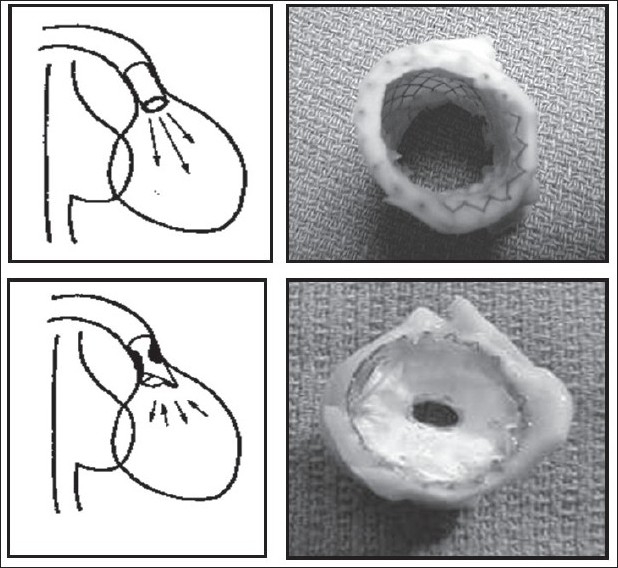
Creation of a chronic porcine model of PI (upper frames) and combined PS/PI (lower frames), achieved with percutaneous delivery of transannular stents (with and without a PTFE diaphragm) into the RVOTO (from Kuehne et al, 2005, used by permission)
Figure 2
Figure 2
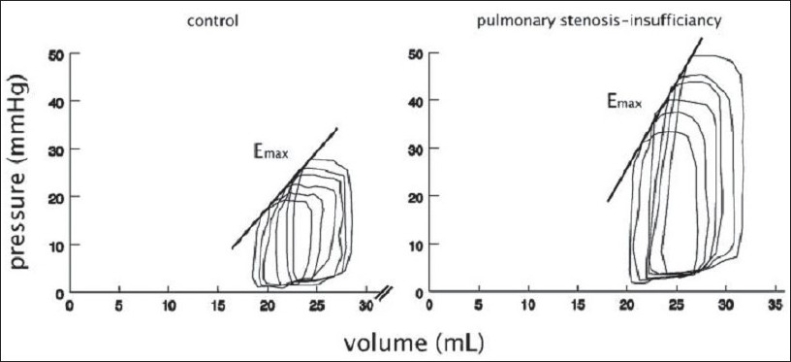
Representative right ventricular pressure-volume loop of a pig with combined pulmonary stenosis and insufficiency and a control animal (measured at rest) at 3 month follow-up. Emax, slope of end-diastolic pressure-volume relation. (from Kuehne et al, 2005, used by permission)
Figure 3
Figure 3
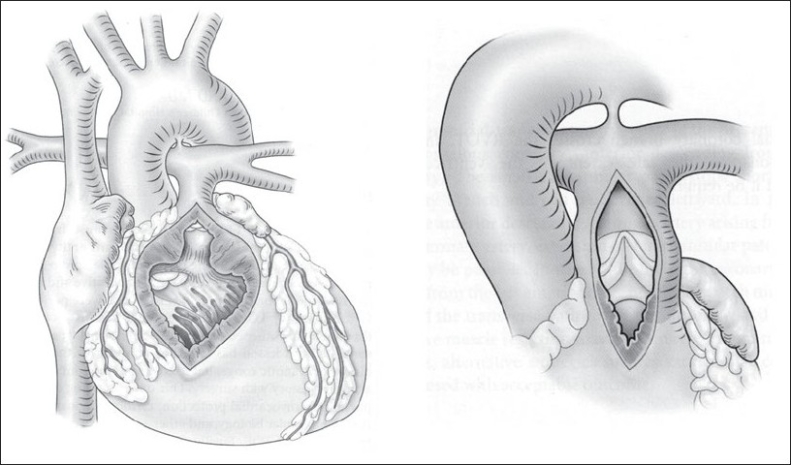
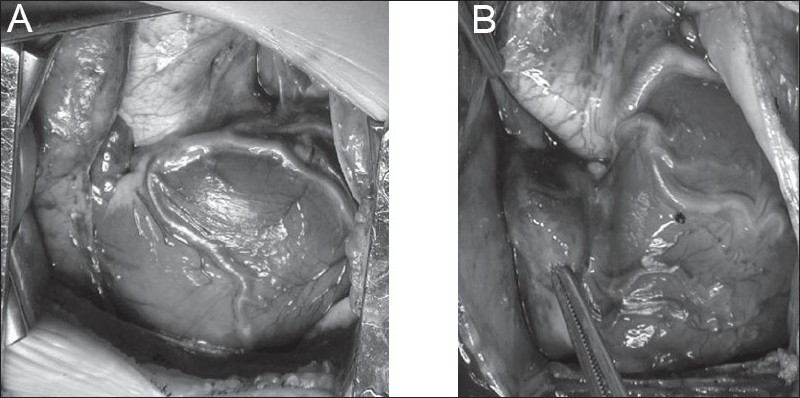
Comparison of the classical transventricular approach (left) and the transatrial-transpulmonary approach (right). In the latter strategy the RV incision is limited to what is required to relieve the RVOTO, with VSD closure and RVOT resection performed via the TV and PA
Figure 4
Figure 4
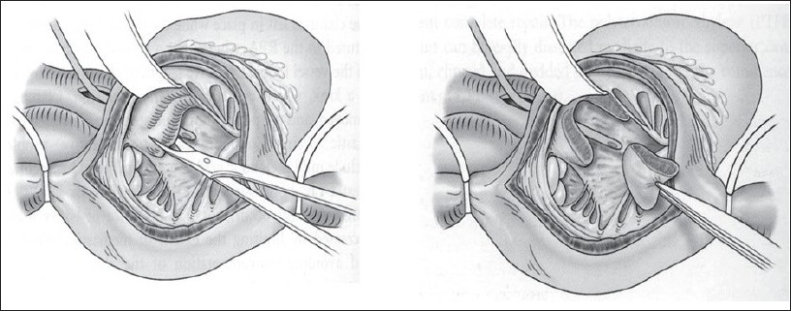
Resection of the parietal extension of the infundibular septum, using a trans tricuspid approach. A Hegar dilator has been passed from the PA into the RV to demonstrate the outlet
Figure 5
Figure 5
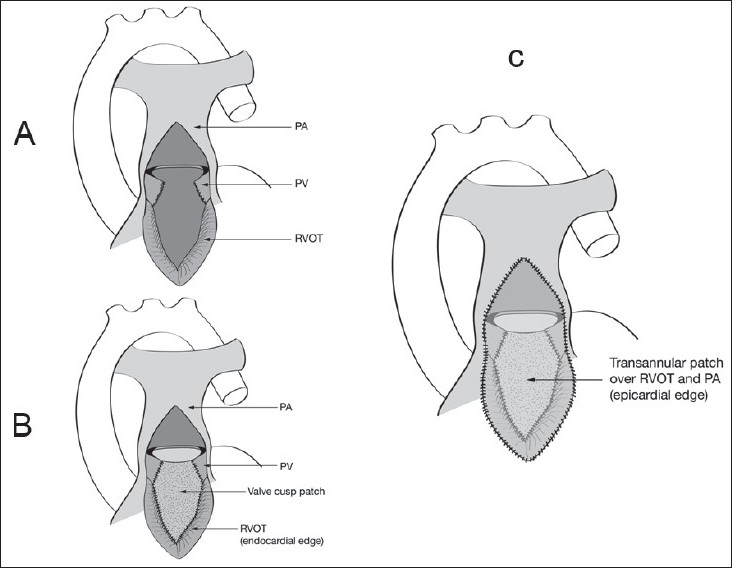
(A) Pulmonary cusp augmentation repair technique. A transannular incision has been created according to calibration of the RVOT diameter (see text). The incision divides the anterior pulmonary valve leaflet, although the exact location will vary with the valve orientation and morphology. (B) Pulmonary cusp augmentation repair technique. A triangular patch of glutaraldehyde-preserved autologous pericardium is sutured to the epicardial edge of the RVOT incision and to the divided edges of the valve leaflet. The leaflet dimensions are based on the caliber of a normal pulmonary valve diameter and should provide sufficient free edge diameter to ensure coaptation with the native valve remnant. (C) Pulmonary cusp augmentation repair technique. A second larger oval patch of the same material is sutured to the epicardial aspect of the RVOT incision and to the edges of the pulmonary arteriotomy, creating a sinus anterior to the reconstructed leaflet
Figure 6
Figure 6
(A) LAD from the RCA, (B) all coronaries arising from the right sinus. Both situations would be problematic for a transventricular repair, but both patients had successful transatrial-transpulmonary repairs
Figure 7
Figure 7
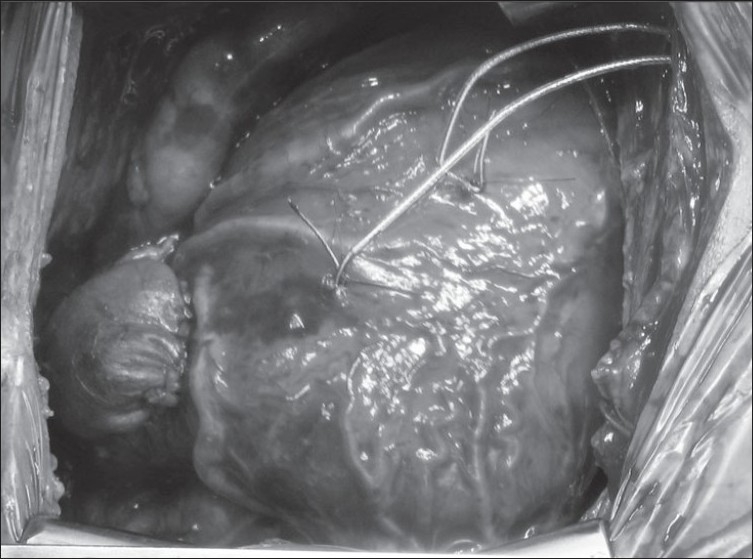
TOF with RCA arising from LAD and crossing the RVOT. A transatrial-transpulmonary repair has been performes with a transannular patch stopping short of the anomalous coronary
Figure 8
Figure 8
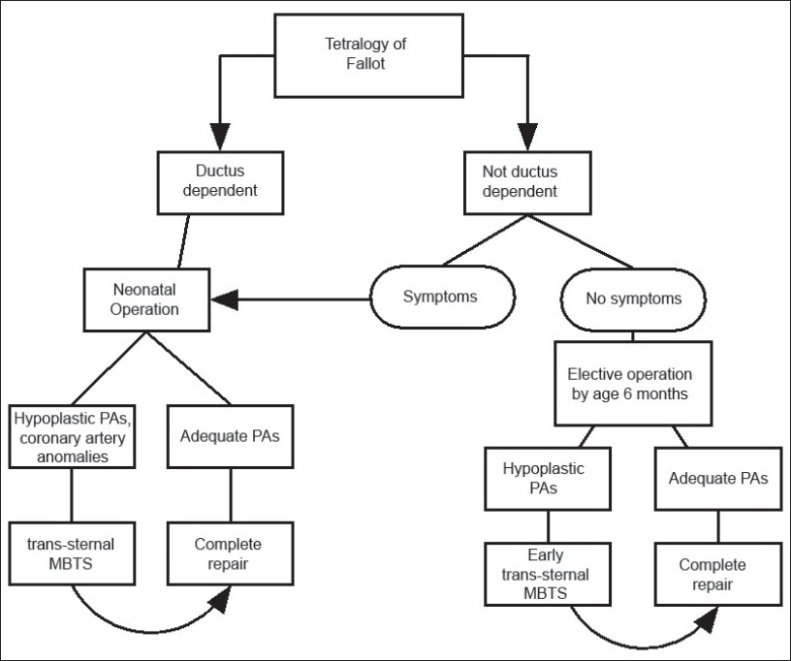
Current protocol for timing of repair for neonates and infants with TOF. In practice, most patients will undergo elective repair by 3-4 months of age, or sooner if indicated clinically. The shunt strategy is reserved for selected cases with unfavorable anatomic features or compromised clinical condition (see text)

References

    1. Knott-Craig CJ, Elkins RC, Lane MM, Holz J, McCue C, Ward KE. A 26-year experience with surgical management of tetralogy of Fallot: Risk analysis for mortality or late reintervention. Ann Thorac Surg. 1998;66:506–11. - PubMed
    1. Nollert G, Fischlein T, Bouterwek S, Böhmer C, Klinner W, Reichart B. Long-term survival in patients with repair of tetralogy of Fallot: 36-year follow-up of 490 survivors of the first year after surgical repair. J Am Coll Cardiol. 1997;30:1374–83. - PubMed
    1. Lillehei CW, Varco RL, Cohen M, Warden HE, Gott VL, DeWall RA, et al. The first open heart corrections of tetralogy of Fallot: A 26-31 year follow-up of 106 patients. Ann Surg. 1986;204:490–502. - PMC - PubMed
    1. Kilner PJ, Balossino R, Dubini G, Babu-Narayan SV, Taylor AM, Pennati G, et al. Pulmonary regurgitation: The effects of varying pulmonary artery compliance, and of increased resistance proximal or distal to the compliance. Int J Cardiol. 2008 Aug 20; [Epub ahead of print] - PubMed
    1. Hon J, Steendijk P, Khan H, Wong K, Yacoub M. Acute effects of pulmonary artery banding in sheep on right ventricle pressure-volume relations: Relevance to the arterial switch operation. Acta Physiol Scand. 2001;172:97–106. - PubMed