


Left hand, but not right hand, reaching is sensitive to visual context
- PMID: 20300930
- PMCID: PMC2862955
- DOI: 10.1007/s00221-010-2214-6
Left hand, but not right hand, reaching is sensitive to visual context
Abstract
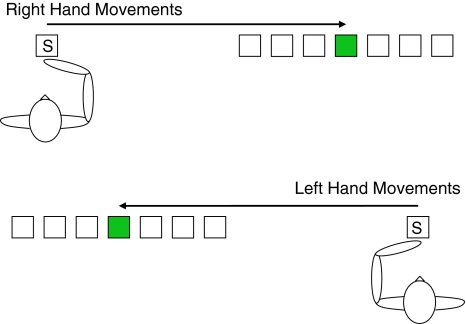
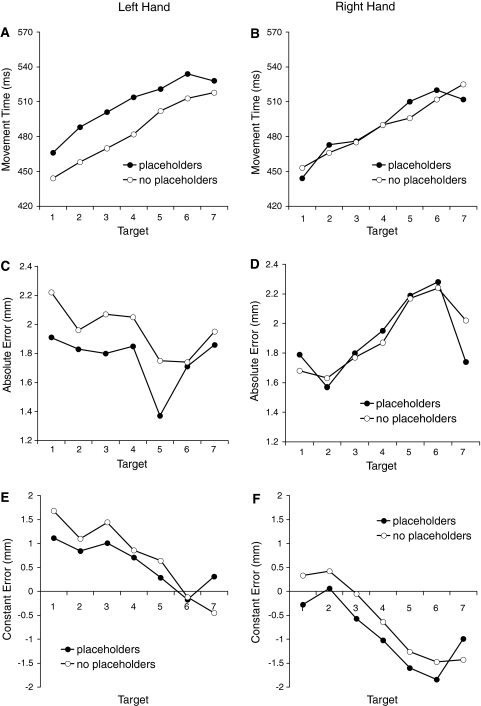
Recently, it has been reported that grasping with the left hand is more vulnerable to visual size illusions than grasping with the right hand. The present study investigated whether this increased sensitivity of the left hand for visual context extends to reaching. Left- and right-handed participants reached for targets embedded in two different visual contexts with either left or right hands. Visual context was manipulated by presenting targets either in a blank field or within an array of placeholders marking possible target locations. Regardless of handedness, the presence of placeholders affected left hand, but not right hand, reaching by improving end-point accuracy and reducing movement speed. Furthermore, left hand reaching was more accurate for far than near targets, whereas right hand reaching showed the opposite pattern. We discuss two possible hemispheric lateralization accounts of these findings.
Figures
References
-
- Elliott D, Chua R. Manual asymmetries in goal-directed movement. In: Elliot D, Roy EA, editors. Manual asymmetries in motor performance. Boca Raton: CRC Press; 1996. pp. 143–158.
MeSH terms
LinkOut - more resources
Full Text Sources
