


Favorable outcomes in patients surviving 5 or more years after allogeneic hematopoietic stem cell transplantation for hematologic malignancies
- PMID: 20302959
- PMCID: PMC2897903
- DOI: 10.1016/j.bbmt.2010.03.005
Favorable outcomes in patients surviving 5 or more years after allogeneic hematopoietic stem cell transplantation for hematologic malignancies
Abstract
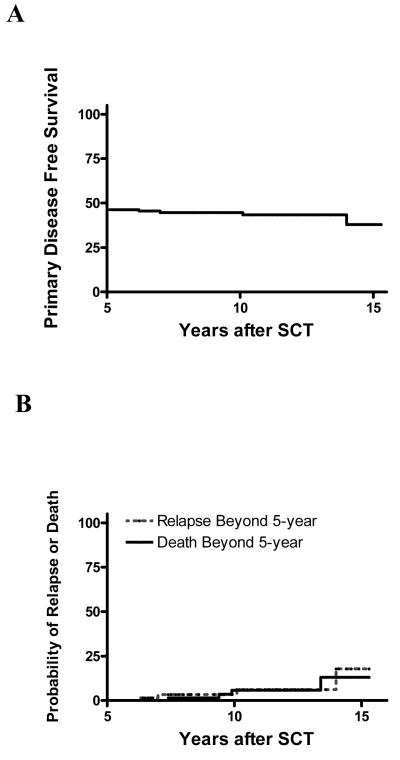
Allogeneic hematopoietic stem cell transplantation (HSCT) is a curative treatment for some hematologic malignancies. As the overall number of survivors continues to increase, studies systematically examining outcomes in long-term survivors are needed. We studied the clinical and quality-of-life outcomes in HSCT recipients surviving 5 or more years from HSCT. Since 1993, 262 patients with hematologic malignancies received a T cell-depleted myeloablative HSCT from an HLA-identical sibling at a single center. Ninety-two survived beyond 5 years from HSCT (median follow-up 9.4 years, range: 5.1-15.3). Median age at transplantation was 35 years (range: 10-56). Twenty-two (24%) received a bone marrow transplant, and 70 (76%) received a peripheral blood HSCT. Of the 92 survivors, 60 completed quality-of-life measures. The main outcomes examined were chronic graft-versus-host-disease, disease relapse, survival, health-related quality-of-life (HRQL) (Functional Assessment of Cancer Therapy-General), physical and mental health (SF-36), and symptom experience (Rotterdam Symptom Checklist). Seventy-five (82%) of 92 survivors no longer required systemic immunosuppressive treatment. Four (4.3%) relapsed with leukemia at a median of 8.5 years (range: 6.2-14.0) after HSCT. Four (4.3%) died between 7.4 and 13.4 years post-HSCT (1 relapse, 1 lung cancer, 1 pneumonia, 1 brain hemorrhage). Most survivors beyond 5 years had an excellent performance status with no difference in physical and mental health and higher HRQL scores (P = .02) compared with population norms. Although physical and psychologic symptom distress was low, those with higher symptom distress experienced inferior HRQL. These results show that 5 or more years after T cell-depleted HSCT for hematologic malignancy most individuals survive disease free with an excellent performance status, preserved physical and psychological health, and excellent HRQL.
Figures
References
-
- Socie G, Stone JV, Wingard JR, et al. Long-term survival and late deaths after allogeneic bone marrow transplantation. Late Effects Working Committee of the International Bone Marrow Transplant Registry. The New England journal of medicine. 1999;341:14–21. - PubMed
-
- Antin JH. Clinical practice. Long-term care after hematopoietic-cell transplantation in adults. The New England journal of medicine. 2002;347:36–42. - PubMed
-
- Kiss TL, Abdolell M, Jamal N, Minden MD, Lipton JH, Messner HA. Long-term medical outcomes and quality-of-life assessment of patients with chronic myeloid leukemia followed at least 10 years after allogeneic bone marrow transplantation. J Clin Oncol. 2002;20:2334–2343. - PubMed
-
- Montero A, Savani BN, Shenoy A, et al. T-cell depleted peripheral blood stem cell allotransplantation with T-cell add-back for patients with hematological malignancies: effect of chronic GVHD on outcome. Biol Blood Marrow Transplant. 2006;12:1318–1325. - PubMed
-
- Pavletic SZ, Martin P, Lee SJ, et al. Measuring therapeutic response in chronic graft-versus-host disease: National Institutes of Health Consensus Development Project on Criteria for Clinical Trials in Chronic Graft-versus-Host Disease: IV. Response Criteria Working Group report. Biol Blood Marrow Transplant. 2006;12:252–266. - PubMed
Publication types
MeSH terms
Grants and funding
LinkOut - more resources
Full Text Sources
Research Materials
