


Progression of lower urinary tract symptoms in older men: a community based study
- PMID: 20303101
- PMCID: PMC2896268
- DOI: 10.1016/j.juro.2010.01.026
Progression of lower urinary tract symptoms in older men: a community based study
Abstract
Purpose: Lower urinary tract symptom progression in community dwelling older men is not well described.
Materials and methods: We evaluated 5,697 participants in Osteoporotic Fractures in Men, a prospective cohort study of community dwelling men 65 years old or older. We characterized lower urinary tract symptoms using the American Urological Association symptom index at 2 time points, including at study entry and at 2-year followup. Progression was examined in the overall cohort and within baseline symptom strata (symptom index 7 or less and 8 or greater) using descriptive statistics.
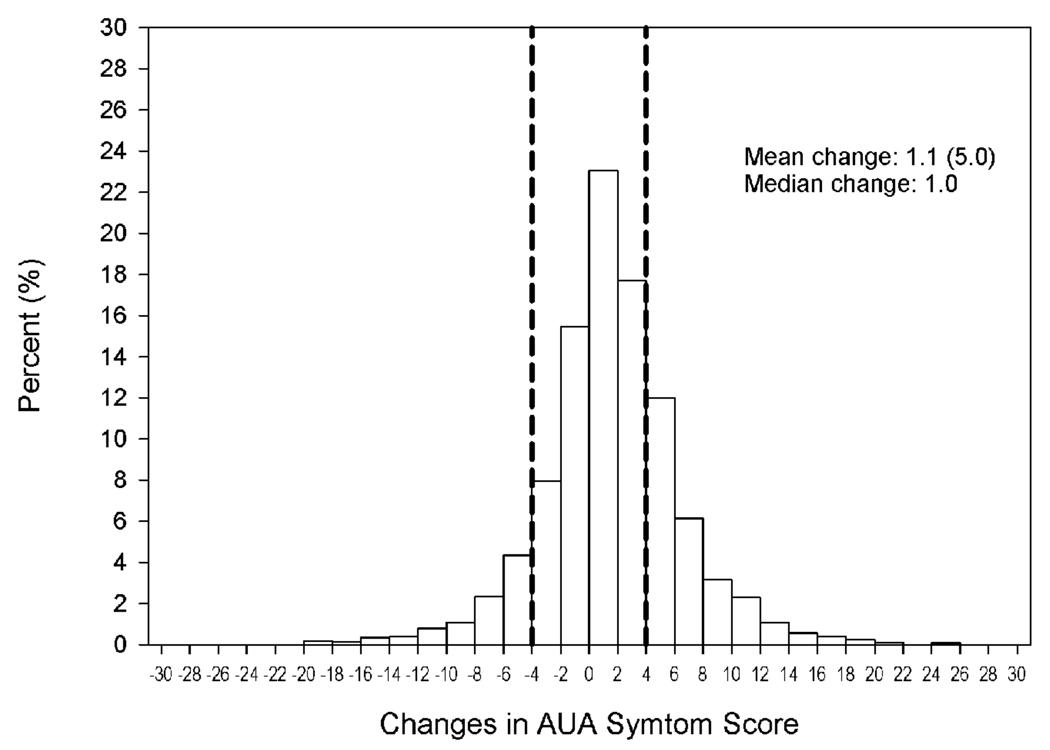
Results: At baseline mean +/- SD age was 73.5 +/- 5.8 years and mean symptom index score was 8.3 +/- 6.3 points. Mean and median total symptom index increased during followup by 1.1 +/- 5.0 and 1.0 points, respectively. Of the 3,092 men with a symptom index of 7 points or less at baseline 883 (29%) reported lower urinary tract symptoms progression (8 points or greater) at followup. The incidence of lower urinary tract symptom progression increased with advancing baseline age. Of the 2,605 men with a symptom index of 8 points or greater at baseline 622 (24%) reported progression of at least 4 points at followup. Of the 2,200 men with a baseline symptom index of 7 points or less and no history of benign prostatic hyperplasia or lower urinary tract symptom treatment 94% remained untreated, 2% reported benign prostatic hyperplasia surgery and 4% reported medication use at followup.
Conclusions: Up to 29% of community dwelling older men with no or mild lower urinary tract symptoms will have clinically significant lower urinary tract symptoms within 2 years. These data help elucidate the natural history of lower urinary tract symptoms in the community and provide useful data to design clinical trials of lower urinary tract symptom prevention.
2010 American Urological Association Education and Research, Inc. Published by Elsevier Inc. All rights reserved.
Figures
References
-
- Wei JT, Calhoun E, Jacobsen SJ. Urologic diseases in America project: benign prostatic hyperplasia. J Urol. 2005;173:1256. - PubMed
-
- Boyle P, Robertson C, Mazzetta C, et al. The prevalence of lower urinary tract symptoms in men and women in four centres. The UrEpik study. BJU Int. 2003;92:409. - PubMed
-
- Kupelian V, Wei JT, O'Leary MP, et al. Prevalence of lower urinary tract symptoms and effect on quality of life in a racially and ethnically diverse random sample: the Boston Area Community Health (BACH) Survey. Arch Intern Med. 2006;166:2381. - PubMed
-
- Taylor BC, Wilt TJ, Fink HA, et al. Prevalence, severity, and health correlates of lower urinary tract symptoms among older men: the MrOS study. Urology. 2006;68:804. - PubMed
-
- Trueman P, Hood SC, Nayak US, et al. Prevalence of lower urinary tract symptoms and self-reported diagnosed 'benign prostatic hyperplasia', and their effect on quality of life in a community-based survey of men in the UK. BJU Int. 1999;83:410. - PubMed
Publication types
MeSH terms
Grants and funding
- U01 AR45632/AR/NIAMS NIH HHS/United States
- N01 CA032102/CA/NCI NIH HHS/United States
- U01 AR45647/AR/NIAMS NIH HHS/United States
- P30 CA23100-23/CA/NCI NIH HHS/United States
- U01 AR45614/AR/NIAMS NIH HHS/United States
- U01 AR045654/AR/NIAMS NIH HHS/United States
- U01-AG027810/AG/NIA NIH HHS/United States
- P30 CA023100/CA/NCI NIH HHS/United States
- U01 AR45583/AR/NIAMS NIH HHS/United States
- U01 AR045614/AR/NIAMS NIH HHS/United States
- U01 AR45654/AR/NIAMS NIH HHS/United States
- U01 AR045583/AR/NIAMS NIH HHS/United States
- U10 CA032102/CA/NCI NIH HHS/United States
- U01 AR045647/AR/NIAMS NIH HHS/United States
- U01 AR45580/AR/NIAMS NIH HHS/United States
- U01 AG027810/AG/NIA NIH HHS/United States
- UL1 RR024140/RR/NCRR NIH HHS/United States
- U01 AR045580/AR/NIAMS NIH HHS/United States
- U01 AG18197/AG/NIA NIH HHS/United States
- U01 AG018197/AG/NIA NIH HHS/United States
- U01 AR066160/AR/NIAMS NIH HHS/United States
- U01 AR045632/AR/NIAMS NIH HHS/United States
