Review
. 2010 Jun 1;264(1-2):63-9.
doi: 10.1016/j.heares.2010.03.002. Epub 2010 Mar 18.

Timing is everything: temporal processing deficits in the aged auditory brainstem

Affiliations
Review

Timing is everything: temporal processing deficits in the aged auditory brainstem

Joseph P Walton. Hear Res. .

Abstract

This summary article reviews the literature on neural correlates of age-related changes in temporal processing in the auditory brainstem. Two types of temporal processing dimensions are considered, (i) static, which can be measured using a gap detection or forward masking paradigms, and (ii) dynamic, which can be measured using amplitude and frequency modulation. Corresponding data from physiological studies comparing neural responses from young and old animals using acoustic stimuli as silent gaps-in-noise, amplitude modulation, and frequency modulation are considered in relation to speech perception. Evidence from numerous investigations indicates an age-related decline in encoding of temporal sound features which may be a contributing factor to the deficits observed in speech recognition in many elderly listeners.


Figures

Fig. 1
Fig. 1
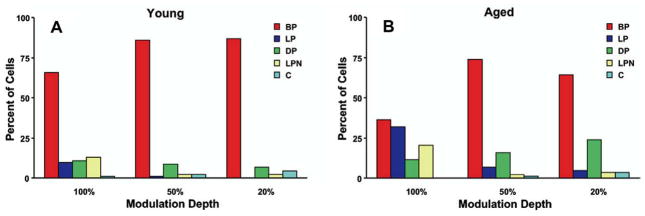
Distribution of synchronization filter properties of fusiform cells from young (A, N = 91) and old (B, N = 84) rats plotted as a function of the three modulation depths that were tested. Filter properties were classified from temporal MTFs into band-pass (BP), low-pass (LP), double-peaked (DP), low-pass notched (LPN) and complex (C). Note the significant loss of BP units in the aged rats, especially for the 100% modulation depth carrier, with a concomitant increase in low-pass units. (adapted with permission from Schatteman et al. (2008).)
Fig. 2
Fig. 2
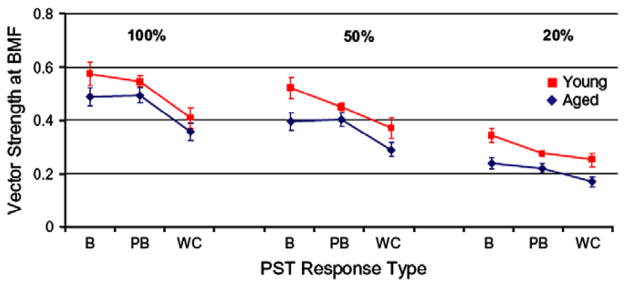
Age-related decline in temporal coding of AM signals at all modulation depths plotted as a function of the unit’s PSTH type, where B = buildup, PB = pauser-buildup and WC = wideband chopper. The mean vector strength is shown for the three response types. Phase-locking declines for all unit types with decreases in modulation depth and is strongest for buildup units regardless of the depth of modulation. Responses from old rats show reduced phase-locking for all three unit types as compared to units from young rats, but the age effect is most pronounced for buildup units. (adapted with permission from Schatteman et al. (2008).)
Fig. 3
Fig. 3
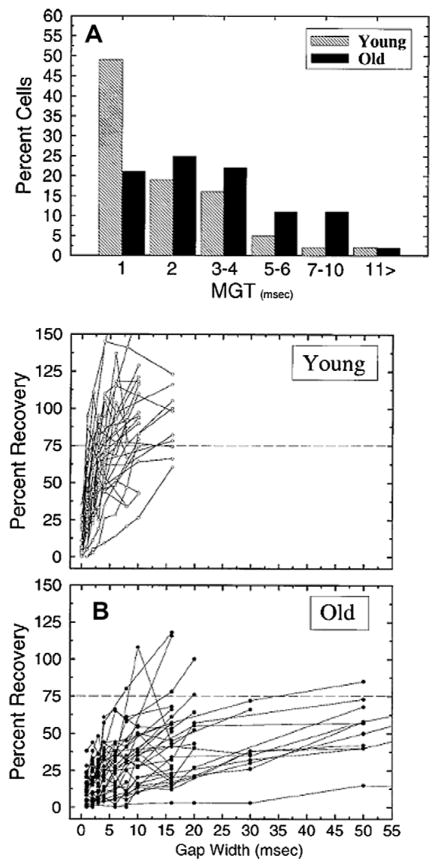
Age-related alteration in encoding silent gaps embedded in noise carriers. Stimuli were two noise bursts presented at 65 dB SPL, of 100 ms and 50 ms duration with a silent gap varying from 1 to 96 ms placed after the first burst. (A) The distribution of minimum gap thresholds (MGTs) from units from young and old CBA mice. There is a significant shift to longer gap thresholds in units recorded from old mice. (B) The percent recovery in driven rate to the second noise burst which delineates the end of the silent gap from young (top panel) and old (bottom panel) mice. A value of 100% indicates that the driven activity to noise burst 1 equaled that to noise burst 2. The horizontal dotted line denotes the 75% recovery point. (adapted with permission from Walton et al. (1998).)
Fig. 4
Fig. 4
Effects of age on gap encoding to pure tones presented at the best frequency of each unit (figure adapted from Finlayson (2002)). Duration of suppression is plotted as a function of each units thresholds, with units with BFs < 10 kHz on the left and those with BFs > 10 kHz on the right. Units from young mice are denoted by the filled symbols (circles and diamonds) and those from old rats by the open symbols (triangles). Threshold does not correlate with the duration of suppression, but for units with BFs < 10 kHz there is a strong effect of age, with the duration of suppression from units of old rats nearly 400 ms longer (dotted versus solid line) than the young data.. (adapted with permission from Finlayson (2002).)
Fig. 5
Fig. 5
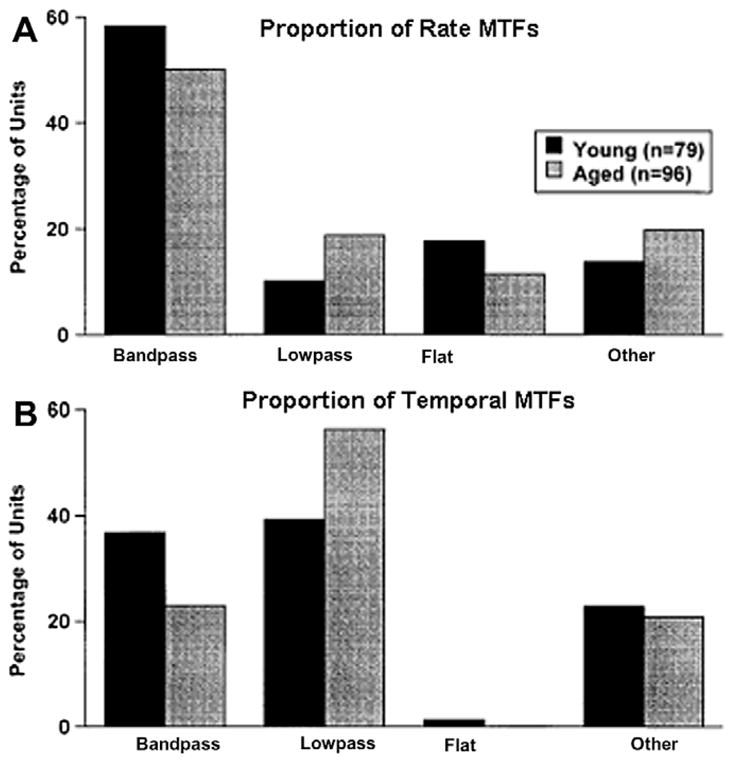
Age-related changes in SAM coding to best frequency tones in auditory midbrain neurons of young and old rats. Signals were 100% SAM tones centered at the units BF. (A) The proportion of units in the different classes of rate MTFs. Neurons from both young and old rats had similar percentages of units. (B) The same comparison for temporal MTFs. Note that neurons from young rats had a higher proportion of band-pass type tMTFs as compared to old rats. As the proportion of flat and other types of tMTFs were nearly identical the data suggests that neurons from aged rats are changing filter shapes, becoming more low-pass than band-pass. (adapted with permission from Shaddock Palombi et al. (2001).)
Fig. 6
Fig. 6
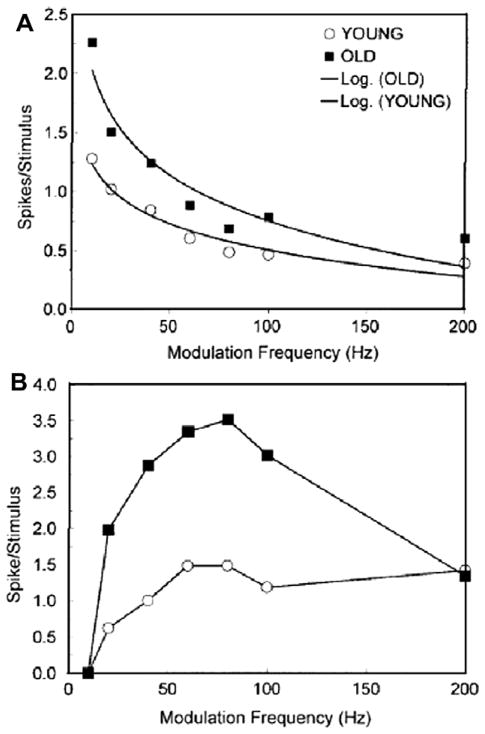
Age-related changes in SAM coding to broadband noise of auditory midbrain neurons in young and old CBA mice. Signals were 100% SAM wideband noise presented at 65 dB SPL. (A) The effect of MF on the transient response, or first cycle of the SAM noise, on driven activity measured in spikes/stimulus (median data plotted). Data were fit with a negative log function. Data sets from both young and old mice show a systematic decrease in median driven response to the onset of the first cycle of modulation as modulation frequency increases. (B) The same comparison for the median periodic response, or the driven response to the remaining cycles of modulation. Note that neurons from young mice tended to display a stable driven response with increases in modulation frequency. In contrast, units from old mice show a sharp increase in driven rate which then declines above 100 Hz MF. (adapted with permission from Walton et al. (2002).)
Fig. 7
Fig. 7
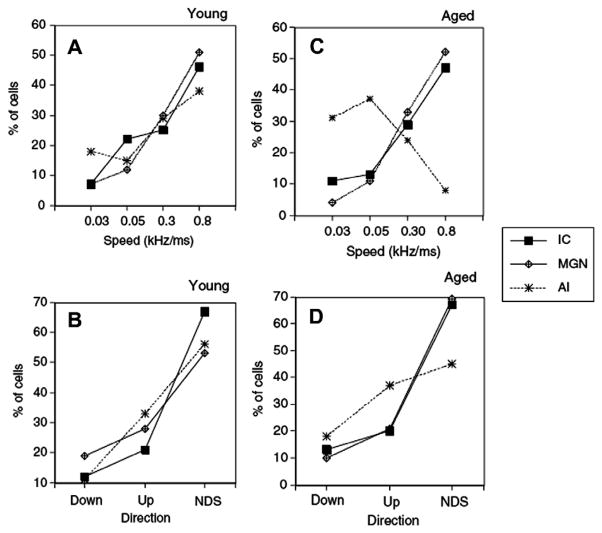
Distribution of FM selectivity for preferred speed (top row) and direction-selectivity (bottom row) from units in three auditory locations: inferior colliculus (IC), auditory thalamus (MGN), and auditory cortex (AI), for units from young (A and B) and aged (C and D) rats. Speed of the FM shown in (A) and (C) ranged from 0.03 to 0.8 kHz/ms. Note that in units from young rats most units preferred faster speeds. In old rats, there was a significant difference in preferred speed between AI and the IC and MGN, where the majority of cells recorded from AI preferred slow speeds while cells from IC and MGN preferred fast sweeps. Similarly, most units from both young and old rats were not sensitive to the direction of FM sweeps (B and C, NDS). (adapted with permission from Mendelson and Lui (2004).)

References

    1. Aitkin LM, Gates GR, et al. Responses of neurons in inferior colliculus to variations in sound-source azimuth. J Neurophysiol. 1984;52 (1):1–17. - PubMed
    1. Aitkin LM, Pettigrew JD, et al. Representation of stimulus azimuth by low-frequency neurons in inferior colliculus of the cat. J Neurophysiol. 1985;53 (1):43–59. - PubMed
    1. Aitkin L, Tran L, et al. The responses of neurons in subdivisions of the inferior colliculus of cats to tonal, noise and vocal stimuli. Exp Brain Res. 1994;98 (1):53–64. - PubMed
    1. Backoff PM, Shadduck Palombi P, et al. Glycinergic and GABAergic inputs affect short-term suppression in the cochlear nucleus. Hear Res. 1997;110 (1–2):155–163. - PubMed
    1. Backoff PM, Shadduck Palombi P, et al. Gamma-aminobutyric acidergic and glycinergic inputs shape coding of amplitude modulation in the chinchilla cochlear nucleus. Hear Res. 1999;134 (1–2):77–88. - PubMed