


Acute kidney injury in critically ill patients infected with 2009 pandemic influenza A(H1N1): report from a Canadian Province
- PMID: 20303633
- PMCID: PMC7125797
- DOI: 10.1053/j.ajkd.2010.01.011
Acute kidney injury in critically ill patients infected with 2009 pandemic influenza A(H1N1): report from a Canadian Province
Abstract
Background: 2009 pandemic influenza A(H1N1) has led to a global increase in severe respiratory illness. Little is known about kidney outcomes and dialytic requirements in critically ill patients infected with pandemic H1N1.
Study design: Prospective observational study.
Setting & participants: 50 patients with pandemic H1N1 admitted to any of 7 intensive care units in Manitoba, Canada, were prospectively followed.
Outcome & measurements: Outcomes were kidney injury and kidney failure defined using RIFLE (risk, injury, failure, loss, end-stage disease) criteria or need for dialysis therapy.
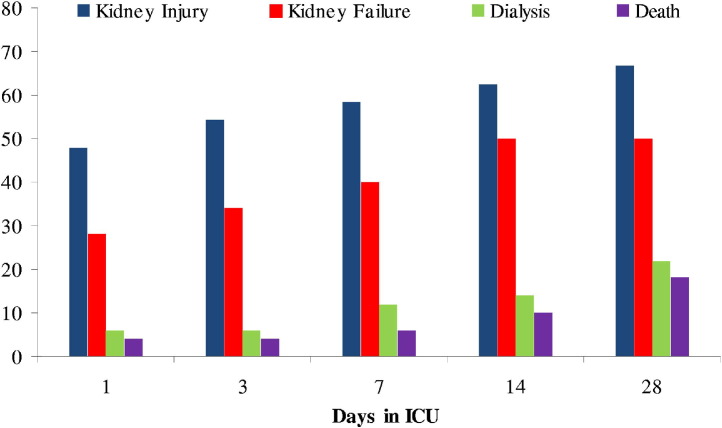
Results: The pandemic H1N1 group was composed of 50 critically ill patients with pandemic H1N1 with severe respiratory syndrome (47 confirmed cases, 3 probable). Kidney injury, kidney failure, and need for dialysis occurred in 66.7%, 66%, and 11% of patients, respectively. Mortality was 16%. Kidney failure was associated with increased death (OR, 11.29; 95% CI, 1.29-98.9), whereas the need for dialysis was associated with an increase in length of stay (RR, 2.38; 95% CI, 2.13-25.75).
Limitations: Small population studied from single Canadian province; thus, limited generalizability.
Conclusions: In critically ill patients with pandemic H1N1, kidney injury, kidney failure, and the need for dialysis are common and associated with an increase in mortality and length of intensive care unit stay.
Copyright 2010 National Kidney Foundation, Inc. Published by Elsevier Inc. All rights reserved.
Figures
References
-
- The ANZIC Influenzae Investigators Critical care services and 2009 H1N1 influenza in Australia and New Zealand. N Engl J Med. 2009;361(20):1925–1934. - PubMed
-
- New South Wales Public Health Network Progression and impact of the first winter wave of the 2009 pandemic H1N1 influenzae in New South Wales, Australia. Euro Surveill. 2009 Oct 22;14(42) pii: 19365. - PubMed
-
- Louie J.K., Acosta M., Winter K. Factors associated with death or hospitalization due to pandemic 2009 influenza A(H1N1) infection in California. JAMA. 2009;302(17):1896–1902. - PubMed
-
- The Australia and New Zealand Extracorporeal Membrane Oxygenation Influenza Investigators Extracorporeal membrane oxygenation for 2009 influenza A(H1N1) acute respiratory distress syndrome. JAMA. 2009;302(17):1888–1895. - PubMed
-
- Dominguez-Cherit G., Lapinsky S.E., Macias A.E. Critically ill patients with 2009 influenza A(H1N1) in Mexico. JAMA. 2009;302(17):1880–1887. - PubMed
Publication types
MeSH terms
LinkOut - more resources
Full Text Sources
Medical
