


Review
doi: 10.1016/j.cell.2010.01.037.
Selective transcription in response to an inflammatory stimulus
Affiliations
- PMID: 20303874
- PMCID: PMC2847629
- DOI: 10.1016/j.cell.2010.01.037
Item in Clipboard
Review
Selective transcription in response to an inflammatory stimulus
Cell.
.
Abstract
An inflammatory response is initiated by the temporally controlled activation of genes encoding a broad range of regulatory and effector proteins. A central goal is to devise strategies for the selective modulation of proinflammatory gene transcription, to allow the suppression of genes responsible for inflammation-associated pathologies while maintaining a robust host response to microbial infection. Toward this goal, recent studies have revealed an unexpected level of diversity in the mechanisms by which chromatin structure and individual transcription factors contribute to the selective regulation of inflammatory genes.
2010 Elsevier Inc. All rights reserved.
Figures
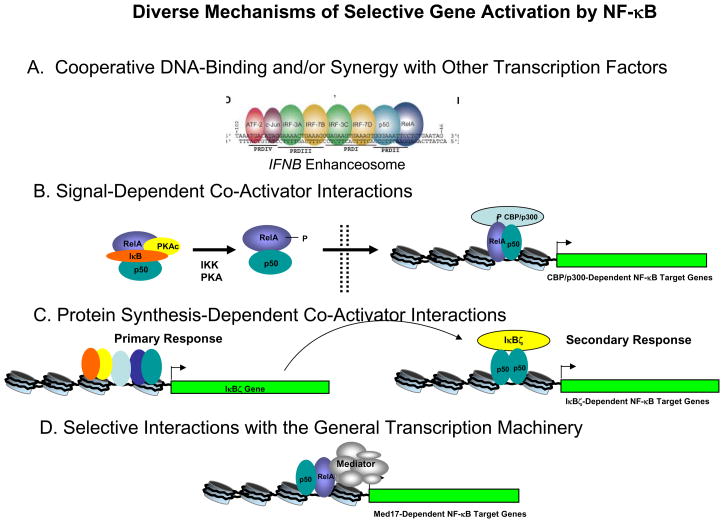
(A) The highly cooperative binding and synergistic function of multiple transcription factors has been found to play a major role in the selective activation of the human IFNB gene (Thanos and Maniatis 1995; Agalioti et al. 2000). Synergy between multiple transcription factors activated by diverse signal transduction pathways is likely to be critical for the selective activation of all genes induced by inflammatory stimuli. (B) Analysis of mice containing a mutation in the RelA S276 phosphoacceptor site have revealed that a select subset of NF-κB target genes depend on S276 phosphorylation (Dong et al. 2008), which promotes an interaction between NF-κB and the p300/CBP co-activators (Zhong et al. 1998, 2002). (C) The Nfkibz gene, which encodes the nuclear IκB protein, IκBζ, is activated at the transcriptional level during the primary response to LPS and other inflammatory stimuli (Yamamoto et al. 2006; Motoyama et al. 2005). IκBζ is subsequently required for the activation of a select subset of secondary response genes. Activation of these genes therefore depends on all signal transduction pathways needed for Nfkibz transcriptional activation. (D) An interaction between RelA and the Med17 subunit of the Mediator complex is needed for activation of a select subset of NF-κB target genes (van Essen et al. 2009). Other inducible transcription factors may be responsible for recruitment of the Mediator complex to other NF-κB target genes, thereby conferring a requirement for these factors for transcriptional activation.
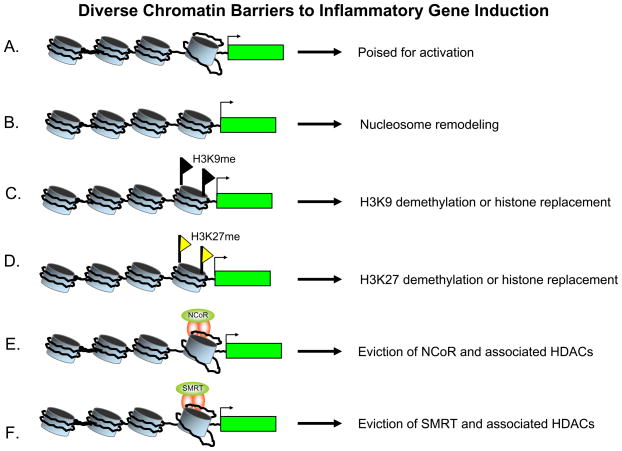
(A) Most genes activated during the primary response to an inflammatory stimulus are poised for activation by their constitutive assembly into a chromatin structure resembling that found at constitutively active genes (Ramirez-Carrozzi et al. 2009; Hargreaves and Medzhitov 2009). At some of these genes, inducible transcription factors may not need to remove chromatin barriers, but these factors must instead enhance transcription initiation, elongation and pre-mRNA processing. Genes within this class are generally induced promiscuously by a wide range of generic signaling pathways. (B) The assembly of promoters and other control regions into stable nucleosomes provides a substantial barrier to transcriptional activation (Ramirez-Carrozzi et al. 2009). SWI/SNF complexes are often required for the remodeling of these nucleosomes. Inducible remodeling, as monitored by restriction enzyme accessibility, requires specialized factors that are either directly activated by a stimulus, such as IRF3, or that are encoded by genes expressed during the primary response to the stimulus. The nucleosome remodeling requirement contributes to the tight regulation of SWI/SNF-dependent genes. (C) and (D) ChIP analyses of large panels of promoters and genome-wide ChIP-Seq experiments have revealed that histone H3K9 and histone H3K27 are heavily methylated at small subsets of inducible promoters in mature unstimulated cells (Saccani and Natoli 2002; De Santa 2007, 2009). Transcriptional activation of these genes generally coincides with the loss of histone H3K9 or H3K27 methylation, suggesting the demethylation or histone replacement may be required for activation. (E) and (F) The NCoR and SMRT co-repressor complexes appear to be associated with distinct subsets of inducible genes in mature, unstimulated cells (Ghisletti et al. 2009; Hargreaves and Medzhitov 2009). Transcriptional activation requires the removal of these co-repressor complexes, which contain histone deaceylases (HDACs) and other subunits that may help maintain a repressive chromatin structure.
References
-
- Agalioti T, Lomvardas S, Parekh B, Yie J, Maniatis T, Thanos D. Ordered recruitment of chromatin modifying and general transcription factors to the IFN-beta promoter. Cell. 2000;103:667–678. - PubMed
-
- Akira S, Uematsu S, Takeuchi O. Pathogen recognition and innate immunity. Cell. 2006;124:783–801. - PubMed
-
- Amit I, Garber M, Chevrier N, Leite AP, Donner Y, Eisenhaure T, Guttman M, Grenier JK, Li W, Zuk O, Schubert LA, Birditt B, Shay T, Goren A, Zhang X, Smith Z, Deering R, McDonald RC, Cabili M, Bernstein BE, Rinn JL, Meissner A, Root DE, Hacohen N, Regev A. Unbiased reconstruction of a mammalian transcriptional network mediating pathogen responses. Science. 2009;326:257–263. - PMC - PubMed
-
- Apostolou E, Thanos D. Virus infection induces NF-κB-dependent interchromosomal associations mediating monoallelic IFN-b gene expression. Cell. 2008;134:85–96. - PubMed
Publication types
MeSH terms
Substances
Grants and funding
LinkOut - more resources
Full Text Sources
Other Literature Sources
