


Review
doi: 10.1016/j.freeradbiomed.2010.03.009.
Epub 2010 Mar 18.
Detection of nitric oxide by electron paramagnetic resonance spectroscopy
Affiliations
- PMID: 20304044
- PMCID: PMC2916063
- DOI: 10.1016/j.freeradbiomed.2010.03.009
Item in Clipboard
Review
Detection of nitric oxide by electron paramagnetic resonance spectroscopy
Free Radic Biol Med.
.
Abstract
Electron paramagnetic resonance (EPR) spectroscopy has been used in a number of ways to study nitric oxide chemistry and biology. As an intrinsically stable and relatively unreactive diatomic free radical, the challenges of detecting this species by EPR are somewhat different from those of transient radical species. This review gives a basic introduction to EPR spectroscopy and discusses its uses to assess and quantify nitric oxide formation in biological systems.
Copyright 2010 Elsevier Inc. All rights reserved.
Figures
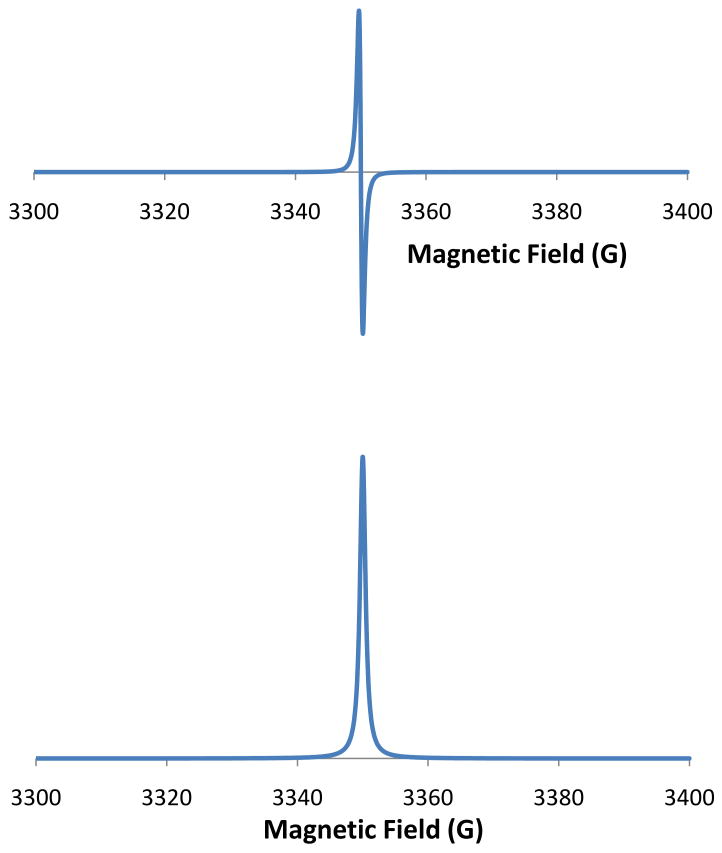
Spectra are simulations created using WinSim.
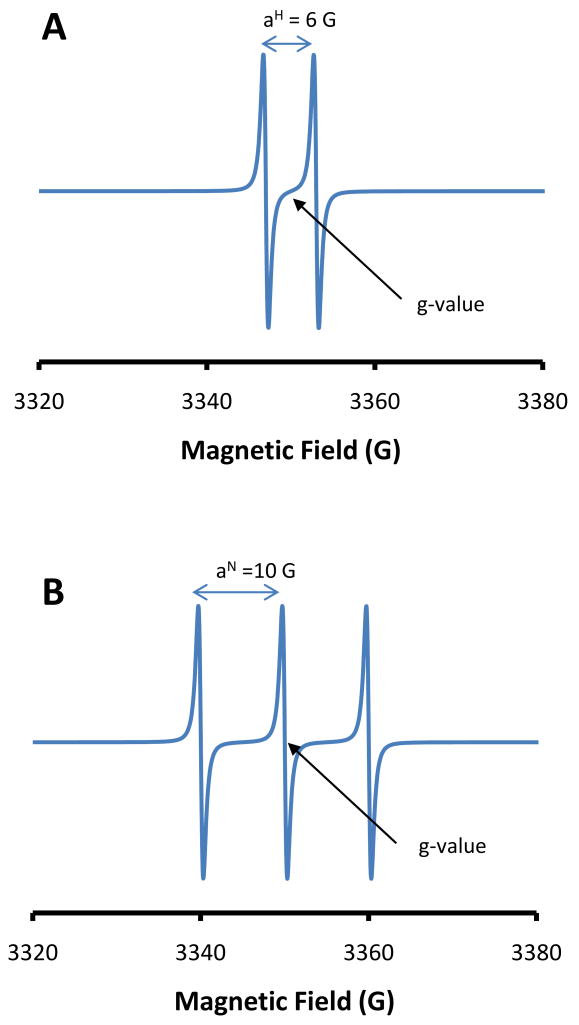
A) The effect of nucleus with nuclear Spin of one half. B) The effect of a nucleus with a nuclear spin of 1. Spectra are simulations created using WinSim.
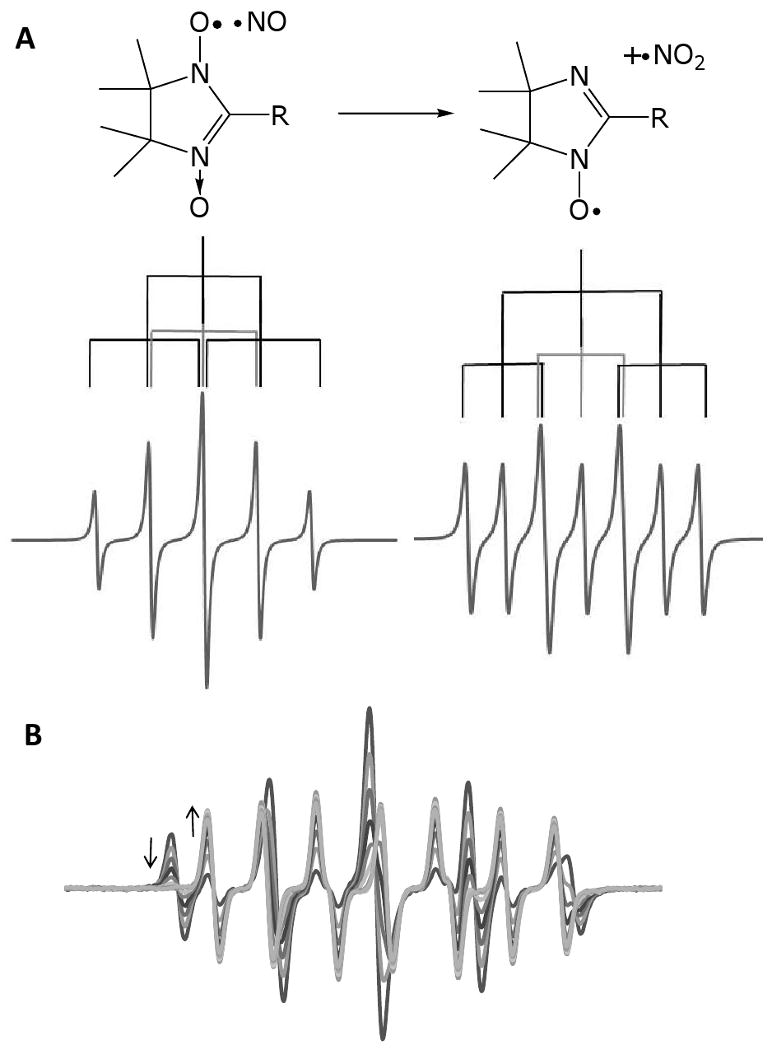
A) Reaction of nitronyl nitroxide with NO showing conversion to an immino nitroxide and nitrogen dioxide. B) Typical EPR spectral changes that occur upon reaction of a nitronyl nitroxide with NO.
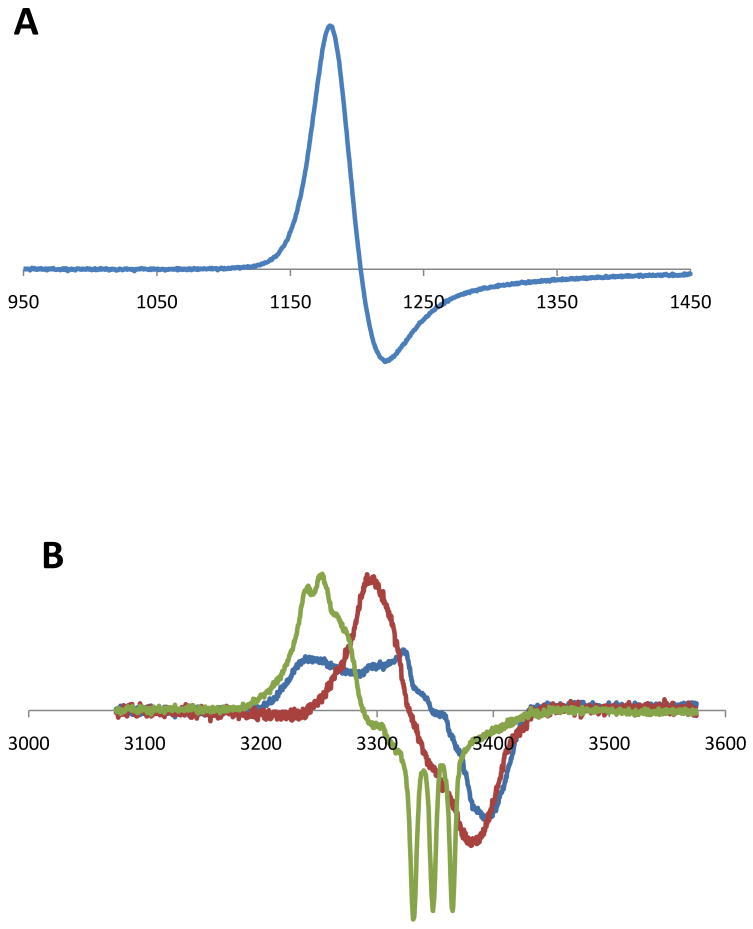
A) MetHb was prepared by incubating human oxyHb with ferricyanide followed by purification on sephadex G25 size exclusion chromatography. The metHb was placed in an EPR tube frozen. The EPR spectrum was taken at 5K using the following EPR parameters. B) EPR spectra of HbNO. EPR spectra of HbNO consist of a superposition of at least three EPR spectra. These derive from the β-chain heme iron-NO complex, the α-chain heme iron NO complex in a 6-coordinate geometry (T-state) and the α-chain heme iron complex in a 5-coordinate geometry (R-State). (Adapted from a Figure originally published in The Journal Of Biological Chemistry Piknova, B., Gladwin, M.T., Schechter, A. N., and Hogg, Nl. Electron paramagnetic resonance analysis of nitrosylhemoglobin in humans during NO inhalation. J. Biol. Chem. 280, 40583-40588. 2005. © the American Society for Biochemistry and Molecular Biology.
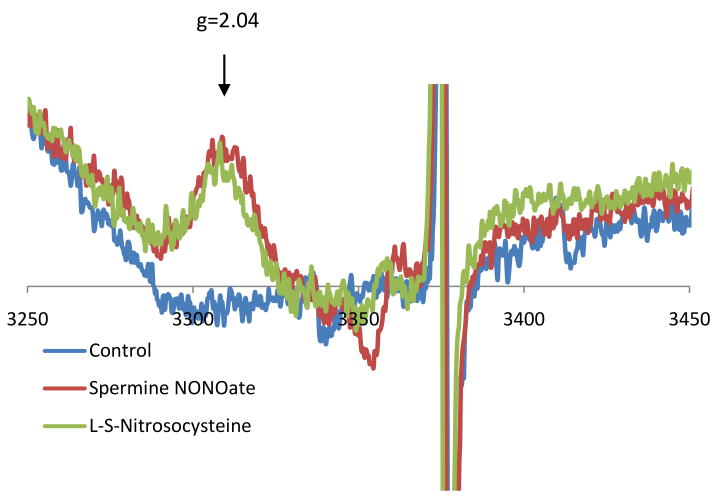
RAW264.7 mouse macrophage-like cells were cultured to confluence. Either spermineNONOate or S-nitrosocysteine were added and incubated for 30 minutes. Cells were scraped and placed in an EPR tube and frozen. EPR spectra were taken at 77K.
References
-
- Duling DR. Simulation of multiple isotropic spin-trap EPR spectra. J Magn Res B. 1994;104:105–110. - PubMed
-
- Knowles PF, March D, Rattle HWE. Magnetic Resonance of Biomolecules. New Jersey: John Wiley and Sons; 1976.
-
- Weil JA, Bolton JR. Electron Paramagnetic Resonance Elementary Theory and Practical Applications. New Jersey: John Wiley and Sons; 2007.
-
- Uehara H, Arimitsu S. Gas-phase electron paramagnetic resonance detection of ntiric oxide and nitrogen dioxide in pulluted air. Anal Chem. 1973;45:1897–1900. - PubMed
-
- Villamena FA, Zweier JL. Detection of Reactive Oxygen and Nitrogen Species by EPR Spin Trapping. Antioxidants & Redox Signaling. 2004;6:619–629. - PubMed
Publication types
MeSH terms
Substances
Grants and funding
LinkOut - more resources
Full Text Sources
Other Literature Sources
Research Materials
