


Nitro-oleic acid inhibits firing and activates TRPV1- and TRPA1-mediated inward currents in dorsal root ganglion neurons from adult male rats
- PMID: 20304940
- PMCID: PMC2879937
- DOI: 10.1124/jpet.109.163154
Nitro-oleic acid inhibits firing and activates TRPV1- and TRPA1-mediated inward currents in dorsal root ganglion neurons from adult male rats
Abstract
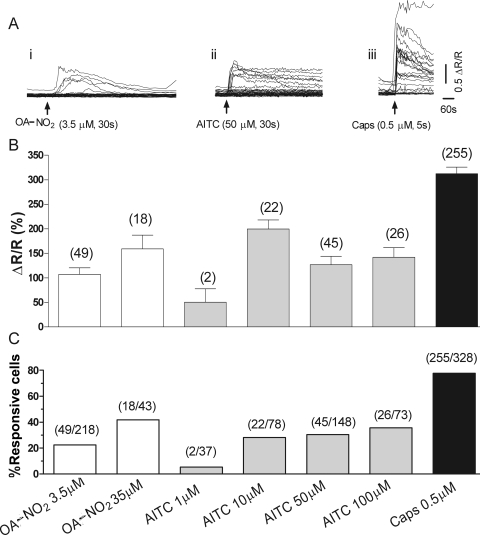
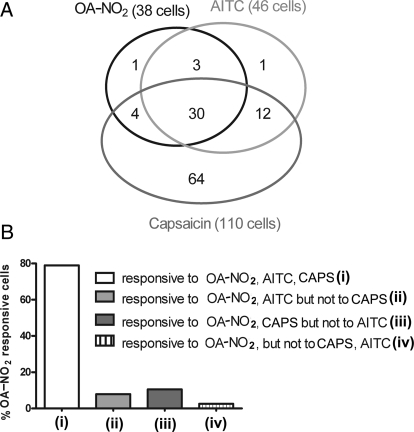
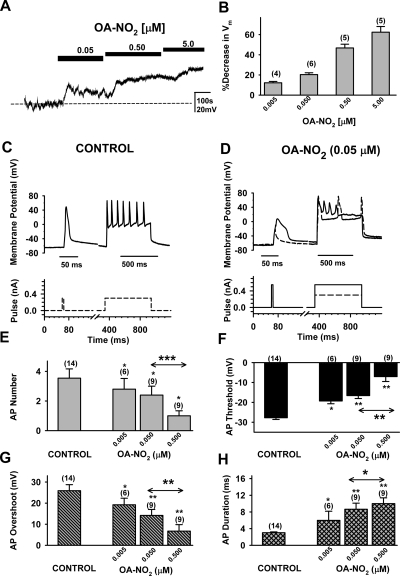
Nitro-oleic acid (OA-NO(2)), an electrophilic fatty acid by-product of nitric oxide and nitrite reactions, is present in normal and inflamed mammalian tissues at up to micromolar concentrations and exhibits anti-inflammatory signaling actions. The effects of OA-NO(2) on cultured dorsal root ganglion (DRG) neurons were examined using fura-2 Ca(2+) imaging and patch clamping. OA-NO(2) (3.5-35 microM) elicited Ca(2+) transients in 20 to 40% of DRG neurons, the majority (60-80%) of which also responded to allyl isothiocyanate (AITC; 1-50 microM), a TRPA1 agonist, and to capsaicin (CAPS; 0.5 microM), a TRPV1 agonist. The OA-NO(2)-evoked Ca(2+) transients were reduced by the TRPA1 antagonist 2-(1,3-dimethyl-2,6-dioxo-1,2,3,6-tetrahydro-7H-purin-7-yl)-N-(4-isopropylphenyl) acetamide (HC-030031; 5-50 microM) and the TRPV1 antagonist capsazepine (10 microM). Patch-clamp recording revealed that OA-NO(2) depolarized and induced inward currents in 62% of neurons. The effects of OA-NO(2) were elicited by concentrations >or=5 nM and were blocked by 10 mM dithiothreitol. Concentrations of OA-NO(2) >or=5 nM reduced action potential (AP) overshoot, increased AP duration, inhibited firing induced by depolarizing current pulses, and inhibited Na(+) currents. The effects of OA-NO(2) were not prevented or reversed by the NO-scavenger carboxy-2-phenyl-4,4,5,5-tetramethylimidazolineoxyl-1-oxyl-3-oxide. A large percentage (46-57%) of OA-NO(2)-responsive neurons also responded to CAPS (0.5 microM) or AITC (0.5 microM). OA-NO(2) currents were reduced by TRPV1 (diarylpiperazine; 5 microM) or TRPA1 (HC-030031; 5 microM) antagonists. These data reveal that endogenous OA-NO(2) generated at sites of inflammation may initially activate transient receptor potential channels on nociceptive afferent nerves, contributing to the initiation of afferent nerve activity, and later suppresses afferent firing.
Figures



References
-
- Baker PR, Lin Y, Schopfer FJ, Woodcock SR, Groeger AL, Batthyany C, Sweeney S, Long MH, Iles KE, Baker LM, et al. (2005) Fatty acid transduction of nitric oxide signaling: multiple nitrated unsaturated fatty acid derivatives exist in human blood and urine and serve as endogenous peroxisome proliferator-activated receptor ligands. J Biol Chem 280:42464–42475 - PMC - PubMed
-
- Dang K, Bielefeldt K, Gebhart GF. (2004) Gastric ulcers reduce A-type potassium currents in rat gastric sensory ganglion neurons. Am J Physiol Gastrointest Liver Physiol 286:G573–G579 - PubMed
Publication types
MeSH terms
Substances
Grants and funding
LinkOut - more resources
Full Text Sources
Other Literature Sources
Miscellaneous
