


Longitudinal sex differences during landing in knee abduction in young athletes
- PMID: 20305577
- PMCID: PMC2924455
- DOI: 10.1249/MSS.0b013e3181dc99b1
Longitudinal sex differences during landing in knee abduction in young athletes
Abstract
Purpose: The objective of this study was to determine whether biomechanical and neuromuscular risk factors related to abnormal movement patterns increased in females, but not males, during the adolescent growth spurt.
Methods: A total of 315 subjects participated in two testing sessions approximately 1 yr apart. Male and female subjects were classified on the basis of their maturation status as pubertal or postpubertal. Three trials of a drop vertical jump (DVJ) were collected. Maximum knee abduction angle and external moments were calculated during the DVJ deceleration phase using a three-dimensional motion analysis system. Changes in knee abduction from the first to second year were compared among four subject groups (female pubertal, female postpubertal, male pubertal, and male postpubertal).
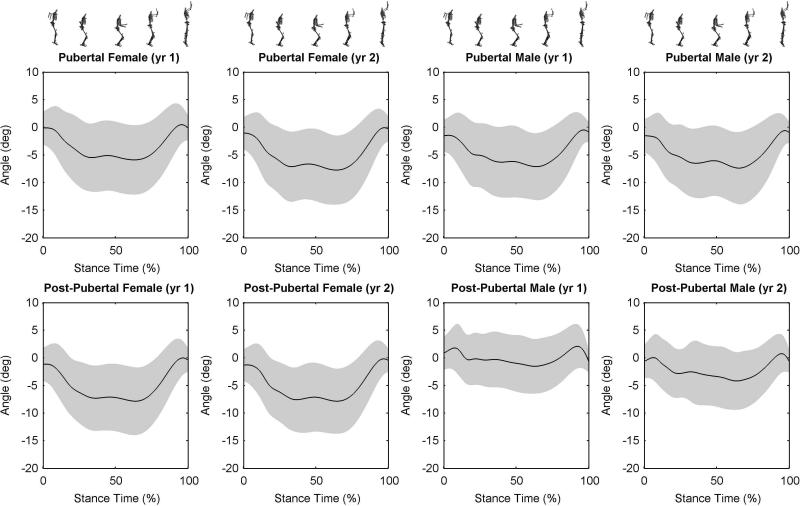
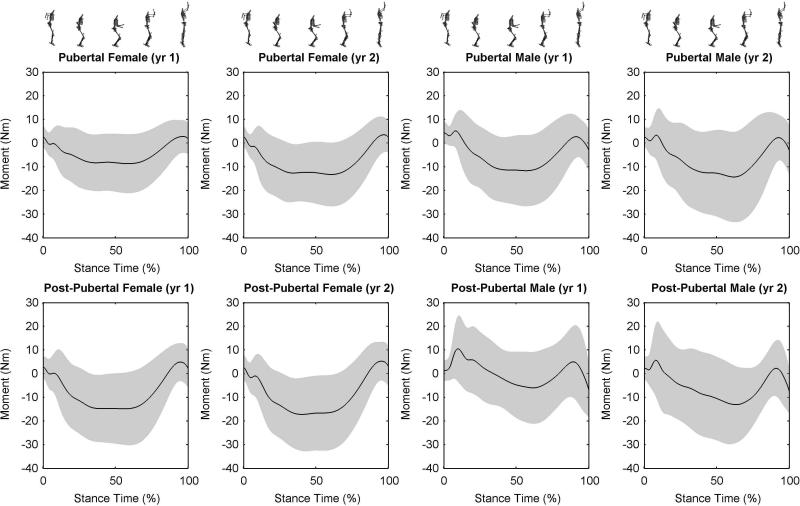
Results: There were no sex differences in peak knee abduction angle or moment during DVJ between pubertal males and females (P > 0.05). However, pubertal females increased peak abduction angle from first to second year (P < 0.001), whereas males demonstrated no similar change (P = 0.90) in the matched developmental stages. After puberty, the peak abduction angle and moment were greater in females relative to males (angle: female -9.3° ± 5.7°, male -3.6° ± 4.6°, P < 0.001; moment: female -21.9 ± 13.5 N·m, male -13.0 ± 12.0 N·m, P = 0.017).
Conclusions: This study identified, through longitudinal analyses, that knee abduction angle was significantly increased in pubertal females during rapid adolescent growth, whereas males showed no similar change. In addition, knee abduction motion and moments were significantly greater for the subsequent year in young female athletes, after rapid adolescent growth, compared with males. The combination of longitudinal, sex, and maturational group differences indicates that early puberty seems to be a critical phase related to the divergence of increased anterior cruciate ligament injury risk factors.
Figures
References
-
- Andrish JT. Anterior cruciate ligament injuries in the skeletally immature patient. Am J Orthop. 2001;30(2):103–10. - PubMed
-
- Bell AL, Pedersen DR, Brand RA. A comparison of the accuracy of several hip center location prediction methods. J Biomech. 1990;23(6):617–21. - PubMed
-
- Besier TF, Lloyd DG, Ackland TR, Cochrane JL. Anticipatory effects on knee joint loading during running and cutting maneuvers. Med Sci Sports Exerc. 2001;33(7):1176–81. - PubMed
-
- Beunen G, Malina RM. Growth and physical performance relative to the timing of the adolescent spurt. Exerc Sport Sci Rev. 1988;16:503–40. - PubMed
-
- Beynnon BD, Fleming BC. Anterior cruciate ligament strain in-vivo: a review of previous work. J Biomech. 1998;31(6):519–25. - PubMed
Publication types
MeSH terms
Grants and funding
LinkOut - more resources
Full Text Sources
Other Literature Sources
Medical
