Review
. 2010 Dec;37(12):2381-97.
doi: 10.1007/s00259-010-1406-4. Epub 2010 Mar 20.

Molecular imaging in atherosclerosis

Affiliations
Review

Molecular imaging in atherosclerosis

Andor W J M Glaudemans et al. Eur J Nucl Med Mol Imaging. 2010 Dec.

Abstract

Atherosclerosis is the major cause of cardiovascular disease, which still has the leading position in morbidity and mortality in the Western world. Many risk factors and pathobiological processes are acting together in the development of atherosclerosis. This leads to different remodelling stages (positive and negative) which are both associated with plaque physiology and clinical presentation. The different remodelling stages of atherosclerosis are explained with their clinical relevance. Recent advances in basic science have established that atherosclerosis is not only a lipid storage disease, but that also inflammation has a fundamental role in all stages of the disease. The molecular events leading to atherosclerosis will be extensively reviewed and described. Further on in this review different modalities and their role in the different stages of atherosclerosis will be discussed. Non-nuclear invasive imaging techniques (intravascular ultrasound, intravascular MRI, intracoronary angioscopy and intravascular optical coherence tomography) and non-nuclear non-invasive imaging techniques (ultrasound with Doppler flow, electron-bean computed tomography, coronary computed tomography angiography, MRI and coronary artery MR angiography) will be reviewed. After that we focus on nuclear imaging techniques for detecting atherosclerotic plaques, divided into three groups: atherosclerotic lesion components, inflammation and thrombosis. This emerging area of nuclear imaging techniques can provide measures of biological activity of atherosclerotic plaques, thereby improving the prediction of clinical events. As we will see in the future perspectives, at present, there is no special tracer that can be called the diagnostic tool to diagnose prospective stroke or infarction in patients. Nevertheless, we expect such a tracer to be developed in the next few years and maybe, theoretically, it could even be used for targeted therapy (in the form of a beta-emitter) to combat cardiovascular disease.


Figures
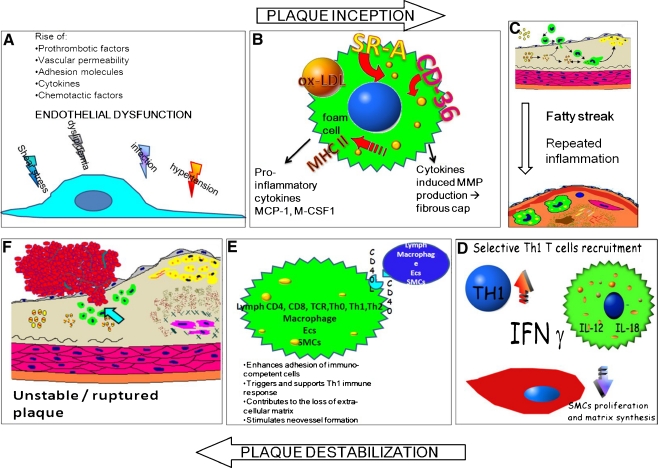
Fig. 1
Fig. 1
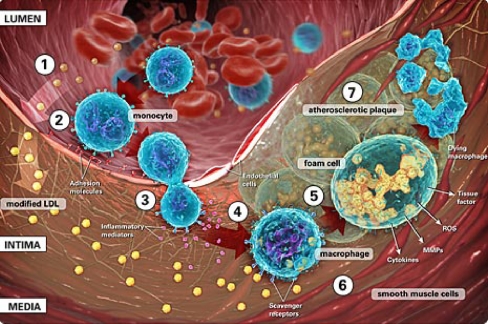
Plaque development is a complex cascade of events. Endothelial injury is initiated by a variety of injurious noxae, including hypertension, dyslipidaemia, shear stress and infections (a). Leaky damaged endothelium allows the passage of leukocytes and lipids into the subendothelial space. Activated endothelial cells increase the expression of adhesion molecules and inflammatory genes. Circulating monocytes migrate into the subendothelial space and differentiate into macrophages (b). Macrophages take up lipids deposited in the intima by a number of receptors, including scavenger receptor A (SR-A) and CD36. Deregulated uptake of modified LDL through these receptors leads to cholesterol accumulation and “foam cell” formation. Multiple foam cells form the fatty streak and secrete proinflammatory cytokines and MMPs. Both factors amplify the local inflammatory response in the lesion and in the local matrix. Repeated cycles of inflammation (c) lead to accumulation of macrophages, some of which can die in this location producing the so-called necrotic core. Living macrophages induce SMC proliferation and migration in the lesion to form the fibrous cap of the advanced complicated stable atherosclerotic lesion (“stable” plaque). T cells also play a major role in the path of inflammation. T cells may encounter antigens such as oxidized LDL and HSPs of endogenous or microbial origin. Several different effector mechanisms can be elicited by immune responses (d). The combination of IFN-γ and TNF-β upregulates the expression of CXCR3 promoting the development of the Th1 lymphocyte ()pathway which is strongly proinflammatory. The selective recruitment and activation of Th1 T cells determines a potent inflammatory cascade leading to the transition from stable to “unstable/ruptured” plaque. During this transition we postulated the existence of a theoretical plaque structure known as “vulnerable” plaque, very similar to the unstable plaque except for plaque erosion/rupture. In this context, IFN-γ strongly inhibits the proliferation of SMCs and the production of interstitial collagens by vascular SMCs, thereby affecting the stability of the fibrous cap (e). Activated macrophages secrete procoagulant proteins and MMPs that can degrade collagen. In addition, ligation of CD40 expressed by macrophages increases the production of matrix-degrading proteases. All this leading to an unstable or ruptured plaque (f)
Fig. 2
Fig. 2
Atherosclerotic plaque development (http://www.resverlogix.com/product_development/nexvas_platform/nexvas_vascular_inflammation.html)
Fig. 3
Fig. 3
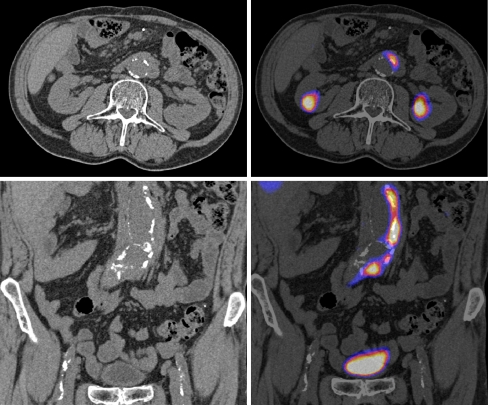
Upper left: CT image transverse view, atherosclerotic plaque in widened abdominal aorta. Upper right: fused FDG PET and CT, transverse view, uptake in atherosclerotic lesion in abdominal aorta. Lower left: CT image coronal view (same patient), multiple atherosclerotic lesions in abdominal aorta. Lower right: fused FDG PET and CT, coronal view, FDG uptake in atherosclerotic lesions in abdominal aorta

References

    1. Ross R. The pathogenesis of atherosclerosis: a perspective for the 1990s. Nature. 1993;362(6423):801–809. - PubMed
    1. Lloyd-Jones DM, Larson MG, Beiser A, Levy D. Lifetime risk of developing coronary heart disease. Lancet. 1999;353(9147):89–92. - PubMed
    1. Scott J. Pathophysiology and biochemistry of cardiovascular disease. Curr Opin Genet Dev. 2004;14(3):271–279. - PubMed
    1. Williams K, Tabas I. The response-to-retention hypothesis of early atherogenesis. Arterioscler Thromb Vasc Biol. 1995;15(5):551–561. - PMC - PubMed
    1. Rapp JH, Lespine A, Hamilton RL, Colyvas N, Chaumeton AH, Tweedie-Hardman J, et al. Triglyceride-rich lipoproteins isolated by selected-affinity anti-apolipoprotein B immunosorption from human atherosclerotic plaque. Arterioscler Thromb. 1994;14(11):1767–1774. - PubMed