


Using a latent variable approach to inform gender and racial/ethnic differences in cocaine dependence: a National Drug Abuse Treatment Clinical Trials Network study
- PMID: 20307798
- PMCID: PMC2844882
- DOI: 10.1016/j.jsat.2009.12.011
Using a latent variable approach to inform gender and racial/ethnic differences in cocaine dependence: a National Drug Abuse Treatment Clinical Trials Network study
Abstract
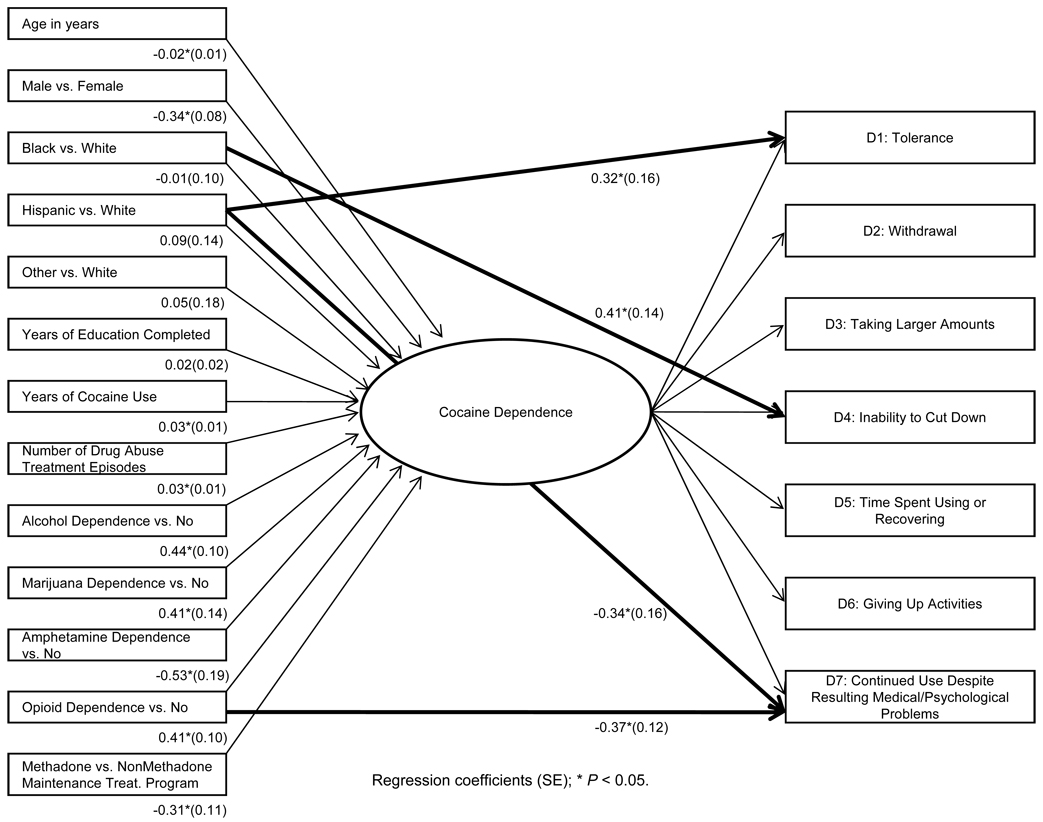
This study applies a latent variable approach to examine gender and racial/ethnic differences in cocaine dependence, to determine the presence of differential item functioning (DIF) or item-response bias to diagnostic questions of cocaine dependence, and to explore the effects of DIF on the predictor analysis of cocaine dependence. The analysis sample included 682 cocaine users enrolled in two national multisite studies of the National Drug Abuse Treatment Clinical Trials Network (CTN). Participants were recruited from 14 community-based substance abuse treatment programs associated with the CTN, including 6 methadone and 8 outpatient nonmethadone programs. Factor and multiple indicators-multiple causes (MIMIC) procedures evaluated the latent continuum of cocaine dependence and its correlates. MIMIC analysis showed that men exhibited lower odds of cocaine dependence than women (regression coefficient, beta = -0.34), controlling for the effects of DIF, years of cocaine use, addiction treatment history, comorbid drug dependence diagnoses, and treatment setting. There were no racial/ethnic differences in cocaine dependence; however, DIF by race/ethnicity was noted. Within the context of multiple community-based addiction treatment settings, women were more likely than men to exhibit cocaine dependence. Addiction treatment research needs to further evaluate gender-related differences in drug dependence in treatment entry and to investigate how these differences may affect study participation, retention, and treatment response to better serve this population.
Keywords: CTN Data Share; Clinical trials network; Cocaine dependence; Differential item functioning; Multiple indicators–multiple causes model.
Conflict of interest statement
Figures
References
-
- American Psychiatric Association. Diagnostic and statistical manual of mental disorders. 4th ed. Washington, DC: American Psychiatric Publishing; 2000. text revision.
-
- Browne MW, Cudeck R. Alternative ways of assessing model fit. In: Bollen KA, Long JS, editors. Testing structural equation models. Newbury Park, CA: Sage Publications; 1993. pp. 136–162.
-
- Bryant KJ, Rounsaville BJ, Babor TF. Coherence of the dependence syndrome in cocaine users. British Journal of Addiction. 1991;86:1299–1310. - PubMed
Publication types
MeSH terms
Substances
Grants and funding
- R21DA027503/DA/NIDA NIH HHS/United States
- K05 DA017009/DA/NIDA NIH HHS/United States
- R21 DA027503/DA/NIDA NIH HHS/United States
- R21 DA 027503/DA/NIDA NIH HHS/United States
- R01DA019901/DA/NIDA NIH HHS/United States
- R33 DA027503/DA/NIDA NIH HHS/United States
- R01 DA019623/DA/NIDA NIH HHS/United States
- U10 DA013043/DA/NIDA NIH HHS/United States
- U10DA013043/DA/NIDA NIH HHS/United States
- 5U10DA013034/DA/NIDA NIH HHS/United States
- U10 DA013034/DA/NIDA NIH HHS/United States
- R01 DA019901/DA/NIDA NIH HHS/United States
- K05DA017009/DA/NIDA NIH HHS/United States
- R01DA019623/DA/NIDA NIH HHS/United States
- HHSN271200522071C/DA/NIDA NIH HHS/United States
LinkOut - more resources
Full Text Sources
Medical
Molecular Biology Databases
