


Fine-tuning synthesis of Yersinia pestis LcrV from runaway-like replication balanced-lethal plasmid in a Salmonella enterica serovar typhimurium vaccine induces protection against a lethal Y. pestis challenge in mice
- PMID: 20308296
- PMCID: PMC2876574
- DOI: 10.1128/IAI.00005-10
Fine-tuning synthesis of Yersinia pestis LcrV from runaway-like replication balanced-lethal plasmid in a Salmonella enterica serovar typhimurium vaccine induces protection against a lethal Y. pestis challenge in mice
Abstract
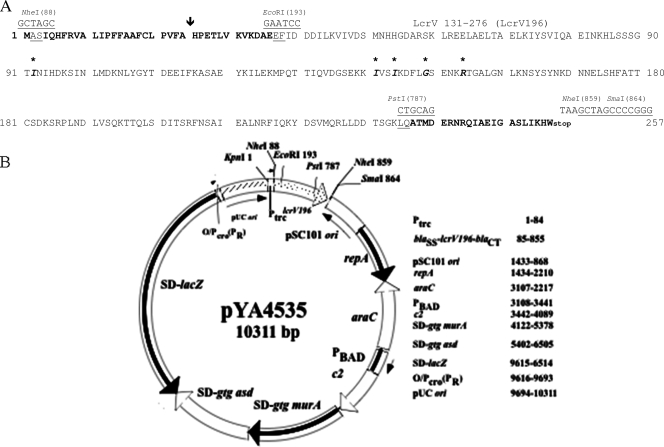
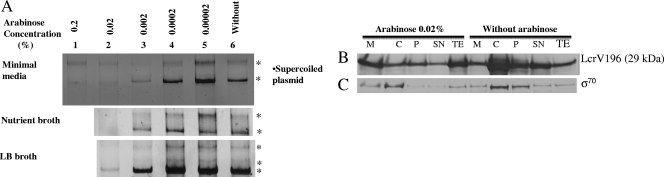
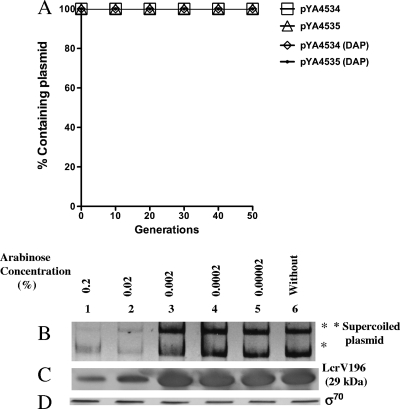
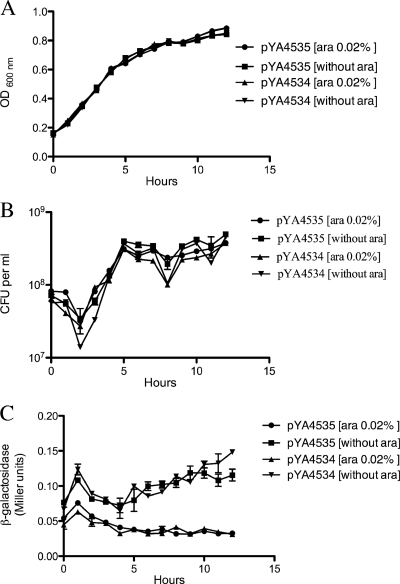
A balanced-lethal plasmid expression system that switches from low-copy-number to runaway-like high-copy-number replication (pYA4534) was constructed for the regulated delayed in vivo synthesis of heterologous antigens by vaccine strains. This is an antibiotic resistance-free maintenance system containing the asdA gene (essential for peptidoglycan synthesis) as a selectable marker to complement the lethal chromosomal DeltaasdA allele in live recombinant attenuated Salmonella vaccines (RASVs) such as Salmonella enterica serovar Typhimurium strain chi9447. pYA4534 harbors two origins of replication, pSC101 and pUC (low and high copy numbers, respectively). The pUC replication origin is controlled by a genetic switch formed by the operator/promoter of the P22 cro gene (O/P(cro)) (P(R)), which is negatively regulated by an arabinose-inducible P22 c2 gene located on both the plasmid and the chromosome (araC P(BAD) c2). The absence of arabinose, which is unavailable in vivo, triggers replication to a high-copy-number plasmid state. To validate these vector attributes, the Yersinia pestis virulence antigen LcrV was used to develop a vaccine against plague. An lcrV sequence encoding amino acids 131 to 326 (LcrV196) was optimized for expression in Salmonella, flanked with nucleotide sequences encoding the signal peptide (SS) and the carboxy-terminal domain (CT) of beta-lactamase, and cloned into pYA4534 under the control of the P(trc) promoter to generate plasmid pYA4535. Our results indicate that the live Salmonella vaccine strain chi9447 harboring pYA4535 efficiently stimulated a mixed Th1/Th2 immune response that protected mice against lethal challenge with Y. pestis strain CO92 introduced through either the intranasal or subcutaneous route.
Figures
References
-
- Abramov, V. M., V. S. Khlebnikov, A. M. Vasiliev, I. V. Kosarev, R. N. Vasilenko, N. L. Kulikova, A. V. Khodyakova, V. I. Evstigneev, V. N. Uversky, V. L. Motin, G. B. Smirnov, and R. R. Brubaker. 2007. Attachment of LcrV from Yersinia pestis at dual binding sites to human TLR-2 and human IFN-gamma receptor. J. Proteome Res. 6:2222-2231. - PubMed
-
- Bochner, B. R. 1984. Curing bacterial cells of lysogenic viruses by using UCB indicator plates. Biotechniques 2:234-240.
-
- Bradford, M. M. 1976. A rapid and sensitive method for the quantitation of microgram quantities of protein utilizing the principle of protein-dye binding. Anal. Biochem. 72:248-254. - PubMed
-
- Branger, C. G., J. D. Fetherston, R. D. Perry, and R. Curtiss III. 2007. Oral vaccination with different antigens from Yersinia pestis KIM delivered by live attenuated Salmonella Typhimurium elicits a protective immune response against plague. Adv. Exp. Med. Biol. 603:387-399. - PubMed
Publication types
MeSH terms
Substances
Grants and funding
LinkOut - more resources
Full Text Sources
Other Literature Sources
Medical
Research Materials
Miscellaneous
