


Prevalence of chronic kidney disease in persons with undiagnosed or prehypertension in the United States
- PMID: 20308607
- PMCID: PMC2880533
- DOI: 10.1161/HYPERTENSIONAHA.110.150722
Prevalence of chronic kidney disease in persons with undiagnosed or prehypertension in the United States
Abstract
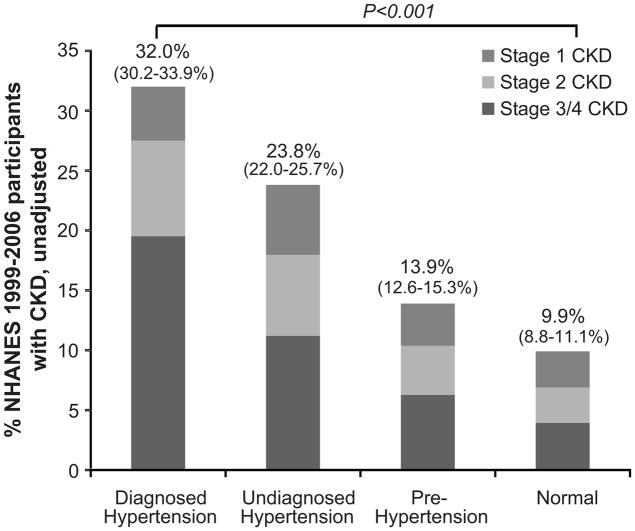
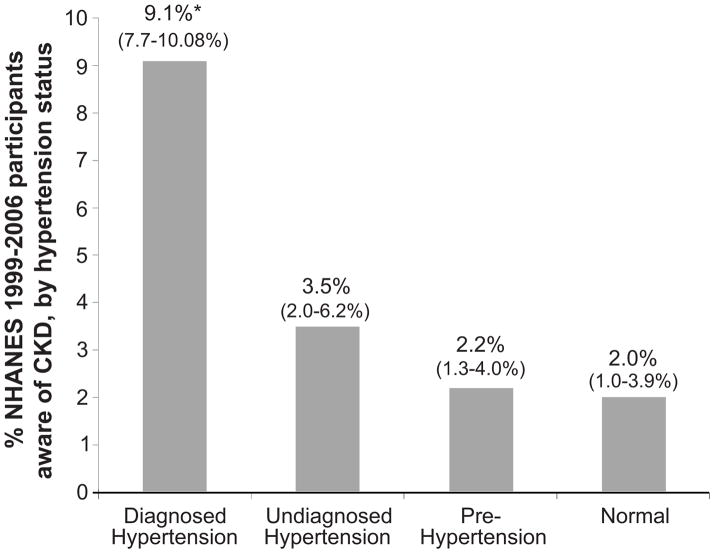
Hypertension is both a cause and a consequence of chronic kidney disease, but the prevalence of chronic kidney disease throughout the diagnostic spectrum of blood pressure has not been established. We determined the prevalence of chronic kidney disease within blood pressure categories in 17 794 adults surveyed by the National Health and Nutrition Examination Survey during 1999-2006. Diagnosed hypertension was defined as self-reported provider diagnosis (n=5832); undiagnosed hypertension was defined as systolic blood pressure > or = 140 mm Hg or diastolic blood pressure > or = 90 mm Hg, without report of provider diagnosis (n=3046); prehypertension was defined as systolic blood pressure > or = 120 and <140 mm Hg or diastolic blood pressure > or = 80 and <90 mm Hg (n=3719); and normal was defined as systolic blood pressure <120 mm Hg and diastolic blood pressure <80 mm Hg (n=5197). Chronic kidney disease was defined as estimated glomerular filtration rate <60 mL/min per 1.73 m(2) or urinary albumin:creatinine ratio >30 mg/g. Prevalences of chronic kidney disease among those with prehypertension and undiagnosed hypertension were 17.3% and 22.0%, respectively, compared with 27.5% with diagnosed hypertension and 13.4% with normal blood pressure, after adjustment for age, sex, and race in multivariable logistic regression. This pattern persisted with varying definitions of kidney disease; macroalbuminuria (urinary albumin:creatinine ratio >300 mg/g) had the strongest association with increasing blood pressure category (odds ratio: 2.37 [95% CI: 2.00 to 2.81]). Chronic kidney disease is prevalent in undiagnosed and prehypertension. Earlier identification and treatment of both these conditions may prevent or delay morbidity and mortality from chronic kidney disease.
Figures
Comment in
-
Epidemiology of chronic kidney disease among normotensives: but what is chronic kidney disease?Hypertension. 2010 May;55(5):1097-9. doi: 10.1161/HYPERTENSIONAHA.110.151811. Epub 2010 Mar 22. Hypertension. 2010. PMID: 20308606 Free PMC article. No abstract available.
References
-
- US Renal Data System. USRDS 2008 annual data report: atlas of end-stage renal disease in the United States. National Institutes of Health, National Institute of Diabetes and Digestive and Kidney Disease; Bethesda, MD: 2008.
-
- Bakris GL, Ritz E. The message for World Kidney Day 2009: hypertension and kidney disease--a marriage that should be prevented. J Hypertens. 2009;27:666–669. - PubMed
-
- Coresh J, Selvin E, Stevens LA, Manzi J, Kusek JW, Eggers P, Van Lente F, Levey AS. Prevalence of chronic kidney disease in the United States. JAMA. 2007;298:2038–2047. - PubMed
-
- Cutler JA, Sorlie PD, Wolz M, Thom T, Fields LE, Roccella EJ. Trends in hypertension prevalence, awareness, treatment, and control rates in United States adults between 1988–1994 and 1999–2004. Hypertension. 2008;52:818–827. - PubMed
-
- Hsu CY, McCulloch CE, Darbinian J, Go AS, Iribarren C. Elevated blood pressure and risk of end-stage renal disease in subjects without baseline kidney disease. Arch Intern Med. 2005;165:923–928. - PubMed
Publication types
MeSH terms
Grants and funding
LinkOut - more resources
Full Text Sources
Medical
