


Association between cognition and function in patients with Parkinson disease with and without dementia
- PMID: 20310053
- PMCID: PMC2963089
- DOI: 10.1002/mds.23073
Association between cognition and function in patients with Parkinson disease with and without dementia
Abstract
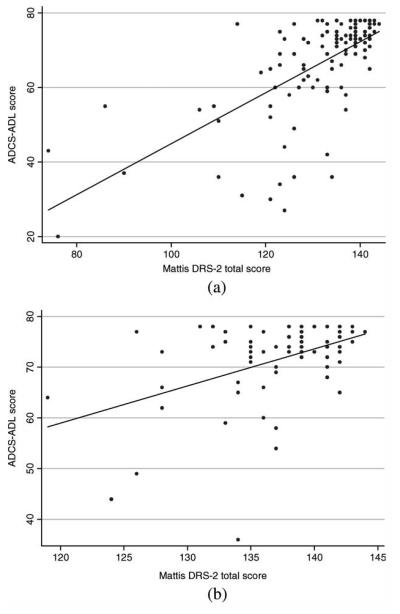
Patients with Parkinson's disease (PD) often have cognitive deficits from the time of diagnosis. Except in patients with dementia, the impact of cognitive symptoms on daily function is not well documented. This study had two objectives: (1) to determine the functional significance of cognitive deficits in nondemented patients with PD and (2) to assess the sensitivity of two measures of global cognitive abilities to identify individuals with impaired ADL function. One hundred eleven subjects with PD and a range of cognitive abilities were included. Of these, 20 were diagnosed with PDD. All subjects were assessed with the Mattis Dementia Rating Scale to two (DRS-2) and the Mini-Mental State Examination (MMSE). ADL function was reported by an informant using the Alzheimer's Disease Cooperative Study Activities of Daily Living Inventory (ADCS-ADL). The ability of the DRS-2 and MMSE to capture the impact of cognitive impairment on ADL function was assessed in the entire cohort and in subsets of nondemented individuals. After adjustment for covariates, cognition as measured by the DRS-2 was strongly related to ADL function in the entire cohort (partial correlation coefficient = 0.55, P < 0.001). The association remained strong when only nondemented subjects were included (r = 0.42, P < 0.001). The DRS-2 was significantly more accurate than the MMSE, particularly for detecting milder degrees of ADL impairment (ROC area = 0.87 vs. 0.75, P = 0.0008). Cognition is associated with impairment in ADL function, even in nondemented patients with PD. However, sensitive cognitive assessment measures may be needed to identify these functionally relevant impairments.
Figures
References
-
- Aarsland D, Andersen K, Larsen JP, Lolk A, Kragh-Sorensen P. Prevalence and characteristics of dementia in Parkinson disease—an 8-year prospective study. Arch Neurol. 2003;60:387–392. - PubMed
-
- Cahn DA, Sullivan EV, Shear PK, Pfefferbaum A, Heit G, Silverberg G. Differential contributions of cognitive and motor component processes to physical and instrumental activities of daily living in Parkinson's Disease. Arch Clin Neuropsychol. 1998;13:575–583. - PubMed
-
- Muslimovic D, Post B, Speelman JD, Schmand B. Cognitive profile of patients with newly diagnosed Parkinson disease. Neurology. 2005;65:1239–1245. - PubMed
-
- Foltynie T, Brayne CE, Robbins TW, Barker RA. The cognitive ability of an incident cohort of Parkinson's patients in the UK. The CamPaIGN Study. Brain. 2004;127(Part 3):550–560. - PubMed
MeSH terms
Grants and funding
LinkOut - more resources
Full Text Sources
Medical
