


Gender-specific association of psychological distress with cardiovascular risk scores
- PMID: 20331387
- PMCID: PMC3440612
- DOI: 10.3109/02813431003648131
Gender-specific association of psychological distress with cardiovascular risk scores
Abstract
Objective: To examine the gender differences in the association of psychological distress with cardiovascular disease (CVD) risk scores using two different CVD risk assessment models.
Design and setting: A cross-sectional, population-based study from 1997 to 1998 in Pieksämäki, Finland.
Subjects: A population sample of 899 (399 male and 500 female) middle-aged subjects.
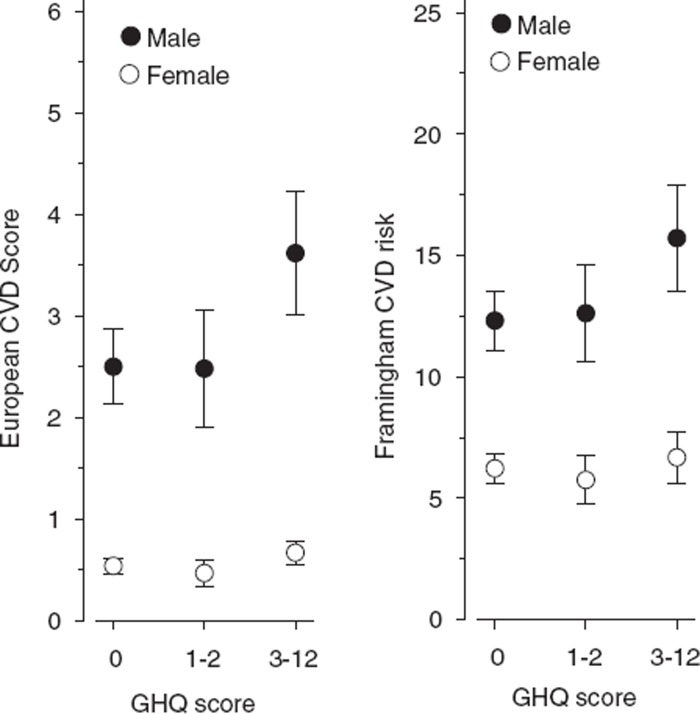
Main outcome measures: The 10-year risk for CVD events was calculated using the European SCORE model and the Framingham CVD risk prediction model. Psychological distress was measured using the 12-item General Health Questionnaire (GHQ-12). Study subjects were allocated into three groups according to their global GHQ-12 -scores: 0 points, 1-2 points, and 3-12 points.
Results: Psychological distress was associated with higher mean CVD risk scores in men. Men in the highest GHQ group (3-12 points) had significantly higher mean European CVD risk score (3.6 [SD 3.3]) compared with men in the lowest group (0 points) (2.5 [SD 2.6]), the difference being 1.1 (95% CI 0.4 to 1.9). The p-value for linearity between the three GHQ groups was 0.003. The Framingham CVD risk prediction model yielded similar results: 15.7 (SD 10.2) vs. 12.3 (SD 9.6), the difference 3.4 (95% CI 1.0 to 6.0) and p-value for linearity 0.008. No significant association was observed in women.
Conclusion: A gender-specific association was found between psychological distress and cardiovascular risk scores. These results highlight the importance of identifying men with psychological distress when assessing CVD risk.
Figures
References
-
- Bjorkelund C, Andersson-Hange D, Andersson K, Bengtsson C, Blomstrand A, Bondyr-Carlsson D, et al. Secular trends in cardiovascular risk factors with a 36-year perspective: Observations from 38- and 50-year-olds in the Population Study of Women in Gothenburg. Scand J Prim Health Care. 2008;26:140–6. - PMC - PubMed
-
- Everson-Rose SA, Lewis TT. Psychosocial factors and cardiovascular diseases. Annu Rev Public Health. 2005;26:469–500. - PubMed
-
- Kubzansky LD, Cole SR, Kawachi I, Vokonas P, Sparrow D. Shared and unique contributions of anger, anxiety, and depression to coronary heart disease: A prospective study in the normative aging study. Ann Behav Med. 2006;31:21–9. - PubMed
MeSH terms
LinkOut - more resources
Full Text Sources
Medical
