


Rapid and mobile determination of alcoholic strength in wine, beer and spirits using a flow-through infrared sensor
- PMID: 20331845
- PMCID: PMC2861024
- DOI: 10.1186/1752-153X-4-5
Rapid and mobile determination of alcoholic strength in wine, beer and spirits using a flow-through infrared sensor
Abstract
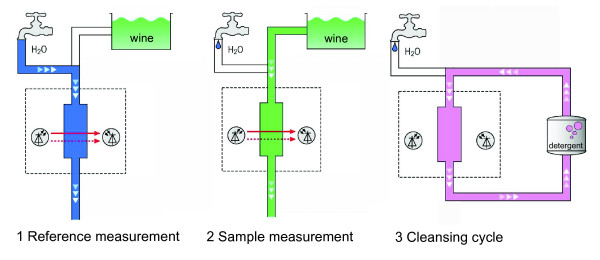
Background: Ever since Gay-Lussac's time, the alcoholic strength by volume (% vol) has been determined by using densimetric measurements. The typical reference procedure involves distillation followed by pycnometry, which is comparably labour-intensive and therefore expensive. At present, infrared (IR) spectroscopy in combination with multivariate regression is widely applied as a screening procedure, which allows one to determine alcoholic strength in less than 2 min without any sample preparation. The disadvantage is the relatively large investment for Fourier transform (FT) IR or near-IR instruments, and the need for matrix-dependent calibration. In this study, we apply a much simpler device consisting of a patented multiple-beam infrared sensor in combination with a flow-through cell for automated alcohol analysis, which is available in a portable version that allows for on-site measurements.
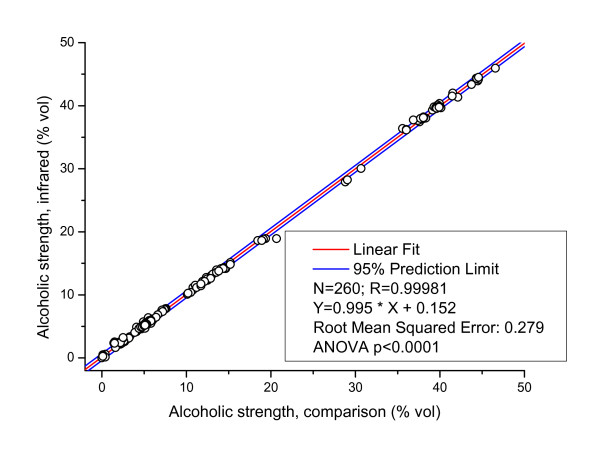
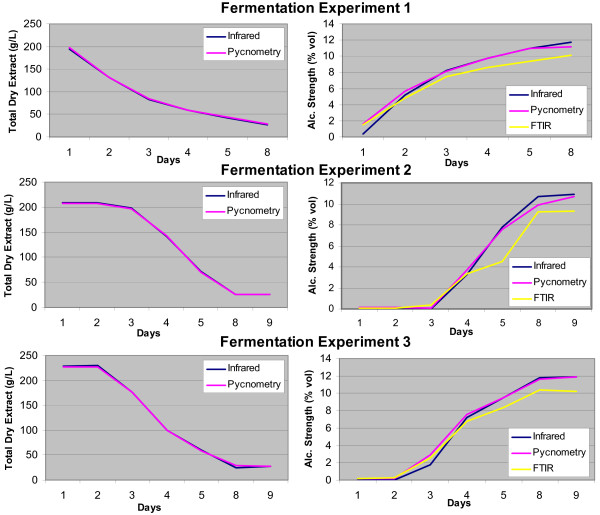
Results: During method validation, the precision of the infrared sensor was found to be equal to or better than densimetric or FTIR methods. For example, the average repeatability, as determined in 6 different wine samples, was 0.05% vol and the relative standard deviation was below 0.2%. Accuracy was ensured by analyzing 260 different alcoholic beverages in comparison to densimetric or FTIR results. The correlation was linear over the entire range from alcohol-free beers up to high-proof spirits, and the results were in substantial agreement (R = 0.99981, p < 0.0001, RMSE = 0.279% vol). The applicability of the device was further proven for the analysis of wines during fermentation, and for the determination of unrecorded alcohol (i.e. non-commercial or illicit products).
Conclusions: The flow-through infrared device is much easier to handle than typical reference procedures, while time-consuming sample preparation steps such as distillation are not necessary. Therefore, the alcoholic strength can be economically and quickly controlled (requiring less than 60 s per sample). The device also gives the opportunity for mobile on-site control in the context of labelling control of wine, beer and spirits, the process monitoring of fermentations, or the evaluation of unrecorded alcohols.
Figures
References
-
- Gay-Lussac J-L. Instruction pour l'usage de l'alcoomètre centésimal et des tables qui l'accompagnent. Paris, France: Chez M. Collardeau; 1824. http://books.google.com/books?id=3ewMAAAAYAAJ
-
- IARC. IARC Monographs on the Evaluation of Carcinogenic Risks to Humans. Vol. 44. Alcohol Drinking. Lyon, France; 1988.
-
- de Brevans J. The manufacture of liquors and preserves. New York, NY: Munn & Co; 1893.
-
- European Commission. Commission Directive 87/250/EEC on the indication of alcoholic strength by volume in the labelling of alcoholic beverages for sale to the ultimate consumer. Off J Europ Comm. 1987;L113:57–58.
-
- Strunk DH, Hamman JW, Timmel BM. Determination of proof of distilled alcoholic beverages, using an oscillating U-tube density meter. J AOAC. 1979;62:653–658.
LinkOut - more resources
Full Text Sources
