Single-nucleotide polymorphisms inside microRNA target sites influence tumor susceptibility
- PMID: 20332227
- PMCID: PMC2853025
- DOI: 10.1158/0008-5472.CAN-09-3541
Single-nucleotide polymorphisms inside microRNA target sites influence tumor susceptibility
Abstract
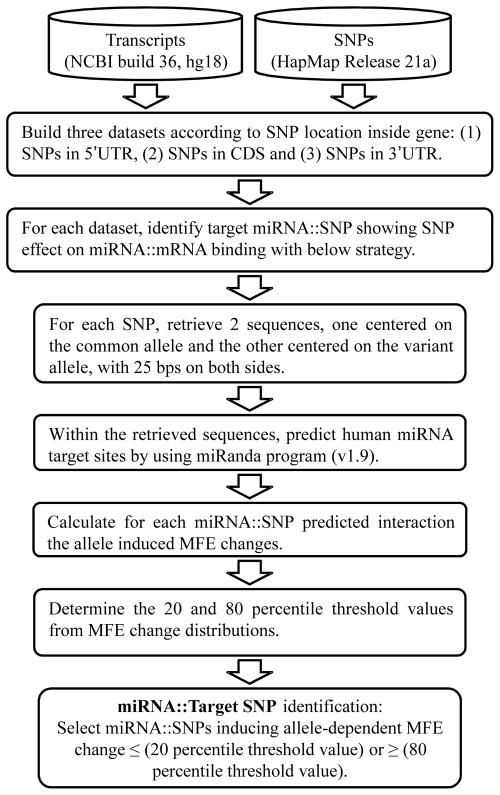
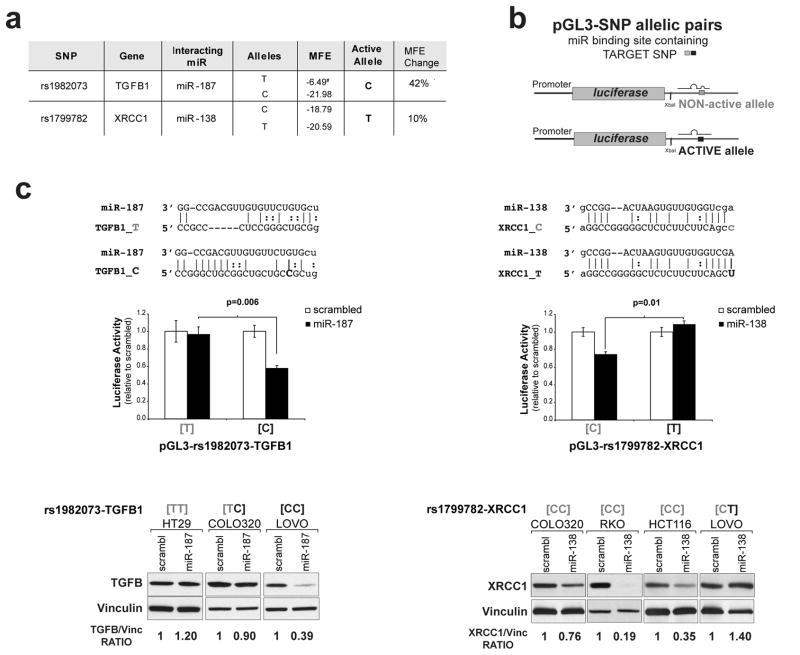
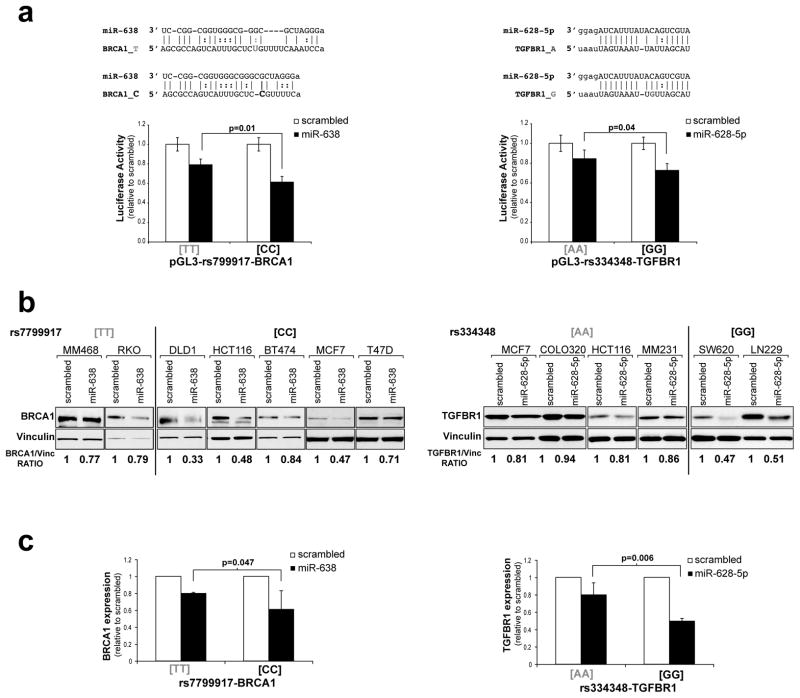
Single-nucleotide polymorphisms (SNP) associated with polygenetic disorders, such as breast cancer (BC), can create, destroy, or modify microRNA (miRNA) binding sites; however, the extent to which SNPs interfere with miRNA gene regulation and affect cancer susceptibility remains largely unknown. We hypothesize that disruption of miRNA target binding by SNPs is a widespread mechanism relevant to cancer susceptibility. To test this, we analyzed SNPs known to be associated with BC risk, in silico and in vitro, for their ability to modify miRNA binding sites and miRNA gene regulation and referred to these as target SNPs. We identified rs1982073-TGFB1 and rs1799782-XRCC1 as target SNPs, whose alleles could modulate gene expression by differential interaction with miR-187 and miR-138, respectively. Genome-wide bioinformatics analysis predicted approximately 64% of transcribed SNPs as target SNPs that can modify (increase/decrease) the binding energy of putative miRNA::mRNA duplexes by >90%. To assess whether target SNPs are implicated in BC susceptibility, we conducted a case-control population study and observed that germline occurrence of rs799917-BRCA1 and rs334348-TGFR1 significantly varies among populations with different risks of developing BC. Luciferase activity of target SNPs, allelic variants, and protein levels in cancer cell lines with different genotypes showed differential regulation of target genes following overexpression of the two interacting miRNAs (miR-638 and miR-628-5p). Therefore, we propose that transcribed target SNPs alter miRNA gene regulation and, consequently, protein expression, contributing to the likelihood of cancer susceptibility, by a novel mechanism of subtle gene regulation.
Figures
References
-
- Filipowicz W, Bhattacharyya SN, Sonenberg N. Mechanisms of post-transcriptional regulation by microRNAs: are the answers in sight? Nat Rev Genet. 2008;9:102–14. - PubMed
-
- Miranda KC, Huynh T, Tay Y, et al. A pattern-based method for the identification of MicroRNA binding sites and their corresponding heteroduplexes. Cell 22. 2006;126:1203–17. - PubMed
-
- Tay Y, Zhang J, Thomson AM, Lim B, Rigoutsos I. MicroRNAs to Nanog, Oct4 and Sox2 coding regions modulate embryonic stem cell differentiation. Nature. 2008;455:1124–8. - PubMed
-
- Spizzo R, Nicoloso MS, Croce CM, Calin GA. SnapShot: MicroRNAs in Cancer. Cell. 2009;137:586e1. - PubMed
-
- Pharoah PD, Dunning AM, Ponder BA, Easton DF. Association studies for finding cancer-susceptibility genetic variants. Nat Rev Cancer. 2004;4:850–60. - PubMed
Publication types
MeSH terms
Substances
Grants and funding
LinkOut - more resources
Full Text Sources
Other Literature Sources
Medical
Miscellaneous