Measuring serum melatonin in epidemiologic studies
- PMID: 20332275
- PMCID: PMC2856692
- DOI: 10.1158/1055-9965.EPI-10-0004
Measuring serum melatonin in epidemiologic studies
Abstract
Background: Epidemiologic data on serum melatonin, a marker of circadian rhythms, and cancer are sparse due largely to the lack of reliable assays with high sensitivity to detect relatively low melatonin levels in serum collected during daylight, as commonly available in most epidemiologic studies.
Methods: To help expand epidemiologic research on melatonin, we assessed the reproducibility and refined a currently available melatonin RIA, and evaluated its application to epidemiologic investigations by characterizing melatonin levels in serum, urine, and/or plasma in 135 men from several ethnic groups.
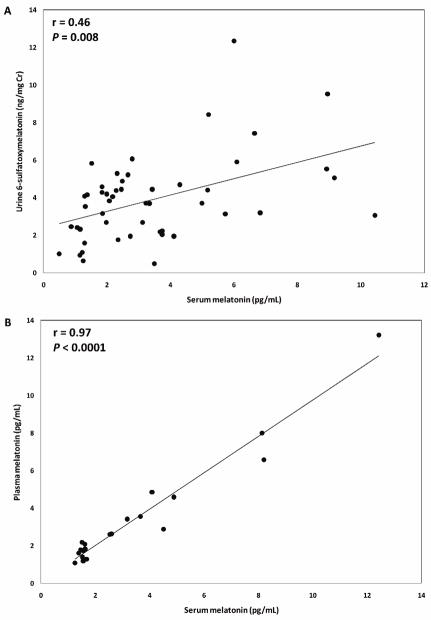
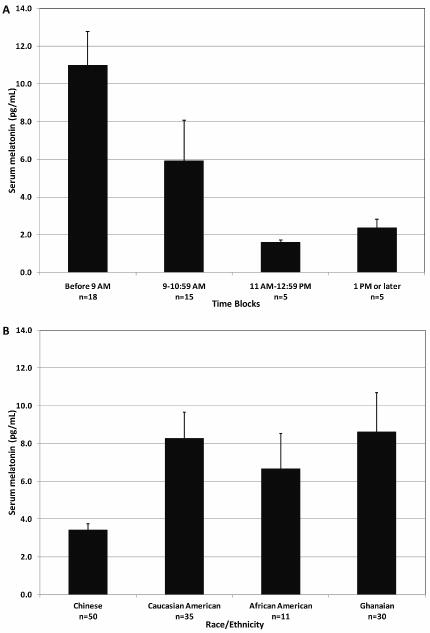
Results: Reproducibility was high for the standard 1.0-mL serum [mean coefficient of variation (CV), 6.9%; intraclass correlation coefficient (ICC), 97.4%; n = 2 serum pools in triplicate] and urine-based (mean CV, 3.5%; ICC, 99.9%) assays. Reproducibility for the 0.5-mL refined-serum assay was equally good (mean CV, 6.6%; ICC, 99.0%). There was a positive correlation between morning serum melatonin and 6-sulfatoxymelatonin in 24-hour urine (r = 0.46; P = 0.008; n = 49 subjects). Melatonin levels in serum-plasma pairs had a high correlation (r = 0.97; P < 1x10(-4); n = 20 pairs). Morning serum melatonin levels were five times higher than those from the afternoon (before 9 a.m. mean, 11.0 pg/mL, versus after 11 a.m. mean, 2.0 pg/mL). Chinese men had lower melatonin levels (mean, 3.4 pg/mL), whereas Caucasian, African-American, and Ghanaian men had similar levels (mean, 6.7-8.6 pg/mL).
Conclusions: These results suggest that melatonin can be detected reliably in serum samples collected in epidemiologic studies in various racial groups.
Impact: With improved assays, it may be possible to investigate the role of melatonin and the emerging circadian rhythm hypothesis in cancer etiology in epidemiologic studies.
Figures
References
-
- Straif K, Baan R, Grosse Y, et al. Carcinogenicity of shift-work, painting, and fire-fighting. The Lancet Oncology. 2007;8:1065–6. - PubMed
-
- Kubo T, Ozasa K, Mikami K, et al. Prospective cohort study of the risk of prostate cancer among rotating-shift workers: findings from the Japan Collaborative Cohort Study. Am J Epidemiol. 2006;164:549–55. - PubMed
-
- Conlon M, Lightfoot N, Kreiger N. Rotating shift work and risk of prostate cancer. Epidemiology. 2007;18:182–3. - PubMed
-
- Band PR, Le ND, Fang R, et al. Cohort study of Air Canada pilots: mortality, cancer incidence, and leukemia risk. Am J Epidemiol. 1996;143:137–43. - PubMed
-
- Irvine D, Davies DM. British Airways flight deck mortality study, 1950–1992. Aviat Space Environ Med. 1999;70:548–55. - PubMed
Publication types
MeSH terms
Substances
Grants and funding
LinkOut - more resources
Full Text Sources