. 2009 Sep 10:1:364-81.
doi: 10.1093/gbe/evp036.

Phylogenomics of sterol synthesis: insights into the origin, evolution, and diversity of a key eukaryotic feature

Affiliations

Phylogenomics of sterol synthesis: insights into the origin, evolution, and diversity of a key eukaryotic feature

Elie Desmond et al. Genome Biol Evol. .

Abstract

The availability of complete genomes from a wide sampling of eukaryotic diversity has allowed the application of phylogenomics approaches to study the origin and evolution of unique eukaryotic cellular structures, but these are still poorly applied to study unique eukaryotic metabolic pathways. Sterols are a good example because they are an essential feature of eukaryotic membranes. The sterol pathway has been well dissected in vertebrates, fungi, and land plants. However, although different types of sterols have been identified in other eukaryotic lineages, their pathways have not been fully characterized. We have carried out an extensive analysis of the taxonomic distribution and phylogeny of the enzymes of the sterol pathway in a large sampling of eukaryotic lineages. This allowed us to tentatively indicate features of the sterol pathway in organisms where this has not been characterized and to point out a number of steps for which yet-to-discover enzymes may be at work. We also inferred that the last eukaryotic common ancestor already harbored a large panel of enzymes for sterol synthesis and that subsequent evolution over the eukaryotic tree occurred by tinkering, mainly by gene losses. We highlight a high capacity of sterol synthesis in the myxobacterium Plesiocystis pacifica, and we support the hypothesis that the few bacteria that harbor homologs of the sterol pathway have likely acquired these via horizontal gene transfer from eukaryotes. Finally, we propose a potential candidate for the elusive enzyme performing C-3 ketoreduction (ERG27 equivalent) in land plants and probably in other eukaryotic phyla.

Keywords: eukaryotes; evolution; phylogenomics; sterols.


Figures
F<sc>IG</sc>. 1.—
FIG. 1.—
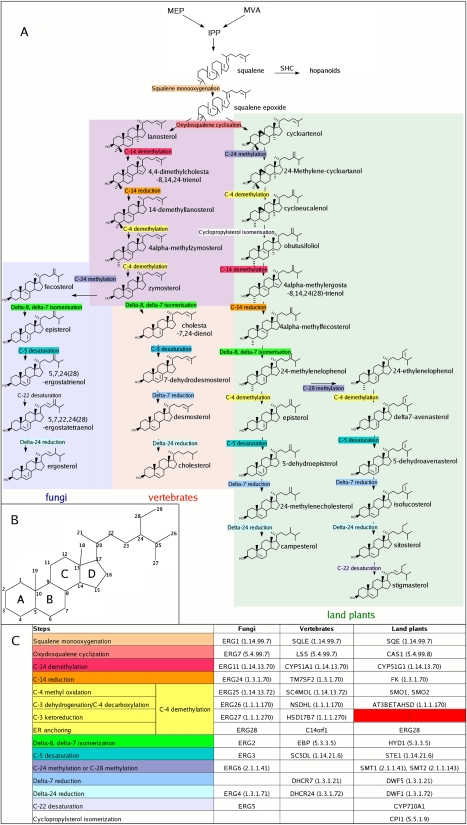
(A) Canonical pathways of sterol synthesis leading to land plants, fungi, and vertebrate sterols. Upstream of squalene, the mevalonate (MVA) and 2-C-methyl-D-erythrol 4-phosphate (MEP) ways leading to IPP are shown. Downstream of squalene, the bacterial pathway of hopanoid synthesis via SHC is also indicated. (B) Numbering of carbons and cycles of steroids. (C) Table indicating the names and EC numbers of fungi, vertebrates, and land plants genes corresponding to each step of the pathway shown in (A). The red box indicates that the gene performing C-3 ketoreduction is still unknown in land plants.
F<sc>IG</sc>. 2.—
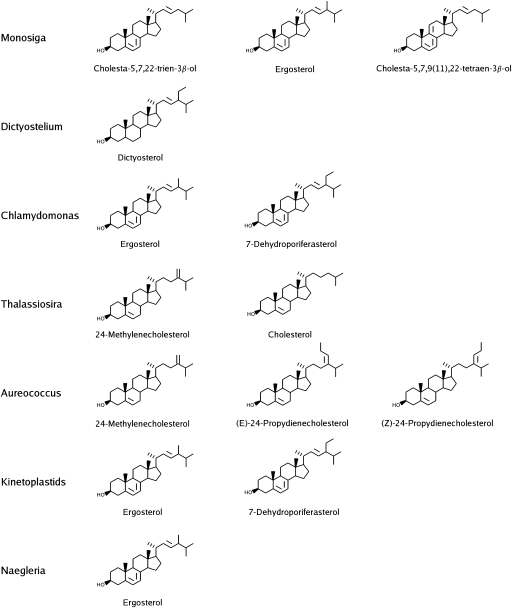
FIG. 2.—
Sterols characterized from organisms other than fungi, vertebrates, and land plants present in our data set. For sterol modifications discussed in the text, refer to figure 1B for numbering.
F<sc>IG</sc>. 3.—
FIG. 3.—
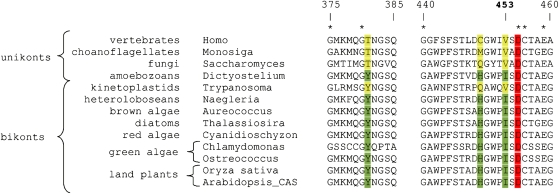
Alignment of ERG7 homologs from representative taxa. The catalytic residue D455 is highlighted in red. Positions 381, 449, and 453 are differentially conserved between lanosterol synthases (yellow) and cycloartenol synthases (green). The numbering refers to the H. sapiens ERG7 homolog (NP_002331).
F<sc>IG</sc>. 4.—
FIG. 4.—
Inference of ancestral sets of sterol enzymes. These are inferred based on a consensus phylogeny of eukaryotes included in our data set according to the most recent data (Burki et al. 2008; Hampl et al. 2009) rooted in between unikonts and bikonts. Lineages where the ability to synthesize sterols has been lost are indicated by red crosses. We inferred maximal and minimal ancestral enzyme contents at the three most ancient nodes (LECA, Unikonts, and Bikonts). Additional proteins in the maximal content with respect to the minimal content are indicated by question marks (see text for details). Putative duplications inferred in the lineage leading to the LECA are indicated by a star. Losses and gains of proteins are indicated only for the most basal branches by purple and blue arrows, respectively.
F<sc>IG</sc>. 5.—
FIG. 5.—
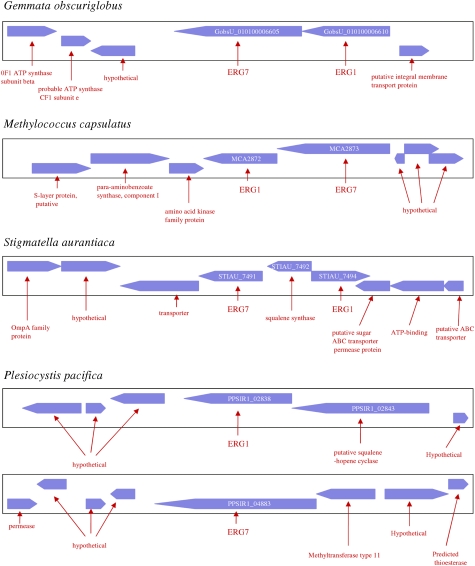
Genomic context of ERG1 and ERG7 genes in the genomes of the four sterol-synthesizing bacteria G. obscuriglobus, M. capsulatus, S. aurantiaca, and P. pacifica.
F<sc>IG</sc>. 6.—
FIG. 6.—
Maximum likelihood tree of ERG1 homologs. Only a subset of the most closely related bacterial monooxygenases are included. Following removal of ambiguously aligned regions, the final data set included 130 conserved positions. The tree was obtained by PHYML (Guindon and Gascuel 2003) as detailed in Materials and Methods. For clarity, only bootstrap values >50% are shown.
F<sc>IG</sc>. 7.—
FIG. 7.—
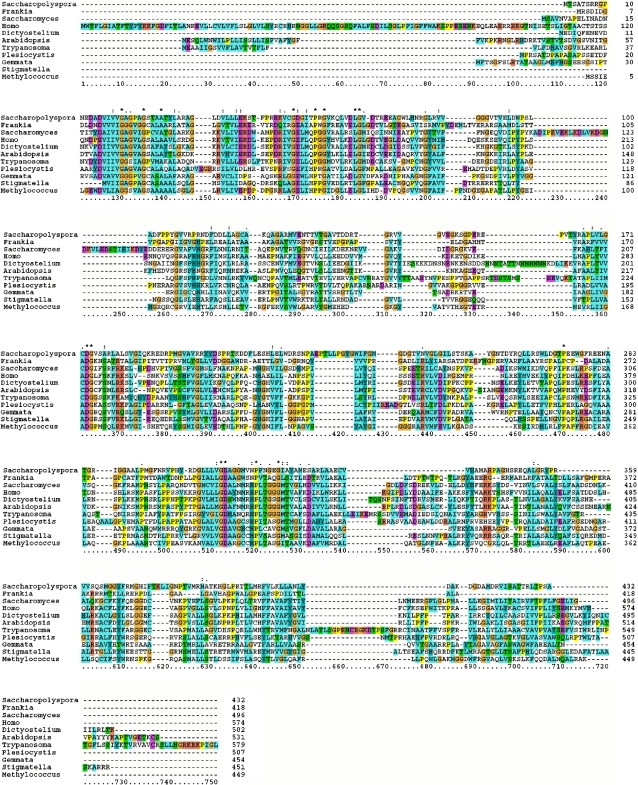
Alignment of ERG1 homologs including sequences of the four sterol-synthesizing bacteria (G. obscuriglobus, M. capsulatus, S. aurantiaca, and P. pacifica), of two other bacteria (Saccharopolyspora erythraea and Frankia alni), and of five representatives of eukaryotes (T. brucei, S. cerevisiae, H. sapiens, D. discoideum, and A. thaliana).
F<sc>IG</sc>. 8.—
FIG. 8.—
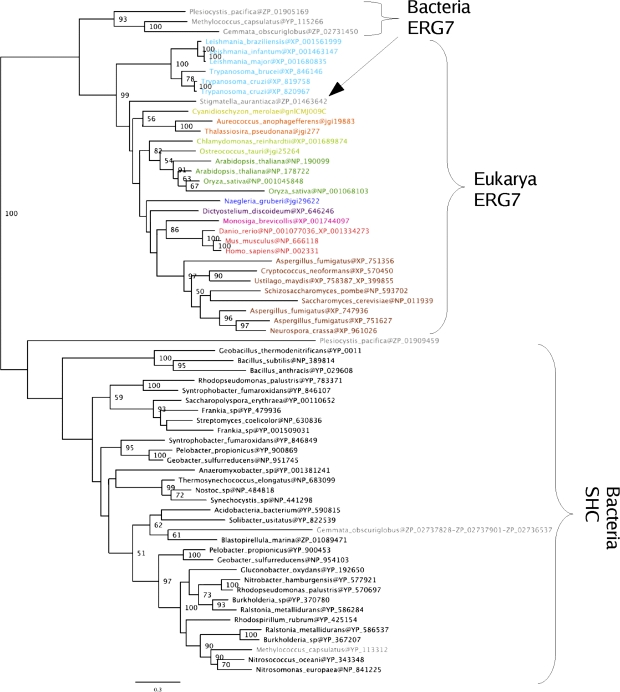
Maximum likelihood tree of ERG7 homologs. Following removal of ambiguously aligned regions, the final data set included 386 conserved positions. The tree was obtained by PHYML with the same criteria as detailed in Materials and Methods.
F<sc>IG</sc>. 9.—
FIG. 9.—
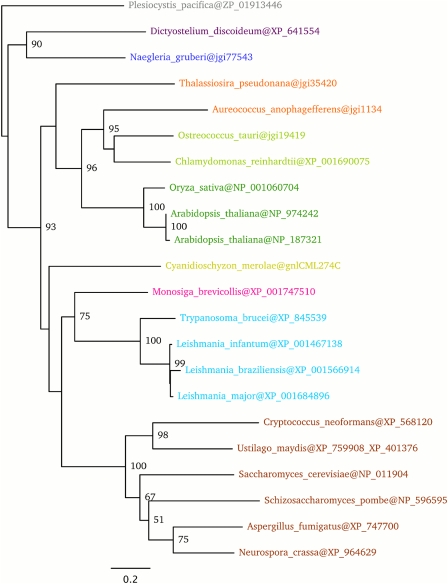
Maximum likelihood tree of putative ERG27 analogues. Following removal of ambiguously aligned regions, the final data set included 483 conserved positions. The tree was obtained by PHYML with the same criteria as in Materials and Methods.

References

    1. Altschul SF, et al. Gapped BLAST and PSI-BLAST: a new generation of protein database search programs. Nucl Acids Res. 1997;25:3389–3402. - PMC - PubMed
    1. Anderson RGW, Jacobson K. Cell biology—a role for lipid shells in targeting proteins to caveolae, rafts, and other lipid domains. Science. 2002;296:1821–1825. - PubMed
    1. Andersson JO. Horizontal gene transfer between microbial Eukaryotes. In: Gogarten MB, Gogarten JP, Olendzenski L, editors. Horizontal gene transfer: genomes in flux. Totowa (NJ): Humana Press Inc; 2009. pp. 473–487.
    1. Bapteste E, Charlebois RL, Macleod D, Brochier C. The two tempos of nuclear pore complex evolution: highly adapting proteins in an ancient frozen structure. Genome Biol. 2005;6(10):R85. - PMC - PubMed
    1. Bloch K. Cholesterol: evolution of structure and function. In: Vance DE, Vance J, editors. Biochemistry of lipids, lipoproteins and membranes. Amsterdam: Elsevier; 1991. pp. 363–381.