


Risk factors for Anterior Cruciate Ligament injury in skeletally immature patients: analysis of intercondylar notch width using Magnetic Resonance Imaging
- PMID: 20333378
- PMCID: PMC2903177
- DOI: 10.1007/s00264-010-0987-7
Risk factors for Anterior Cruciate Ligament injury in skeletally immature patients: analysis of intercondylar notch width using Magnetic Resonance Imaging
Abstract
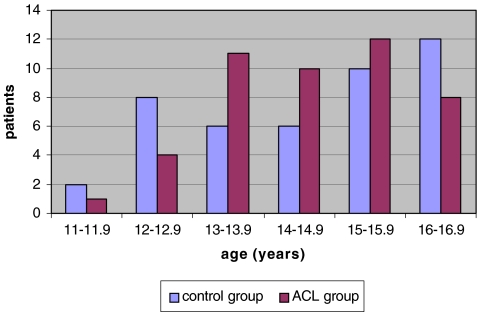
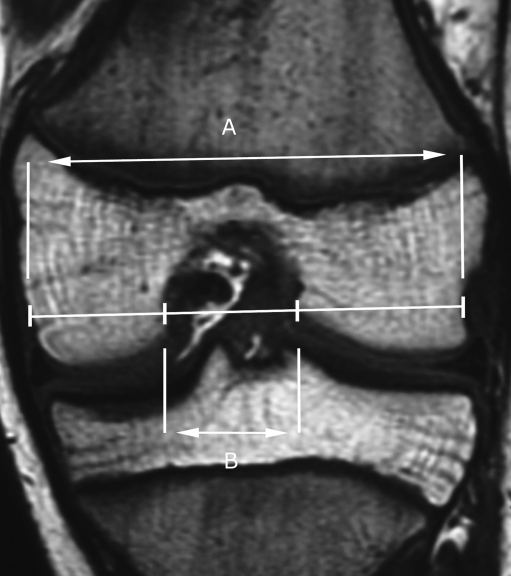
The necessity for identification of risk factors for Anterior Cruciate Ligament, ACL injury has challenged many investigators. Many authors have reported lower Notch Width Index, NWI measured on radiographs in patients with midsubstance ACL lesions compared to control groups. Since a narrow intercondylar notch has been implicated as a possible risk factor related to ACL injury we decided to compare NWI measured on MRI scans between age-matched groups with acute ACL injury with those of the normal population. The purpose of this study was to measure intercondylar notch width on MRI scans in an immature population to determine if there was a difference between the population with ACL tears and a control group. We also wanted to assess age as a risk factor in an ACL injury population. We retrospectively analysed the MRI scans of 46 patients with ACL injuries and 44 patients with normal MRI findings who served as a control group for NWI measurements. For the ACL injury group we collected information from medical charts including age at the time of injury, gender, mechanism of injury, type of activity practised at the time of injury and prevalence of meniscal injury. Demographic data of the control group were comparable with those from the study group. We found a statistically significant (p < 0.001) difference in the mean value of the intercondylar notch width between normal knees (0.2691) and the ACL injury population (0.2415). In the ACL injury group we did not find differences in NWI values with regard to gender, involved side, mechanism of injury and type of sport practised at the time of injury. A narrower intercondylar notch was found to be associated with the risk of ACL rupture in an immature population. The young group of athletes with ACL injury needs further study to prospectively assess the risk of knee injuries.
Figures
References
-
- Palmer I. On the injuries to the ligaments of the knee joint. A clinical study. Acta Chir Scand Suppl. 1938;53:1–28.
-
- Lund-Hanssen H, Gannon J, Engebretsen L, et al. Intercondylar notch width and the risk for anterior cruciate ligament rupture. A case-control study in 46 female handball players. Acta Orthop Scand. 1994;65(5):529–532. - PubMed
-
- Shelbourne KD, Davis TJ, Klootwyk TE. The relationship between intercondylar notch width of the femur and the incidence of anterior cruciate ligament tears. A prospective study. Am J Sports Med. 1998;26(3):402–408. - PubMed
Publication types
MeSH terms
LinkOut - more resources
Full Text Sources
Medical
