


Enantioselective polyene cyclization via organo-SOMO catalysis
- PMID: 20334384
- PMCID: PMC2880463
- DOI: 10.1021/ja100185p
Enantioselective polyene cyclization via organo-SOMO catalysis
Abstract
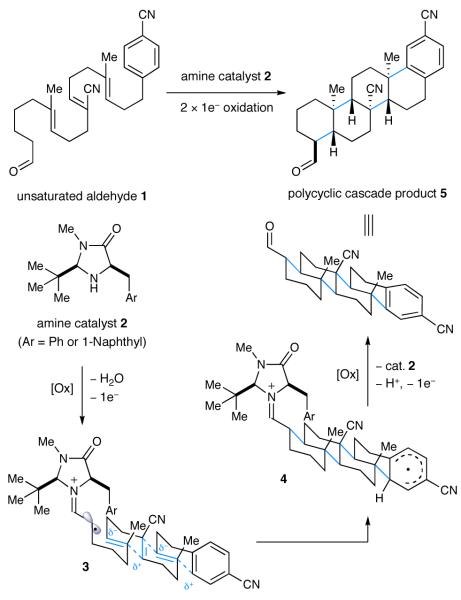
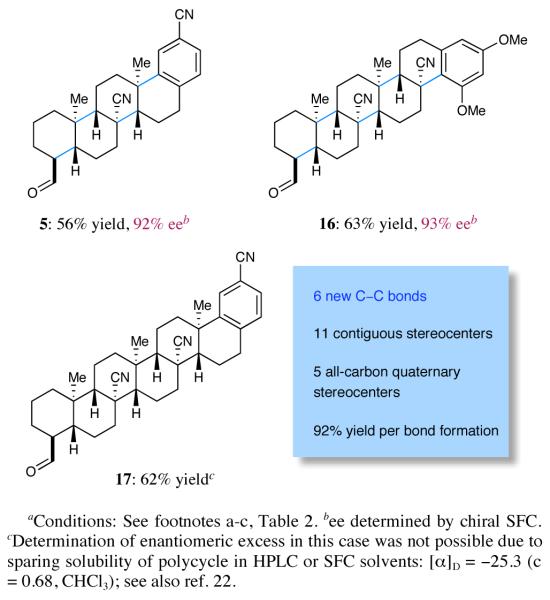
The first organocatalytic enantioselective radical polycyclization has been accomplished using singly occupied molecular orbital (SOMO) catalysis. The presented strategy relies on a selective single-electron oxidation of chiral enamines formed by condensation of polyenals with an imidazolidinone catalyst employing a suitable copper(II) oxidant. The reaction proceeds under mildly acidic conditions at room temperature and shows compatibility with an array of electron-poor as well as electron-rich functional groups. Upon termination by radical arylation followed by subsequent oxidation and rearomatization, a range of polycyclic aldehydes were accessed (12 examples, 54-77% yield, 85-93% ee). The enantioselective formation of up to six new carbocycles in a single catalyst-controlled cascade is described. Evidence for a radical-based cascade mechanism is indicated by a series of experimental results.
Figures
References
-
- van Tamelen EE. Acc. Chem. Res. 1968;1:111.
- van Tamelen EE, McCormick JP. J. Am. Chem. Soc. 1969;91:1847. - PubMed
- Johnson WS, Kinnel RB. J. Am. Chem. Soc. 1966;88:3861. - PubMed
- Johnson WS, Semmelhack MF, Sultanbawa MUS, Dolak LA. J. Am. Chem. Soc. 1968;90:2994.
- Goldsmith DJ, Phillips CF. J. Am. Chem. Soc. 1969;91:5862.
-
-
For an early review, see: Bartlett PA. In: Asymmetric Synthesis. Morrison JD, editor. Vol. 3. Academic Press; Orlando: 1984. p. 341. For selected examples of substrate- or auxiliary-controlled enantioselective synthesis, see: Bartlett PA, Johnson WS. J. Am. Chem. Soc. 1973;95:7501. Johnson WS, Brinkmeyer RS, Kapoor VM, Yarnell TM. J. Am. Chem. Soc. 1977;99:8341. Johnson WS, Fletcher VR, Chenera B, Bartlett WR, Tham FS, Kullnig RK. J. Am. Chem. Soc. 1993;115:497. Corey EJ, Lin S. J. Am. Chem. Soc. 1996;118:8765. Bogenstätter M, Limberg A, Overman LE, Tomasi AL. J. Am. Chem. Soc. 1999;121:12206. For a reagent-controlled enantioselective example, see: Zhao Y-J, Loh T-P. J. Am. Chem. Soc. 2008;130:10024.
-
-
- Ishihara K, Nakamura S, Yamamoto H. J. Am. Chem. Soc. 1999;121:4906.
- Ishihara K, Ishibashi H, Yamamoto H. J. Am. Chem. Soc. 2001;123:1505.
- Ishibashi H, Ishihara K, Yamamoto H. J. Am. Chem. Soc. 2004;126:11122. - PubMed
- Sakakura A, Ukai A, Ishihara K. Nature. 2007;445:900. - PubMed
- Mullen CA, Campbell MA, Gagné MR. Angew. Chem., Int. Ed. 2008;147:6011. - PMC - PubMed
-
-
Breslow R, Barrett E, Mohaosi E. Tetrahedron Lett. 1962:1207. Breslow R, Olin SS, Groves JT. Tetrahedron Lett. 1968:1837. For a related example, see: Lallemand JY, Julia M, Mansuy D. Tetrahedron Lett. 1973:4461.
-
Publication types
MeSH terms
Substances
Grants and funding
LinkOut - more resources
Full Text Sources
