. 2010 Mar 24:9:85.
doi: 10.1186/1475-2875-9-85.

Algorithms to predict cerebral malaria in murine models using the SHIRPA protocol

Affiliations

Algorithms to predict cerebral malaria in murine models using the SHIRPA protocol

Yuri C Martins et al. Malar J. .

Abstract

Background: Plasmodium berghei ANKA infection in C57Bl/6 mice induces cerebral malaria (CM), which reproduces, to a large extent, the pathological features of human CM. However, experimental CM incidence is variable (50-100%) and the period of incidence may present a range as wide as 6-12 days post-infection. The poor predictability of which and when infected mice will develop CM can make it difficult to determine the causal relationship of early pathological changes and outcome. With the purpose of contributing to solving these problems, algorithms for CM prediction were built.

Methods: Seventy-eight P. berghei-infected mice were daily evaluated using the primary SHIRPA protocol. Mice were classified as CM+ or CM- according to development of neurological signs on days 6-12 post-infection. Logistic regression was used to build predictive models for CM based on the results of SHIRPA tests and parasitaemia.

Results: The overall CM incidence was 54% occurring on days 6-10. Some algorithms had a very good performance in predicting CM, with the area under the receiver operator characteristic ((au)ROC) curve > or = 80% and positive predictive values (PV+) > or = 95, and correctly predicted time of death due to CM between 24 and 72 hours before development of the neurological syndrome ((au)ROC = 77-93%; PV+ = 100% using high cut off values). Inclusion of parasitaemia data slightly improved algorithm performance.

Conclusion: These algorithms work with data from a simple, inexpensive, reproducible and fast protocol. Most importantly, they can predict CM development very early, estimate time of death, and might be a valuable tool for research using CM murine models.


Figures
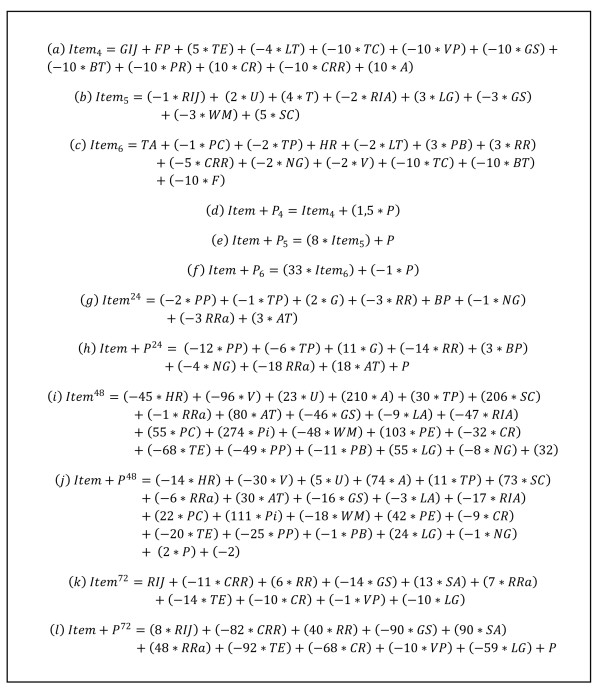
Figure 1
Figure 1
Scores designed for prediction of CM using logistic regression. Item and Item+P scores were designed for prediction of CM using a stepwise multiple logistic regression analysis to identify the most important prognostic factors of SHIRPA individual scores for the occurrence of CM. Itemx and Item+Px scores are based on the day of infection and made to select animals that will develop CM. Itemy and Item+Py scores were made to predict if mice will develop CM after 24, 48 or 72 hours. RIJ = Rearing in Jar; GIJ = Grooming in Jar; U = Urination; FP = Faecal Pellets; BP = Body Position; SA = Spontaneous Activity; RRa = Respiration Rate; T = Tremor; TA = Transfer arousal; LA = Locomotor Activity; RIA = Rearing in Arena; PC = Palpebral Closure; Pi = Piloerection; G = Gait; PE = Pelvic Elevation; TE = Tail Elevation; TEs = Touch Escape; PP = Positional Passivity; TC = Trunk Curl; LG = Limb Grasping; VP = Visual Placing; GS = Grip Strength; BT = Body Tone; PR = Pinna Reflex; CR = Corneal Reflex; TP = Toe Pinch; WM = Wire Manoeuvre; SC = Skin colour; HR = Heart Rate; LT = Limb Tone; AT = Abdominal Tone; L = Lacrimation; S = Salivation; PB = Provoked Biting; RR = Righting Reflex; CRR = Contact Righting Reflex; NG = Negative Geotaxis; F = Fear; I = Irritability; A = Aggression; V = Vocalization.
Figure 2
Figure 2
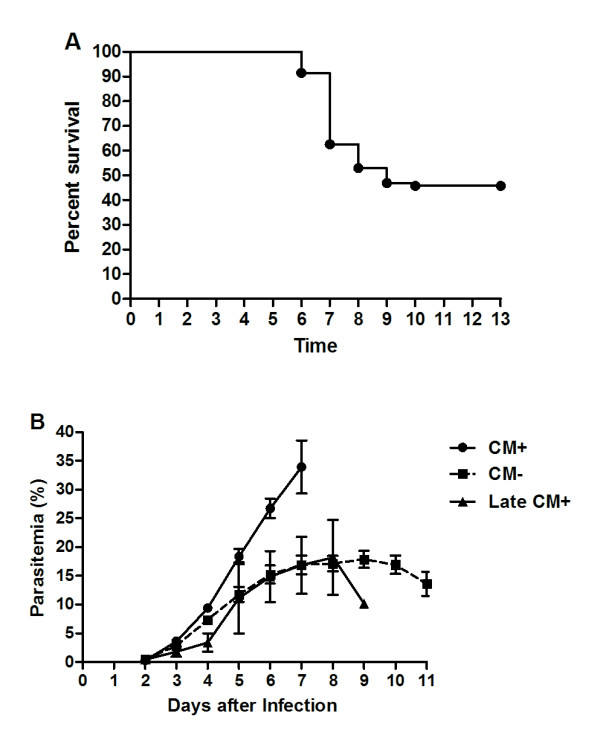
Survival curve (A) and course of parasitaemia (B) of mice infected with Plasmodium berghei ANKA. C57Bl/6 animals were infected with 1 × 10⁶ Plasmodium berghei ANKA-parasitized red blood cells. CM+ = mice that developed cerebral malaria on days 6 - 8 after infection; CM- = mice that did not develop cerebral malaria; Late CM+ = mice that developed cerebral malaria on days 9 and 10 after infection. Results are expressed as means in (A) and means ± SEM in (B).
Figure 3
Figure 3
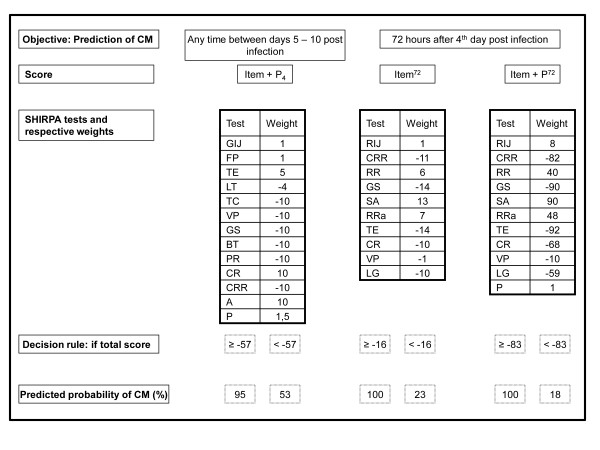
A step by step protocol applied on day 4 post infection for predicting CM. Item+P4 score should be used to estimate the probability of CM development on any time between days 5 - 10 post infection. Item72 and Item+P72 should be used to estimate the probability of CM development on day 7 post infection (72 hours after day 4 post infection). SHIRPA tests and its respective weights compounding each score are shown in the third line. Values obtained for each SHIRPA test should be multiplied by its respective weight and summed up to get a final score. A decision rule based on a specific final value for each score is shown. A final score above or equal (≥) this value is considered positive and is associated with a high probability of cerebral malaria (CM) development. On the other hand, a final score below this value (<) is considered negative and is associated with a low probability of CM. RIJ = Rearing in Jar; GIJ = Grooming in Jar; FP = Faecal Pellets; SA = Spontaneous Activity; RRa = Respiration Rate; TE = Tail Elevation; TC = Trunk Curl; LG = Limb Grasping; VP = Visual Placing; GS = Grip Strength; BT = Body Tone; PR = Pinna Reflex; CR = Corneal Reflex; LT = Limb Tone; RR = Righting Reflex; CRR = Contact Righting Reflex; A = Aggression; P = Parasitemia.
Figure 4
Figure 4
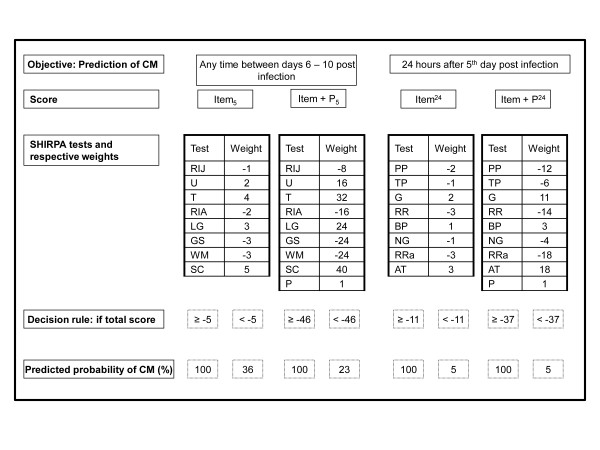
A step by step protocol applied on day 5 post infection for predicting CM. Item5 and Item+P5 scores should be used estimate the probability of CM development on any time between days 6 - 10 post infection. Item24 and Item+P24 should be used to estimate the probability of CM development on day 6 post infection (24 hours after day 5 post infection). SHIRPA tests and its respective weights compounding each score are shown in the third line. Values obtained for each SHIRPA test should be multiplied by its respective weight and summed up to get a final score. A final score above or equal (≥) this value is considered positive and is associated with a high probability of cerebral malaria (CM) development. On the other hand, a final score under this value (<) is considered negative and is associated with a low probability of CM. RIJ = Rearing in Jar; U = Urination; BP = Body Position; RRa = Respiration Rate; T = Tremor; RIA = Rearing in Arena; G = Gait; PP = Positional Passivity; TC = Trunk Curl; LG = Limb Grasping; GS = Grip Strength; TP = Toe Pinch; WM = Wire Manoeuvre; SC = Skin colour; AT = Abdominal Tone; RR = Righting Reflex; NG = Negative Geotaxis; P = Parasitemia.
Figure 5
Figure 5
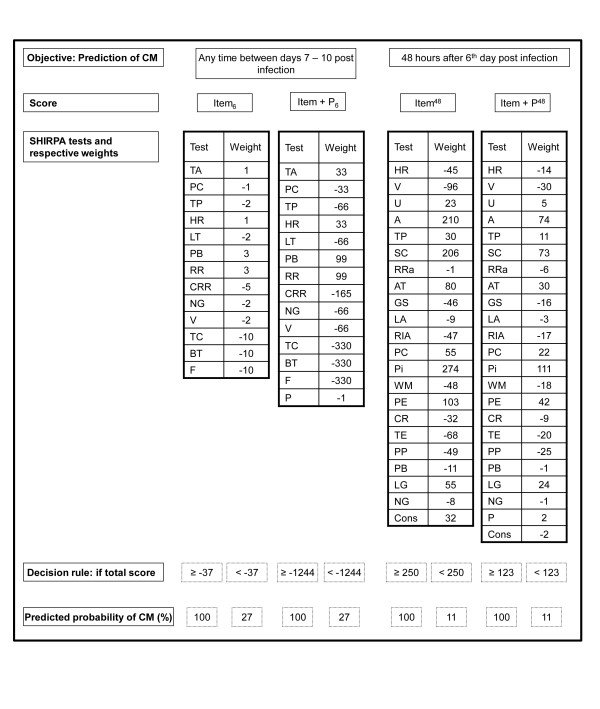
A step by step protocol applied on day 6 post infection for predicting CM. Item6 and Item+P6 scores should be used estimate the probability of CM development on any time between days 7 - 10 post infection. Item48 and Item+P48 should be used to estimate the probability of CM development on day 8 post infection (48 hours after day 6 post infection). SHIRPA tests and its respective weights compounding each score are shown in the third line. Values obtained for each SHIRPA test should be multiplied by its respective weight and summed up to get a final score. A final score above or equal (≥) this value is considered positive and is associated with a high probability of cerebral malaria (CM) development. On the other hand, a final score under this value (<) is considered negative and is associated with a low probability of CM. U = Urination; RRa = Respiration Rate; TA = Transfer arousal; LA = Locomotor Activity; RIA = Rearing in Arena; PC = Palpebral Closure; Pi = Piloerection; PE = Pelvic Elevation; TE = Tail Elevation; PP = Positional Passivity; TC = Trunk Curl; LG = Limb Grasping; GS = Grip Strength; BT = Body Tone; CR = Corneal Reflex; TP = Toe Pinch; WM = Wire Manoeuvre; SC = Skin colour; HR = Heart Rate; LT = Limb Tone; AT = Abdominal Tone; PB = Provoked Biting; RR = Righting Reflex; CRR = Contact Righting Reflex; NG = Negative Geotaxis; F = Fear; A = Aggression; V = Vocalization; Cons = constant; P = Parasitemia.

References

    1. John CC, Bangirana P, Byarugaba J, Opoka RO, Idro R, Jurek AM, Wu B, Boivin MJ. Cerebral malaria in children is associated with long-term cognitive impairment. Pediatrics. 2008;122:e92–99. doi: 10.1542/peds.2007-3709. - DOI - PMC - PubMed
    1. McKenzie FE, Smith DL, O'Meara WP, Riley EM. Strain theory of malaria: the first 50 years. Adv Parasitol. 2008;66:1–46. full_text. - PMC - PubMed
    1. Idro R, Jenkins NE, Newton CR. Pathogenesis, clinical features, and neurological outcome of cerebral malaria. Lancet Neurol. 2005;4:827–840. doi: 10.1016/S1474-4422(05)70247-7. - DOI - PubMed
    1. Hunt NH, Golenser J, Chan-Ling T, Parekh S, Rae C, Potter S, Medana IM, Miu J, Ball HJ. Immunopathogenesis of cerebral malaria. Int J Parasitol. 2006;36:569–582. doi: 10.1016/j.ijpara.2006.02.016. - DOI - PubMed
    1. Alves FP, Durlacher RR, Menezes MJ, Krieger H, Silva LH, Camargo EP. High prevalence of asymptomatic Plasmodium vivax and Plasmodium falciparum infections in native Amazonian populations. Am J Trop Med Hyg. 2002;66:641–648. - PubMed

Publication types

LinkOut - more resources