. 2010 Jun;61(6):1795-806.
doi: 10.1093/jxb/erq046. Epub 2010 Mar 24.

Functional diversification of AGAMOUS lineage genes in regulating tomato flower and fruit development

Affiliations

Functional diversification of AGAMOUS lineage genes in regulating tomato flower and fruit development

Irvin L Pan et al. J Exp Bot. 2010 Jun.

Abstract

AGAMOUS clade genes encode MADS box transcription factors that have been shown to play critical roles in many aspects of flower and fruit development in angiosperms. Tomato possesses two representatives of this lineage, TOMATO AGAMOUS (TAG1) and TOMATO AGAMOUS-LIKE1 (TAGL1), allowing for an analysis of diversification of function after gene duplication. Using RNAi (RNA interference) silencing, transgenic tomato lines that specifically down-regulate either TAGL1 or TAG1 transcript accumulation have been produced. TAGL1 RNAi lines show no defects in stamen or carpel identity, but show defects in fruit ripening. In contrast TAG1 RNAi lines show defects in stamen and carpel development. In addition TAG1 RNAi lines produce red ripe fruit, although they are defective in determinacy and produce ectopic internal fruit structures. e2814, an EMS- (ethyl methane sulphonate) induced mutation that is temperature sensitive and produces fruit phenotypes similar to that of TAG1 RNAi lines, was also characterized. Neither TAG1 nor TAGL1 expression is disrupted in the e2814 mutant, suggesting that the gene corresponding to the e2814 mutant represents a distinct locus that is likely to be functionally downstream of TAG1 and TAGL1. Based on these analyses, possible modes by which these gene duplicates have diversified in terms of their functions and regulatory roles are discussed.


Figures
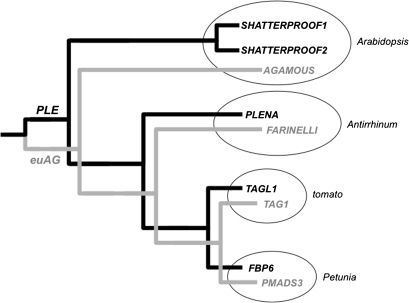
Fig. 1.
Fig. 1.
AGAMOUS clade genes in four model species. A major duplication event occurred prior to the emergence of the core eudicots that gave rise to two clades of AGAMOUS-like MADS box genes. PLE and euAG lineages are shown in black and grey, respectively.
Fig. 2.
Fig. 2.
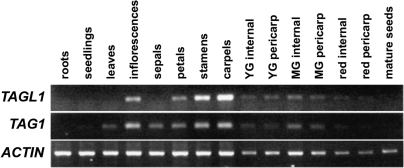
TAGL1 and TAG1 expression levels in wild-type tissue. TAG1 and TAGL1 expression levels were detected by RT-PCR using dissected tissues from different stages as indicated. For fruit, pericarp was separated from the rest of the fruit tissue (internal) for analysis. YG, young green; MG, mature green fruit.
Fig. 3.
Fig. 3.
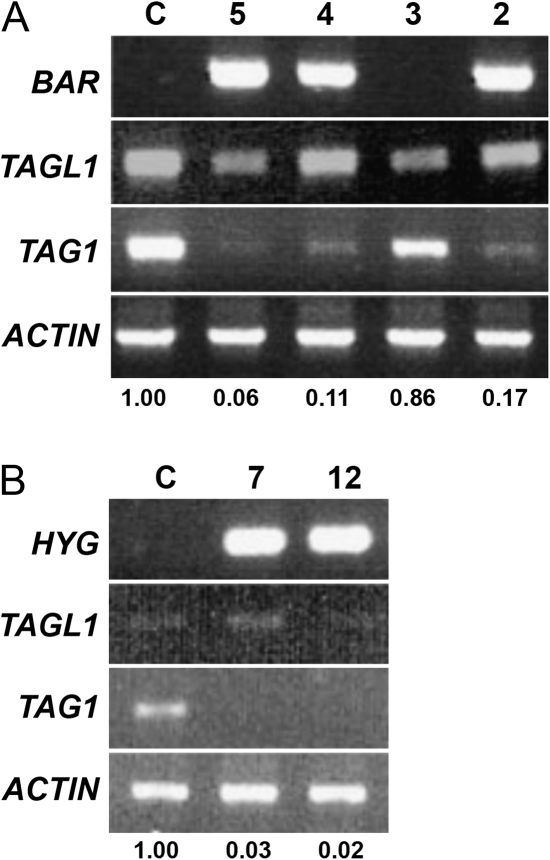
TAG1 RNAi lines show reduction in TAG1 expression levels. Semi-quantitative RT-PCR on buds from control and TAG1 RNAi lines. TAG1 levels were normalized to actin and are shown relative to the control sample. Expression of TAGL1 was also examined in all lines as indicated. (A) RNAi lines made using a shorter (262 bp) fragment for silencing. Line 3 was scored as negative for transformation. Lines 2, 4, and 5 show a significant reduction in TAG1 RNA levels. (B) RNAi lines made using a longer (430 bp) fragment for silencing. Lines 7 and 12 show almost complete lack of TAG1 transcripts. BAR, BASTA resistance marker; HYG, hygromycin resistance marker, indicating the presence of the transgene.
Fig. 4.
Fig. 4.
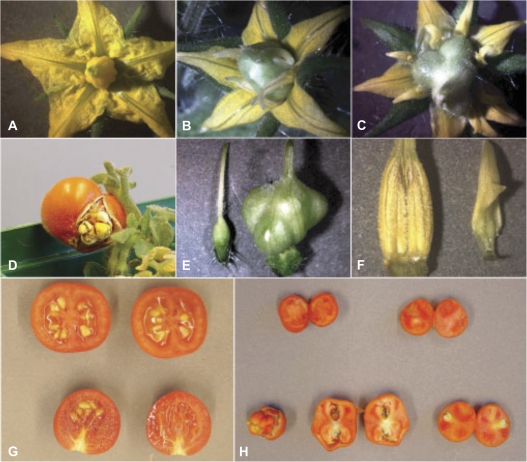
RNAi silencing of TAG1 produces defects in stamens and affects floral determinacy. (A) Control flower ∼3 dpa. (B) TAG1 RNAi line 4 flower made using a shorter (262 bp) fragment for silencing. (C) TAG1 RNAi line 7 flower made using a longer (430 bp) fragment for silencing. (D) TAG1 RNAi line 2 with the ‘fruit inside fruit’ phenotype. (E) Control (left) and TAG1 RNAi line 7 (right) carpels. (F) Control (left) and TAG1 RNAi line 7 (right) stamens showing petalloid tissue. (G) Control red, ripe fruit. (H) Range of phenotypes of TAG1 RNAi line 7 fruit: (top) ectopic exocarp tissue, (bottom left) ‘fruit inside fruit’ (bottom centre and right) internal flower structures.
Fig. 5.
Fig. 5.
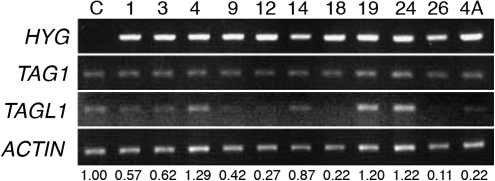
TAGL1 expression levels in TAGL1 RNAi lines. Semi-quantitative RT-PCR on green fruit from control (C) and TAGL1 RNAi lines. TAGL1 levels were normalized to actin and are shown relative to the control sample. Lines 1–26 were produced using the 222 bp fragment for silencing; line 4A was produced using the longer (495 bp) fragment for silencing. Expression of TAG1 was also examined by RT-PCR in all lines. HYG, hygromycin resistance marker indicating the presence of the transgene.
Fig. 6.
Fig. 6.
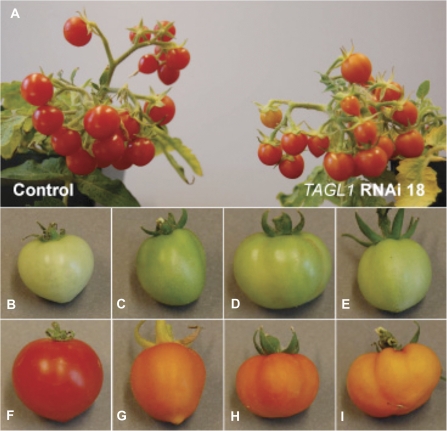
RNAi silencing of TAGL1 affects fruit colour. (A) Overview of control (left) and RNAi line TAGL1-18 (right) plants showing differences in fruit colour. (B–E) Fruit 36 dpa; (F–I) fruit 45dpa. (B) and (F) Control line mature green (36 dpa) and red (45 dpa) fruits. (C) and (G) RNAi line TAGL1-4A. Note the pointy fruit in (G). (D) and (H) RNAi line TAGL1-9. (E) and (I) RNAi line TAGL1-18.
Fig. 7.
Fig. 7.
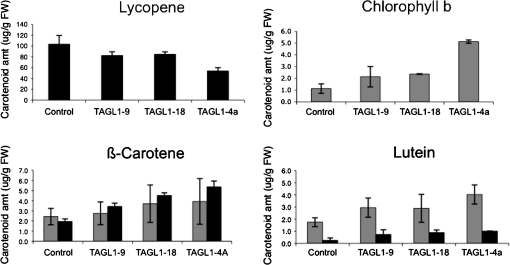
Chlorophyll and carotenoid levels in TAGL1 RNAi lines. Chlorophyll b and carotenoid levels were determined using mature green (36 dpa; grey bars) and ripe (45 dpa; black bars) fruit from three different TAGL1 RNAi lines as well as controls, by HPLC using mean HPLC peak areas (n=2). Standard errors are shown.
Fig. 8.
Fig. 8.
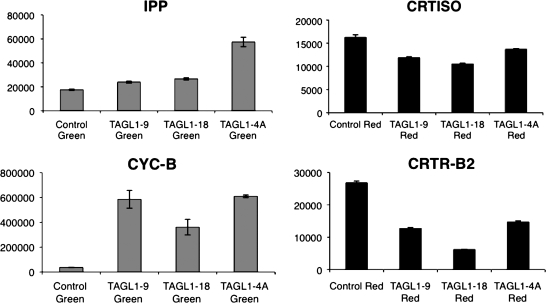
Transcript levels of carotenoid biosynthesis genes in TAGL1 RNAi lines. Relative transcript levels were determined by quantitative RT-PCR using gene-specific primers on green (grey bars) and red (black bars) fruit. 18S RNA was used as an internal control to normalize the relative level of each transcript. Standard errors of three replicates are shown. IPP, encoding isopentenyl diphosphate; CrtISO, carotenoid isomerase; CYC-B, lycopene β-cyclase (chromoplast specific); and CrtR-b2, β-ring carotene hydroxylase (chromoplast specific).
Fig. 9.
Fig. 9.
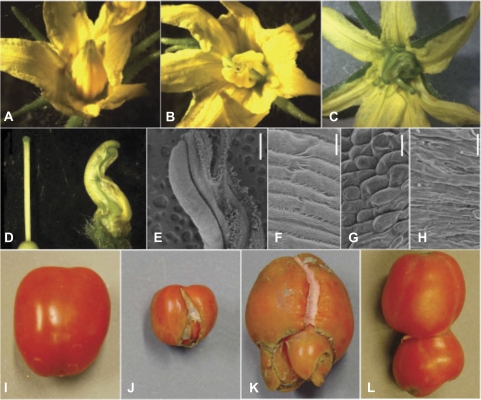
Phenotypes of the e2814 mutant. (A) Wild-type cv M82 flower. (B) e2814 mutant flower showing green, narrow stamens. (C) e2814 mutant flower shows conversion of all stamens to green, carpelloid structures. (D) Wild-type M82 carpel (left) and e2814 carpel with fused stamens (right). (E) Scanning electron microscopy image of an e2814 carpel and a fused, carpelloid stamen. (F) Epidermal cells of a wild-type M82 carpel. (G) Epidermal cells of a wild-type M82 stamen. (H) Epidermal cells of carpelloid, fused stamens from (E). (I) Wild-type M82 ripe fruit. (J) TAG1-9 RNAi fruit. (K) e2814 mutant fruit resembles the TAG1 RNAi fruit phenotype. (L) e2814 mutant fruit with severe ‘fruit inside fruit’ phenotype. Bars=1040 mm (E), 13 mm (F and H), 35 mm (G).
Fig. 10.
Fig. 10.
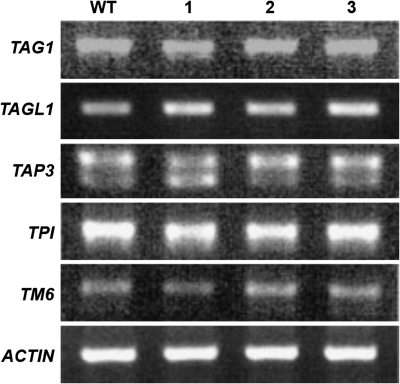
e2814 lines show no change in the expression of several MADS box genes. RT-PCR on flowers from M82 wild-type (WT); e2814 flowers showing a wild-type phenotype (1), and stamen and carpel phenotypes (2, 3).

References

    1. Alba R, Payton P, Fei Z, McQuinn R, Debbie P, Martin GB, Tanksley SD, Giovannoni JJ. Transcriptome and selected metabolite analyses reveal multiple points of ethylene control during tomato fruit development. The Plant Cell. 2005;17:2954–2965. - PMC - PubMed
    1. Angenent GC, Franken J, Busscher M, Van Dijken A, Van Went JL, Dons HJM, Van Tunen AJ. A novel class of MADS box genes is involved in ovule development in Petunia. The Plant Cell. 1995;7:1569–1582. - PMC - PubMed
    1. Blanc G, Wolfe KH. Widespread paleopolyploidy in model plant species inferred from age distributions of duplicate genes. The Plant Cell. 2004;16:1667–1678. - PMC - PubMed
    1. Bowman JL, Smyth DR, Meyerowitz EM. Genes directing flower development in Arabidopsis. The Plant Cell. 1989;1:37–52. - PMC - PubMed
    1. Bradley D, Carpenter R, Sommer H, Hartley N, Coen E. Complementary floral homeotic phenotypes result from opposite orientations of a transposon at the plena locus of Antirrhinum. Cell. 1993;72:85–95. - PubMed

Publication types

MeSH terms